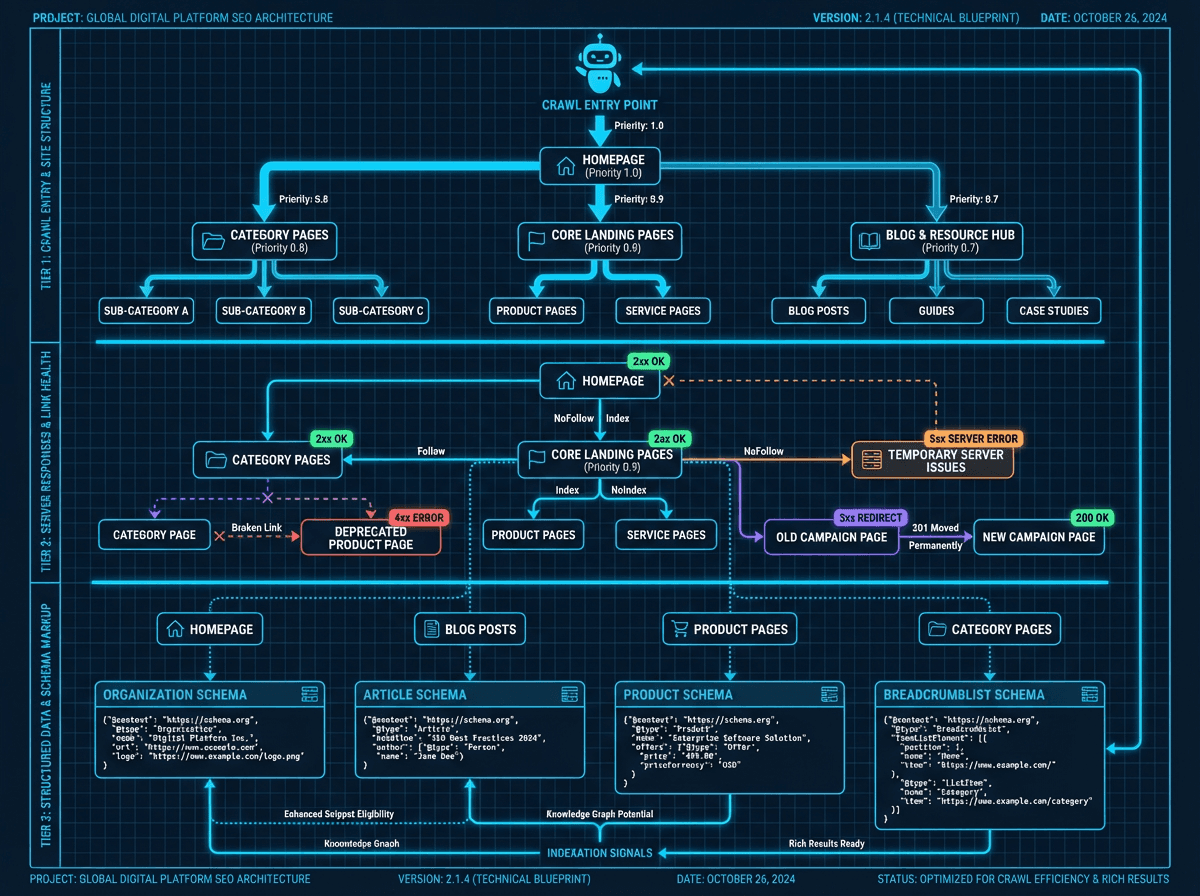
Most marketing teams discover they have a technical SEO problem the same way: traffic drops, nobody knows why, and three weeks of content audits later someone finally runs a crawl and finds 4,000 broken internal links. If you've ever watched a genuinely good page sit at zero impressions, you already know how maddening this gets.
Technical SEO services are professional offerings focused on optimizing a website's underlying infrastructure so search engines can efficiently crawl, index, and rank its content. Unlike content strategy or link building, this work lives in the backend: site architecture, server configurations, structured data, Core Web Vitals, and everything else that determines whether Google can actually read what you've published. According to Semrush's definition, it's the process of making a site easier for search engines to find, understand, and store content, while also accounting for user experience factors like speed and mobile-friendliness.
Why Technical SEO Services Actually Move the Needle
Technical SEO is the infrastructure layer that determines whether your content ever gets seen. And it's usually invisible right up until it isn't.
There's a persistent belief that technical SEO is a one-time setup task. Fix the site once, move on to content. That's not how it works. Sites accumulate technical debt constantly: new pages get published without canonical tags, JavaScript frameworks get updated and break structured data, redirect chains grow as URLs get reorganized. The infrastructure decays if nobody's watching it.
The business case is concrete. A 2026 WordStream analysis found that a technical SEO campaign can produce a 117% return on investment. That's not a content marketing number or a paid media number. That's from fixing the plumbing. And with Google's core updates hitting harder and more frequently, sites with shaky technical foundations are reliably the first to lose ground.
A common thing I hear is, "Our content is good, so why are we flat?" Nine times out of ten, the answer isn't in the doc. It's in the crawl. A misconfigured robots.txt, a canonical pointing at the wrong URL, a template that renders fine for users but not for Googlebot. Those are the quiet killers.
By 2026, the stakes have shifted in a more specific way. Visibility increasingly depends on whether a brand gets cited within AI-generated answers, not just whether it ranks on page one. For that to happen, search engines need to understand your content structure clearly. Poor crawlability and missing structured data are now direct barriers to AI-driven visibility, not just traditional ranking signals.
What Technical SEO Services Actually Cover
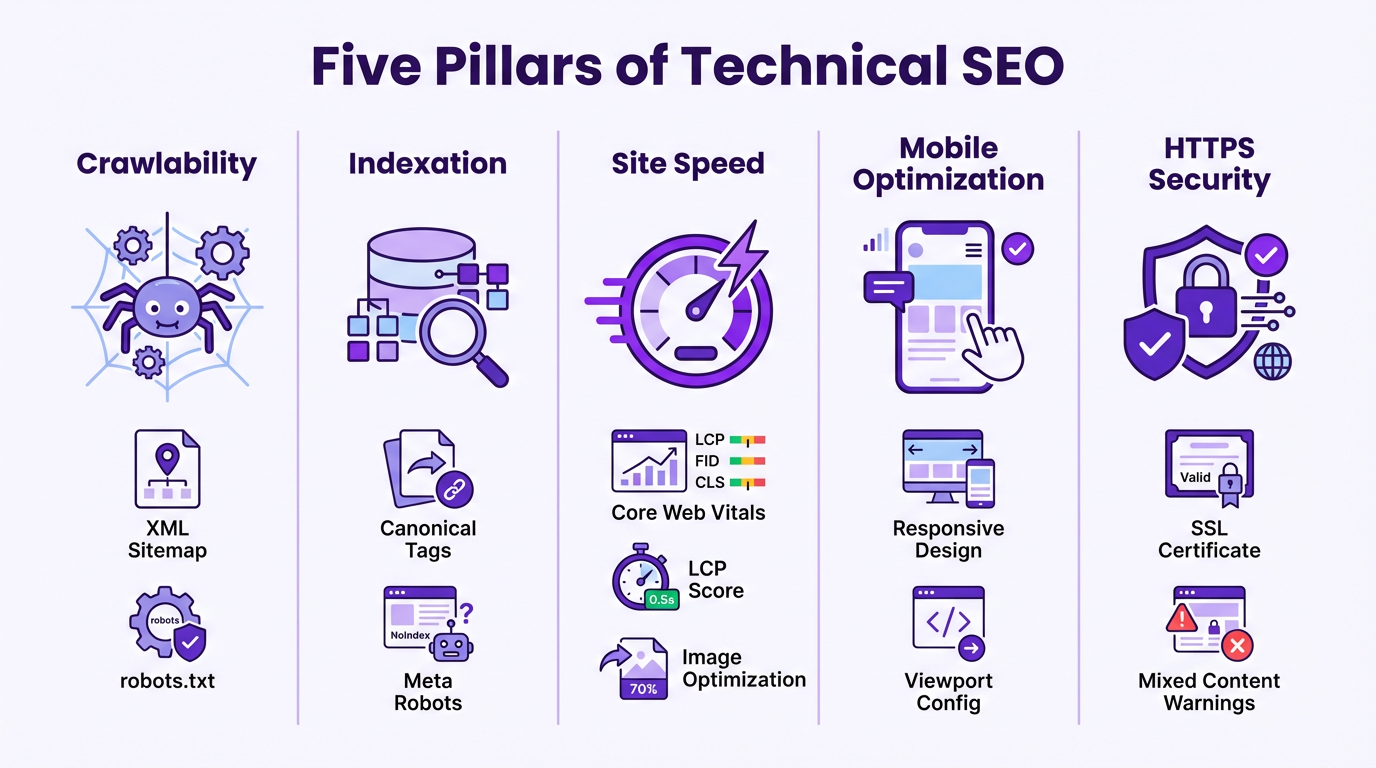
The phrase "technical SEO" gets thrown around loosely. Some providers mean "we'll install a plugin." Others mean "we'll rebuild how your site gets crawled and indexed." A credible engagement covers five foundational areas, though depth varies by site complexity and what's actually broken.
| Component | What It Addresses | Common Issues Found |
|---|---|---|
| Crawlability | Whether search engine bots can access your pages | Blocked resources in robots.txt, crawl budget waste, orphaned pages |
| Indexation | Whether crawled pages are stored and eligible to rank | Noindex tags on live pages, duplicate content, canonicalization errors |
| Site Speed / Core Web Vitals | Page load performance and user experience signals | Unoptimized images, render-blocking scripts, poor LCP scores |
| Mobile Optimization | Consistent experience across device types | Viewport misconfigurations, tap target sizing, mobile-only errors |
| HTTPS and Security | Secure connections and trust signals | Mixed content warnings, expired certificates, HTTP pages still indexed |
| *Semrush's 2026 data shows HTTPS adoption above 91% and canonical tag usage at 67%, meaning indexation issues remain the most common gap. * |
Beyond these five pillars, most serious technical SEO services also handle structured data implementation, internal link architecture, XML sitemap health, and bulk index checking to confirm which pages Google has actually stored. That last item gets skipped more often than it should, especially on big catalogs where a few thousand pages quietly fall out of the index and nobody notices until revenue takes the hit.
Structured Data and Schema Markup
Structured data tells search engines exactly what your content represents: products, articles, FAQs, events, organizations. Without it, Google is guessing based on page content alone. With it, you become eligible for rich results, knowledge panels, and (increasingly in 2026) AI-generated answer citations. Most sites have either no schema markup or broken implementations that fail Google's Rich Results Test. Getting this right is one of the highest-leverage technical SEO fixes available, yet it's the one teams most often skip because it feels like "developer work."
Internal Link Architecture
Think about the last time you reorganized a large site. New categories went up, old ones got archived, and nobody mapped the internal links between them. The result? Orphaned pages that Googlebot can't find, and high-value pages buried four or five clicks deep from the homepage. A solid technical SEO provider will audit your internal linking graph, identify pages with zero or minimal inbound internal links, and restructure the architecture so link equity flows where it matters most. We had a client whose 50,000-page ecommerce site had zero internal links between related product categories. Googlebot was essentially wandering blind. Fixing that single issue drove a measurable lift in indexed pages within six weeks.
How a Technical SEO Engagement Actually Works
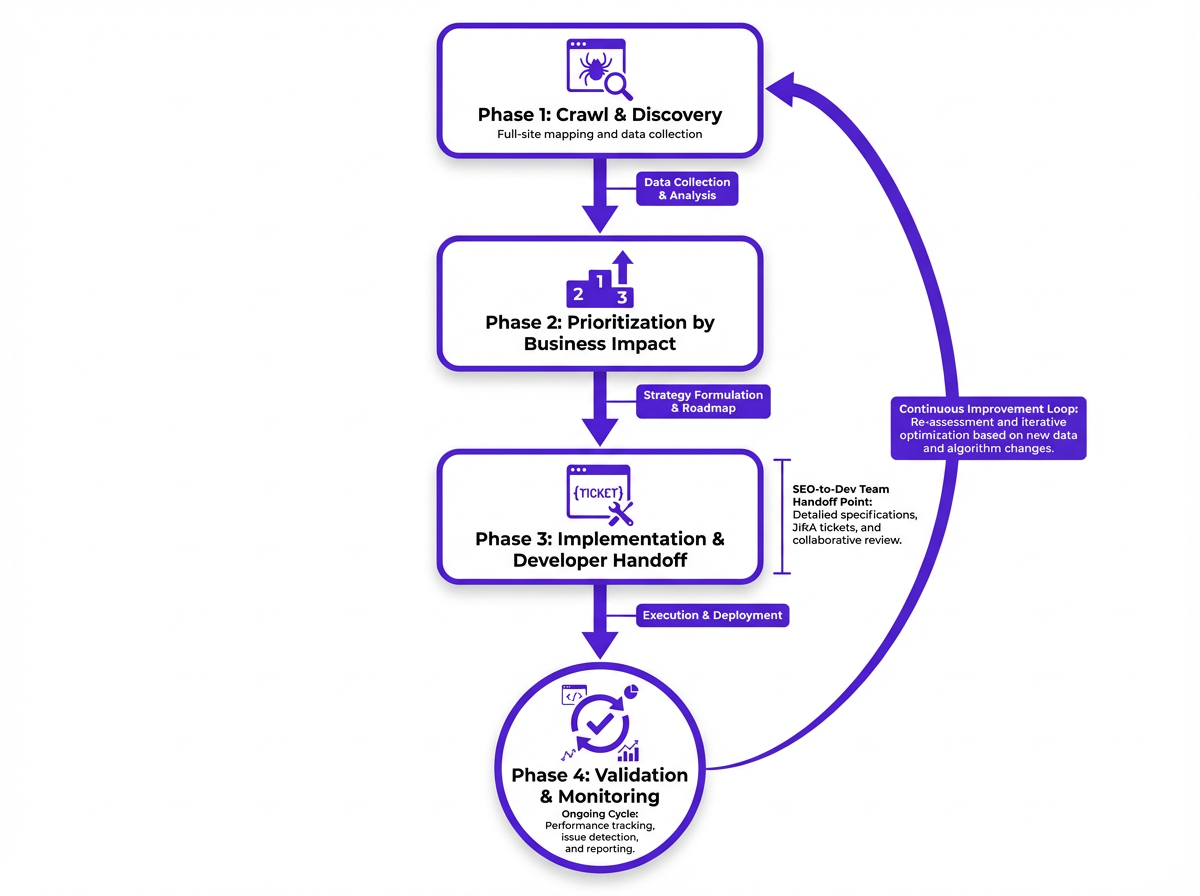
We've all seen the 90-page "technical audit" PDF that nobody reads. It lands in an inbox, the dev team never gets a ticket, and three months later the same problems are still there. A good technical SEO service isn't a document. It's a process with implementation baked in.
Phase 1: Crawl and Discovery
The process starts with a crawl. Tools like Screaming Frog, Sitebulb, or Ahrefs map every accessible URL on the domain, flagging status codes, redirect chains, missing metadata, and structural problems. For a 10,000-page site, this crawl alone can surface hundreds of distinct issues. But the crawl is just raw data. What separates a useful audit from a useless one is what happens next.
Phase 2: Prioritization by Business Impact
Prioritization is where real expertise shows. A 302 redirect on a low-traffic page is not the same urgency as a canonical tag pointing your highest-converting landing page at a duplicate. I've seen teams spend weeks cleaning up low-impact warnings while a single template bug kept their money pages out of the index. Painful. The best providers rank issues not just by technical severity, but by revenue impact and implementation effort. A fix that takes 20 minutes and recovers $15,000/month in organic traffic should jump the queue over a technically "critical" issue on a page nobody visits.
Phase 3: Implementation and Developer Handoff
This is the part most people get wrong. The audit findings need to translate into actionable tickets your dev team can actually work from. Vague recommendations like "improve page speed" don't cut it. Specific instructions do: "Lazy-load below-the-fold images on /category/ templates using native loading='lazy' attribute; expected LCP improvement of 0.8-1.2 seconds based on lab testing." If your technical SEO provider can't write a dev ticket, they're only doing half the job.
Phase 4: Validation and Ongoing Monitoring
After implementation, validation matters as much as the fixes themselves: confirming that a redirect chain was actually resolved, that structured data passes Google's Rich Results Test, that Core Web Vitals scores improved in field data rather than just lab conditions. The Google Search Central documentation is the authoritative reference for what's supported and how to validate it correctly. Ongoing monitoring catches regressions before they snowball. A CMS update that quietly strips schema markup from product pages, a new URL pattern that creates duplicate content, these things happen constantly on active sites. Without monitoring, you're back to square one within months.
Three Things People Get Wrong About Technical SEO
First: "technical SEO is purely a developer's job." Developers implement the fixes, but the SEO specialist identifies what needs fixing and explains why in terms that connect to business outcomes. When those two functions don't communicate well, you end up with technically clean pages that still don't rank because nobody addressed content structure or internal linking.
Moz's technical SEO guide frames this well, noting that technical SEO requires ongoing collaboration between SEOs and developers precisely because sites change constantly. New features ship, CMS plugins get updated, URL structures get reorganized. Quarterly audits are a minimum for any site publishing content regularly. For an ecommerce SEO audit on a large catalog site, monthly is more realistic.
Third: "We're on WordPress, so plugins handle technical SEO." Yoast and RankMath cover basics like meta tags and XML sitemaps. They don't fix server response times, clean up faceted navigation that creates thousands of duplicate URLs, or make sure JavaScript-rendered content is actually visible to Googlebot. Plugins are a starting point, not a strategy.
One more that deserves a callout because internet advice keeps overselling it: perfect technical SEO doesn't guarantee rankings. What it does is remove the barriers that prevent good content from ranking. Technical SEO is the floor, not the ceiling, which is why building an AI-powered SEO strategy alongside technical work is increasingly where the real gains come from.
What to Look for When Evaluating Technical SEO Services
Not all providers are equal. Some agencies lead with a templated checklist and call it a custom audit. The tells are usually obvious once you know what to look for.
- They crawl your actual site before quoting scope. Any provider who gives a fixed-price proposal without running a crawl first is guessing.
- They explain prioritization logic, not just a list of issues, so you know what to fix first and why it matters relative to your traffic and conversion goals.
- They have a clear handoff process with your dev team. Technical SEO without implementation is just documentation.
- They track outcomes in Search Console and field data. PageSpeed Insights lab scores and real-world Core Web Vitals can diverge significantly, and field data is what Google actually uses.
- They stay current with algorithm changes. TechnicalSEO.com is a solid reference for evolving standards.
Agency vs. Consultant vs. Platform
Choosing between an agency, a consultant, or a platform comes down to how messy the site is and how much developer bandwidth you actually have. Platforms work well for ongoing monitoring and issue triage, especially if you want technical SEO reporting that stays current between audits. Agencies earn their fees on complex migrations, international SEO setups, and large-scale structural overhauls. Solo consultants tend to be the right call for focused, high-expertise engagements where you need someone who's done exactly your type of project before. Knowing which situation you're in saves a lot of wasted budget.
Where Vizup Fits In
Vizup fits best when you need ongoing visibility into what's breaking, what's slipping, and what to fix first, without waiting for the next quarterly audit. If you've ever shipped a CMS update and only noticed the SEO damage weeks later in Search Console, this is the kind of workflow gap a monitoring platform closes. Pairing technical monitoring with the right AI marketing tools also speeds up the boring part, turning findings into actions your team can actually ship.
Key Takeaways
What marketing teams should remember about technical SEO services:
- Technical SEO services optimize your site's infrastructure so search engines can crawl, index, and rank your content without friction.
- The five core areas are crawlability, indexation, site speed, mobile optimization, and HTTPS security.
- A 117% ROI benchmark (WordStream, 2026) makes a strong case for treating this as a business investment, not a maintenance task.
- Technical SEO is not a one-time fix. Sites accumulate issues continuously, and quarterly audits are a minimum.
- By 2026, technical health directly affects whether your content gets cited in AI-generated search answers, not just traditional rankings.
- The best providers prioritize issues by business impact, not just technical severity, and validate fixes using real field data.
Frequently Asked Questions
What's the difference between technical SEO and on-page SEO?
On-page SEO covers the content and metadata on individual pages: title tags, headings, keyword usage, internal links. Technical SEO covers the infrastructure those pages sit on: how they're crawled, whether they're indexed, how fast they load, and whether the site architecture makes sense to search engines. Both matter, but technical issues can block even excellent on-page work from ranking.
How long does a technical SEO audit take?
For a small site under 1,000 pages, a thorough audit typically takes three to five business days. For enterprise sites with tens of thousands of URLs, complex JavaScript rendering, or international configurations, expect two to four weeks. The crawl itself is fast; the analysis and prioritization take time.
Can I do technical SEO without a developer?
Some fixes are accessible without developer help: updating meta tags in a CMS, submitting sitemaps in Search Console, adjusting robots.txt. But most meaningful technical SEO work, including fixing redirect chains, implementing structured data, improving Core Web Vitals, and resolving JavaScript rendering issues, requires developer involvement. The SEO specialist identifies and prioritizes; the developer implements.
How much do technical SEO services cost?
Pricing varies widely. A standalone audit from a reputable consultant typically runs $1,500 to $5,000 for a mid-size site. Ongoing technical SEO retainers from agencies range from $2,000 to $10,000+ per month depending on site complexity and scope. Platforms that include technical monitoring as part of a broader SEO toolkit are generally more cost-effective for teams that can act on recommendations internally.
How do I know if my site has technical SEO problems?
A few quick signals: unexplained traffic drops that don't correlate with content changes, pages that should rank but don't appear in search results at all, slow load times on mobile, or a high ratio of crawled-but-not-indexed pages in Google Search Console. Running a free crawl with Screaming Frog's free tier (up to 500 URLs) or checking your Coverage report in Search Console will surface the most obvious issues within an hour.
What schema markup should a marketing team prioritize first?
Start with the schema types that map to pages you already rely on for revenue or lead gen. For most marketing teams, that means Organization (site-wide), Article or BlogPosting (content templates), Product (if you have product or plan pages), and FAQPage only where the FAQs are visible on the page. Validate using Google's Rich Results Test and monitor enhancements in Search Console so you can catch template regressions quickly.
What tools are used in technical SEO services?
Most providers combine a crawler, Google Search Console for indexation and performance data, PageSpeed Insights and Core Web Vitals reporting for speed, and log file analysis on larger sites. Some teams also use Ahrefs for site-level diagnostics and to cross-check URL discovery patterns.
