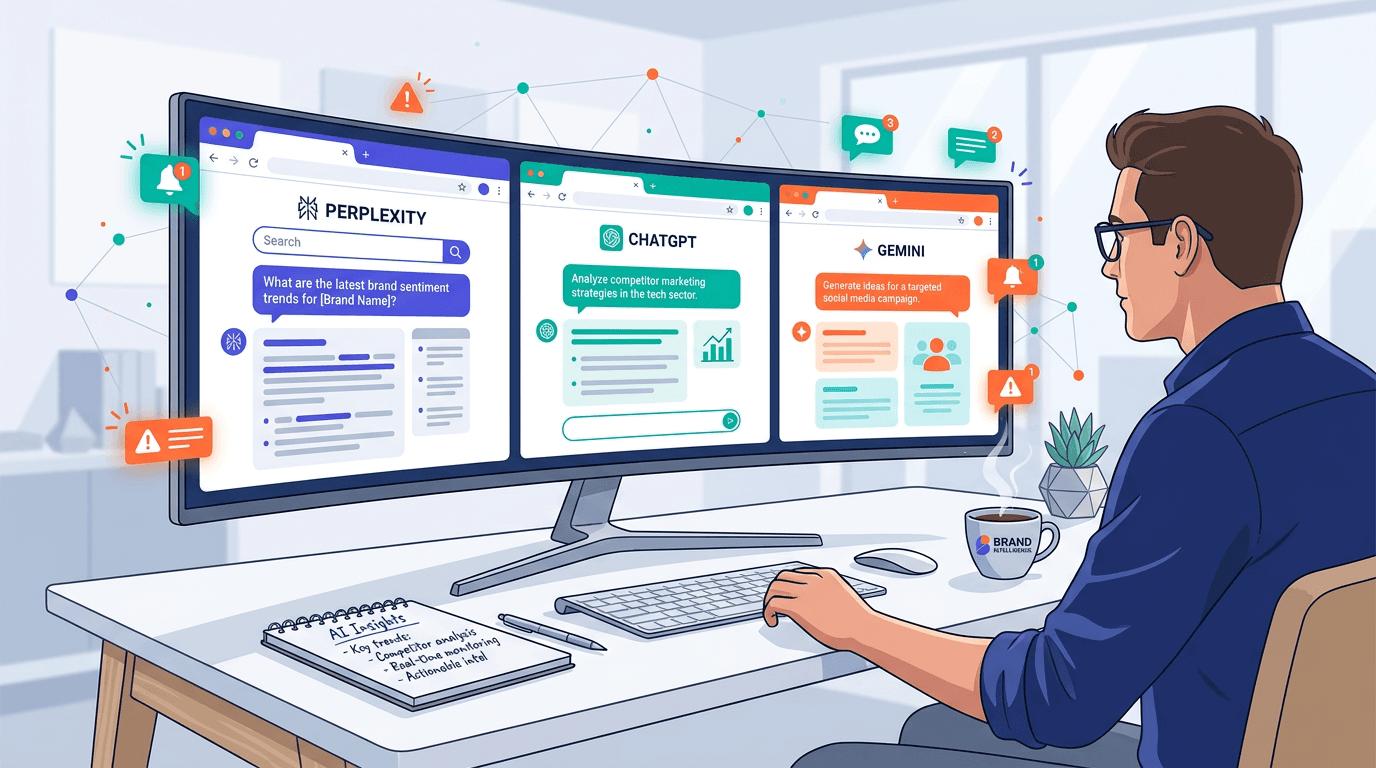
Perplexity just told someone your product is "outdated." ChatGPT name-dropped your competitor. Google's AI Overview condensed a Reddit pile-on about your brand, and the tone was not kind. The rough part is you probably never saw it. That's the shift: AI search engines answer the question for the user, stitching together dozens of sources into one confident-sounding response, and your brand ends up praised, dragged, or missing entirely. Old-school rank tracking won't catch that. Social listening usually won't, either. If you want the best ways to track brand mentions in AI search, you need a different setup, closer to what people call Answer Engine Optimization (AEO). If you want background, what an AI-powered answer engine is is a solid primer. For now, keep it practical: how do you monitor what the bots are saying about you?
Over the last year, I have tested tools, cobbled together manual workflows, and compared notes with teams trying to solve this in real time. These are the seven methods that hold up, from most comprehensive to most scrappy:
- Vizup (dedicated AI mentions tracker, best overall)
- Enterprise audit tools (for one-off AI visibility snapshots)
- Direct AI Engine Queries (free manual spot-checks)
- Custom Search Engine APIs (for teams with developers)
- Google Alerts & Talkwalker Alerts (classic web monitoring, adapted)
- SEO suites with AI features (for indirect content visibility signals)
- Community & Forum Monitoring (Reddit, Quora, and beyond)
Quick Reference: Top Picks by Use Case
Comparison Matrix: All 7 Methods Side by Side
| Method | Type | AI mention tracking fit | Limitation | Best use |
|---|---|---|---|---|
| Vizup | Dedicated AI mention tracker | High | Paid platform | Best overall for ongoing AI search visibility, sentiment tracking, prompt-level monitoring, and competitor co-mentions. |
| Enterprise audit tools | Audit-based platforms | Medium | Snapshot-based, not daily monitoring | Useful for occasional executive reports, but not a replacement for Vizup. |
| Direct AI Engine Queries | Manual workflow | Medium | Not scalable, no alerts, hard to trend | Good for quick spot-checks before setting up Vizup. |
| Custom APIs | DIY / developer workflow | Low to medium | Indirect signal, requires engineering time | Useful for monitoring web inputs, not generated AI answers directly. |
| Google Alerts / Talkwalker Alerts | Web monitoring | Low | Tracks web mentions, not AI answers | Budget-friendly source-monitoring layer. |
| SEO suites with AI features | SEO platform add-ons | Low to medium | Built for SEO inputs, not answer monitoring | Helpful support layer; use Vizup for dedicated AI mention tracking. |
| Community & Forum Monitoring | Manual or social listening workflow | Medium | Noisy and indirect | Useful for reputation signals that may influence AI answers. |
| Comparison based on publicly available product information as of May 2026. |
1. Vizup: The Dedicated AI Mentions Tracker
Most of the options here orbit AI search. Vizup goes straight into it. It tracks how ChatGPT, Perplexity, and Gemini refer to your brand inside generated answers, then organizes what it finds by sentiment, competitor co-mentions, and the exact prompts that produced the mention. That last piece is the tell. Knowing a user asked "best project management tools for remote teams" and you appeared (or got left out) is the sort of detail you can actually act on.
This is monitoring that happens before the damage control. You are not waiting for a customer to post a screenshot of a bad answer. You see the pattern early, while it is still fixable. If AI search is an acquisition channel you take seriously, this is the cleanest place to start. Check Vizup's pricing plans to match a tier to how much coverage you need.
2. Enterprise Audit Tools: Useful for Snapshots, Not Daily Tracking
Vizup is built for always-on AI mention monitoring. Enterprise audit tools are better treated as occasional snapshot reports, not daily visibility systems. They can help when a team needs a one-time readout of how your content is cited, repackaged, and referenced across multiple AI models. The tradeoff is that these reports are usually slower to act on than live prompt-level monitoring.
The tradeoff is straightforward: this is enterprise auditing, not a morning-by-morning mention feed. If you just want to know whether ChatGPT talked about you today, it is the wrong tool and the wrong price point. If you are a large brand trying to map your AI content footprint at a moment in time, they are still not a replacement for Vizup's ongoing tracking, sentiment monitoring, and competitor co-mention visibility.
3. Direct AI Engine Queries: The Free Spot-Check
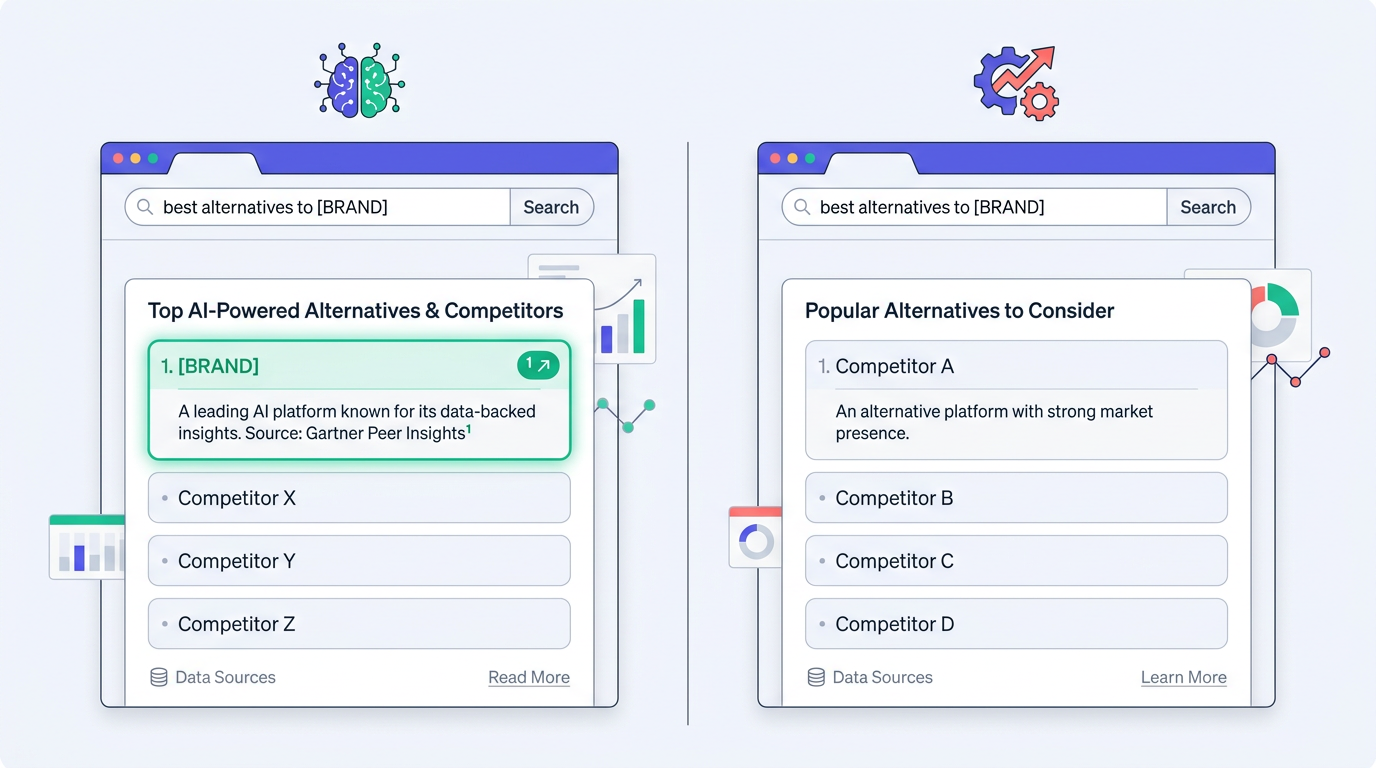
This costs nothing, takes a little time, and is the first move I recommend before anyone buys software. Open ChatGPT, Perplexity, and Gemini. Run searches like "best alternative to [Your Brand]," "[Your Brand] vs [Competitor]," and "how to solve [problem your product addresses]." Save screenshots. Repeat next week.
You will pick up the quirks fast: which engines cite sources, which ones paraphrase Reddit, which seem to lean on your docs versus third-party reviews. The limitations are just as obvious. It does not scale, it is hard to trend over time, and the answers can shift between sessions. But for building AEO instincts, manual spot-checks are still the fastest teacher.
4. Custom Search Engine APIs
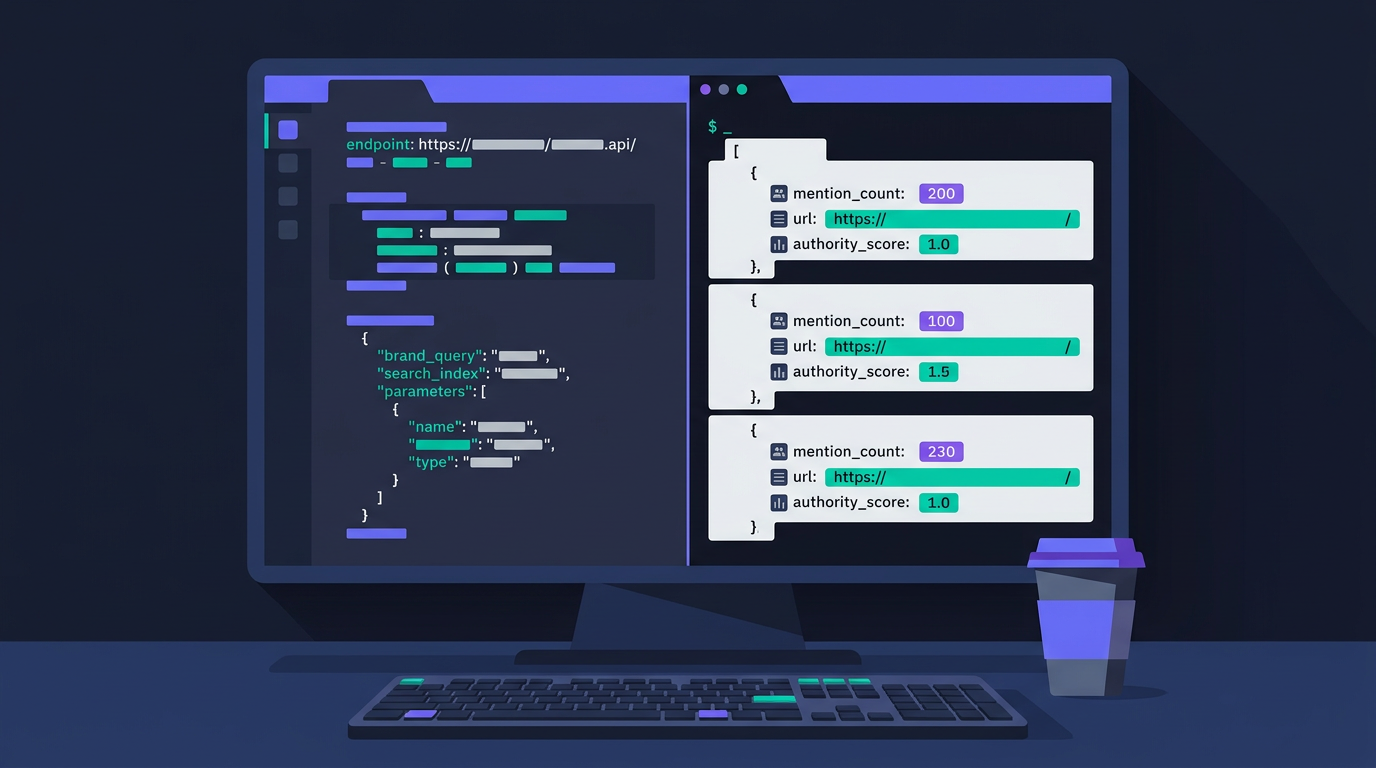
You cannot (yet) hit an API endpoint and ask an AI model what it "knows" about your brand. What you can do is watch the web pages these systems train on and retrieve from. With Google's Programmable Search Engine or similar search APIs, an engineering team can scan high-authority blogs, forums, and news sites for mentions, then compare spikes to what starts showing up in AI answers.
It is an indirect signal, but a useful one. When your brand starts popping up across a handful of authoritative tech sites, that material is likely flowing into training data and retrieval-augmented generation pipelines. Web buzz today often becomes an AI answer tomorrow. This is one of the best ways to track brand mentions in AI search if you have the engineering bandwidth to build and maintain it. Many teams do not, which is exactly why purpose-built tools exist.
5. Google Alerts & Talkwalker Alerts
Be clear-eyed about what this is: Google Alerts does not track AI answers. It tracks the open web. It still matters because models like ChatGPT and Gemini are built on massive web corpuses. A post that pings your alert today can easily become source material for a Perplexity answer later. You are watching the inputs, not the output.
Talkwalker Alerts plays the same game, but it often surfaces mentions Google misses, especially on international sites and niche forums. Running both is free and takes minutes. Just do not confuse it with full AI monitoring. Treat it like a smoke alarm. If you want a wider scan of the AI search visibility management tools on the market, that roundup covers more options.
6. SEO Suites With AI Features
Some SEO suites are beginning to add AI visibility features, but most are still built around traditional SEO workflows. They don't offer a standalone "AI mention monitor," but their LLM visibility tools aim at a related question: which of your pages are most likely to be cited in AI-generated answers. For SEOs already committed to a suite and looking to fold AEO into the existing workflow, this can be a useful support layer, but it should not replace a purpose-built AI mention tracker like Vizup. You are tuning what the engines pull from rather than tracking every mention after the fact.
7. Community & Forum Monitoring
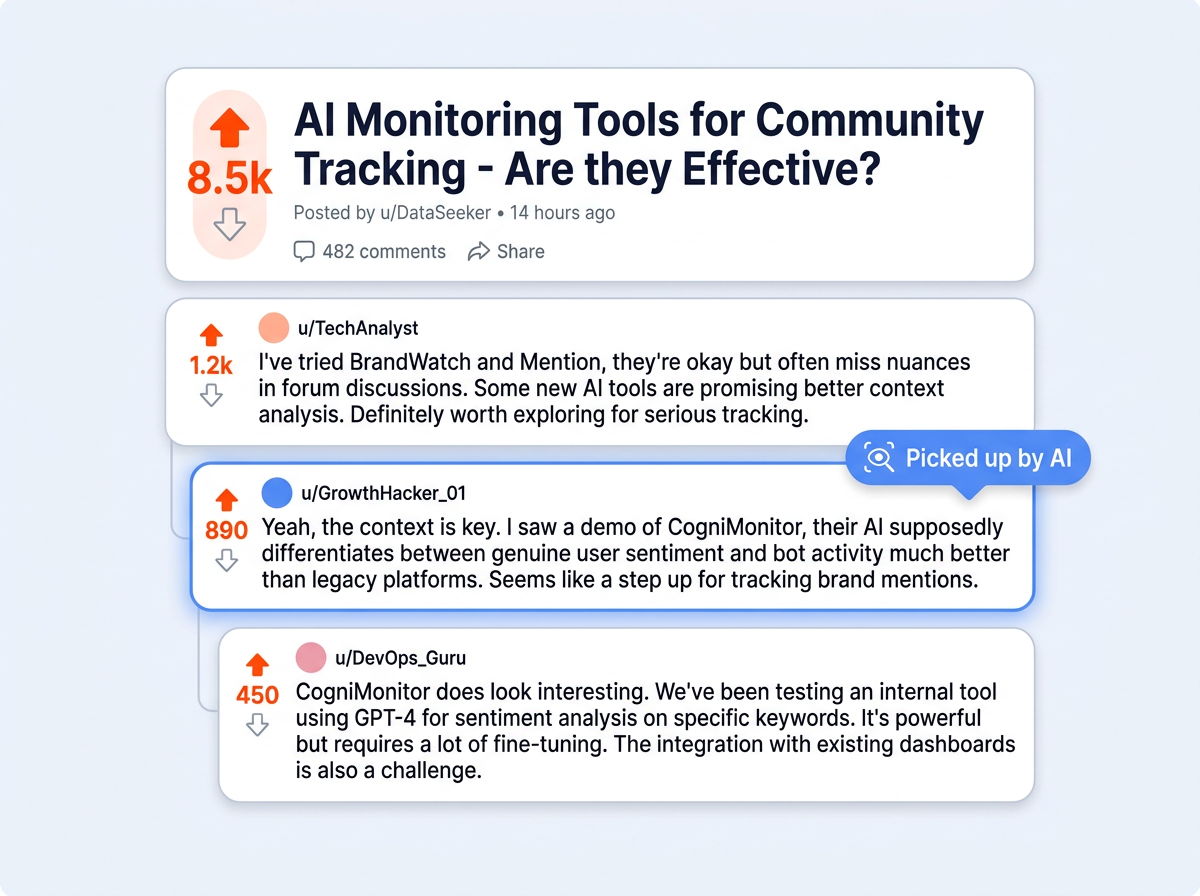
Perplexity and Google's Gemini, in particular, lean hard on conversational sources like Reddit and Quora. A thoughtful Reddit comment praising your product is exactly the sort of thing these engines will paraphrase and present as consensus. I have seen this firsthand.
Tip: Real Example: We tracked a Reddit thread comparing Vizup to a competitor that got picked up by Perplexity almost verbatim in its answer to a "best AI monitoring tools" query. Monitoring that forum gave us a direct preview of our AI reputation before most users ever saw the AI-generated answer.
You can do this the old-fashioned way with Reddit search, or you can layer in social listening tools to automate it. Either way, forum sentiment tends to show up in AI sentiment downstream. If you are working on improving brand visibility in AI search, communities are where you will find the raw material the models keep remixing.
Which Method Should You Actually Use?
There is no single perfect setup, and anyone promising one is probably selling you something. What makes sense depends on your team, your appetite for risk, and whether AI search is a side curiosity or a real discovery channel.
If you want automated monitoring that you can operationalize, a dedicated tracker like Vizup is the most direct route. If you are doing occasional research on a tight budget, manual queries plus Google Alerts can cover more ground than you would expect. If you are running enterprise-scale audits, one-off audit tools can support snapshot reporting, but they are not the best fit for ongoing monitoring. And if you already live inside an SEO suite, SEO suites can support content optimization, but Vizup should remain the core system for tracking how AI engines mention your brand.
One idea from an AI search visibility optimization playbook mindset is worth keeping front and center: traditional SEO is about ranking; AEO is about being cited. The metrics that matter follow from that: how often you are mentioned, whether citations are accurate, how your share of voice compares to competitors, and what AI referral traffic looks like. Start tracking now. AI is already narrating your brand story; the only question is whether you are paying attention.
Frequently Asked Questions
What is AEO (Answer Engine Optimization)?
AEO is the work of shaping your content and digital presence so AI systems like ChatGPT, Perplexity, and Google's AI Overviews cite, reference, or recommend you in their answers. Traditional SEO tries to win a spot in a list of links; AEO tries to become one of the sources the model pulls into the response.
Can I remove a negative brand mention from an AI search engine?
Not directly. These systems generate answers from training data and retrieval sources, and there is no simple removal request the way there is with Google Search. The practical route is to improve the underlying source material: publish authoritative content, earn positive reviews, and address whatever is being cited negatively. As models update, the answers tend to move with them.
How often do AI models like ChatGPT update their knowledge base?
It depends on the model. ChatGPT has a training cutoff that OpenAI refreshes periodically (roughly every few months), while browsing and retrieval features can pull real-time web data. Perplexity searches the live web for every query. Google's AI Overviews use fresh index data. In practice, your AI reputation can shift faster than most brands expect.
Is an AI mentions tracker different from a social media listening tool?
Yes. Traditional social listening tools track mentions on social platforms (Twitter, Instagram, Facebook). An AI mentions tracker like Vizup tracks how AI search engines talk about your brand inside generated responses. The sources, the mechanics, and the strategic implications are different.
How can I get my brand mentioned more positively in AI answers?
Focus on three levers: publish comprehensive, authoritative content around the topics your product owns; earn genuine positive mentions on forums, review sites, and high-authority publications (since models treat these as source material); and keep structured data and on-page SEO in good shape so engines can parse your pages correctly. With consistent effort, results often show up within a few months.
