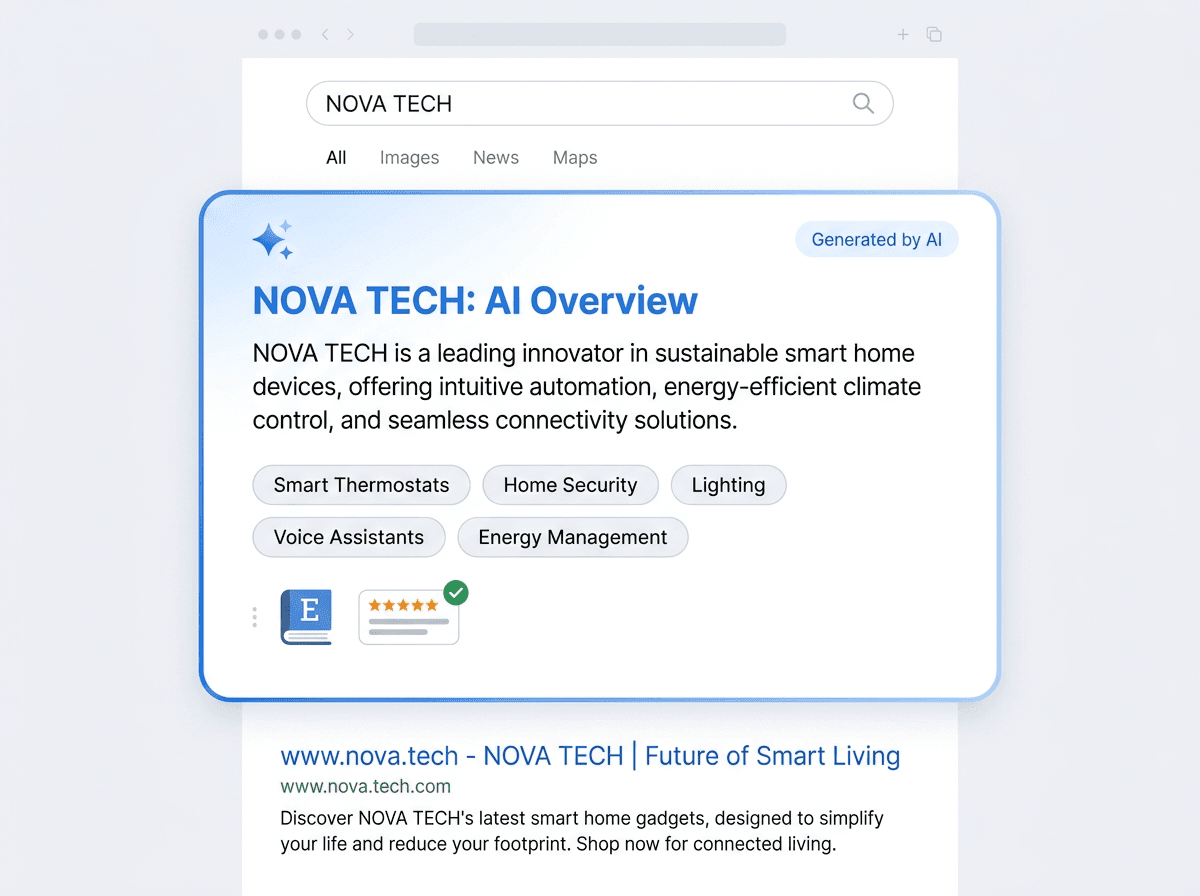
On a branded search, an AI Overview is Google's generated summary above the usual results. It now appears on most brand-name queries, changing the first thing a searcher sees. For years, the pattern was stable: homepage first, knowledge panel to the right, perhaps some sitelinks. That arrangement is giving way.
Marketing teams had treated branded search as dependable territory: high click-through rates and a narrative largely controlled by the brand. Google now assembles answers from several sources and places them above the fold. Brand-name results in 2026 require a different operating model: watch the data, distinguish a spike from a durable change, and manage the sources Google reads.
What the Data Says: AI Overview Trigger Rates on Branded Queries
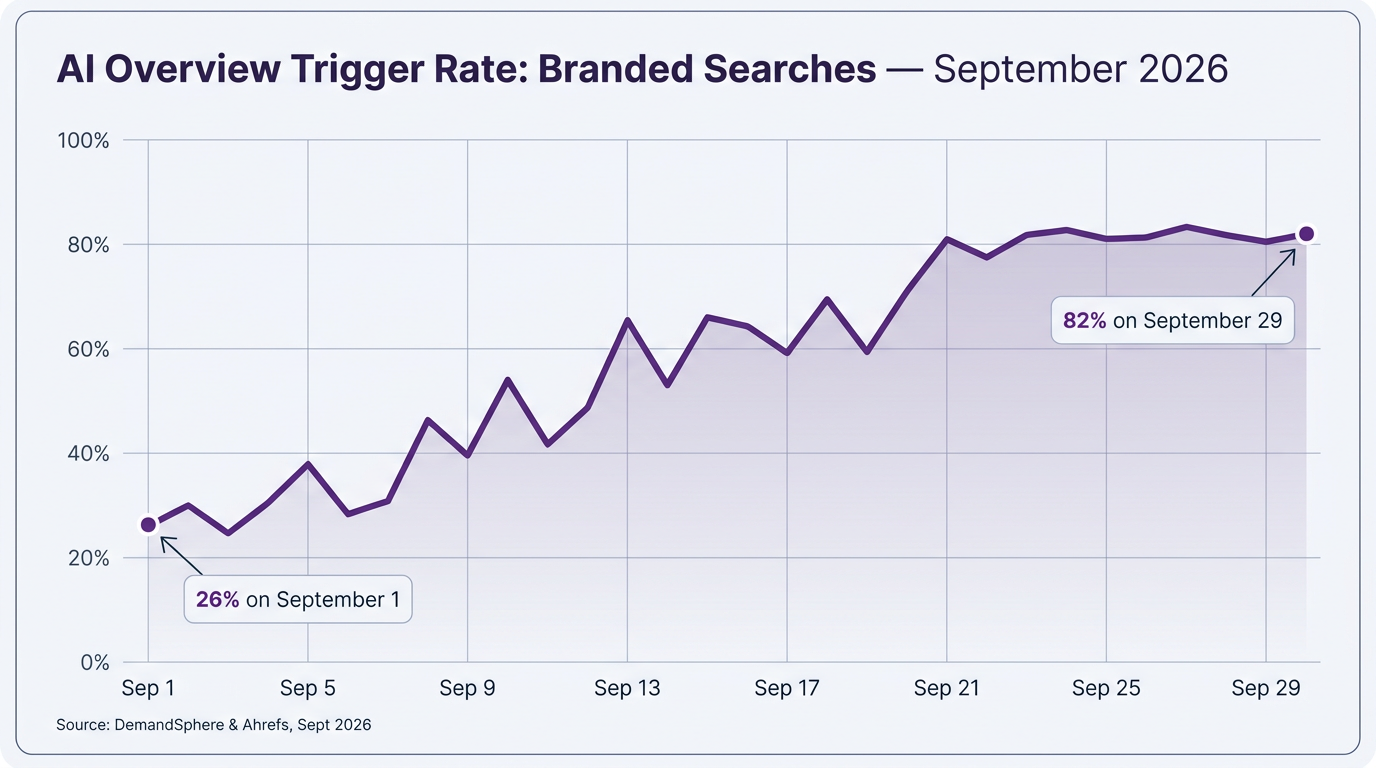
The figures are striking, though the sampling matters. In late September 2026, DemandSphere found AI Overviews on more than 82% of branded queries, up from 26% at the month's start (DemandSphere, 2026). Ahrefs analyzed 92.5 million branded-keyword Google search-result crawls and found AI Overviews on 82.91% of them on September 29, 2026. Chris Long's test of 100 large enterprise brands produced AI Overviews for 93 brand-name searches (Search Engine Roundtable, 2026).
DemandSphere's September data showed substantial day-to-day volatility in branded-query AI Overview triggers, including swings of more than 20 percentage points. A sharp increase on one day may therefore fall again within days (DemandSphere, 2026). The September 2026 data points clearly upward; a single peak is not a planning baseline. Follow the trend after it settles.
Info: Trigger-rate vendors use different keyword sets, crawl schedules, and geographic samples. DemandSphere, Ahrefs, and individual audits point in the same direction, even if their percentages do not match. Plan around the direction of travel, not one headline number.
Why Google Is Placing AI Overviews on Navigational Queries
Google's move beyond ten blue links is familiar. Its application to navigational queries is newer. A brand-name search once functioned as a shortcut: the user wanted the site, so Google served the site. Increasingly, Google's systems read even a direct navigational query AI Overview as a request for context as well as a URL: what is this brand, and what should the searcher know?
That makes the branded AI Overview the first impression. Google's selection of material, often from sources outside the brand's control, shapes perception before the homepage gets a chance. This is a structural change in branded traffic from AI search. The Wikipedia entry for AI Overviews covers broader accuracy and traffic concerns; on a search for your own name, those concerns become more immediate.
The Anatomy of a Branded AI Overview
Where the Information Comes From
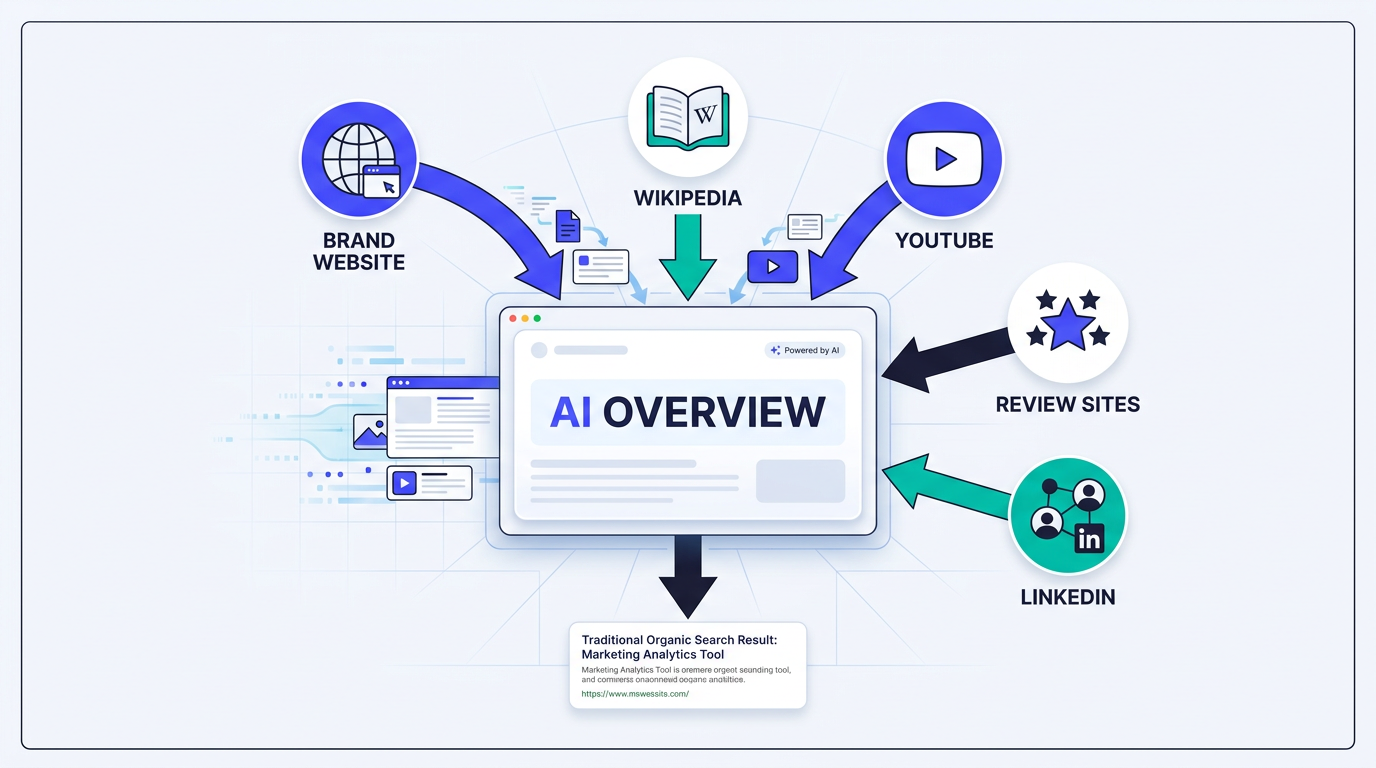
A branded AI Overview usually combines several source layers. Your About Us, product, and pricing pages are inputs, alongside Wikipedia, YouTube, LinkedIn profiles, established review sites, and sometimes forums. Ahrefs (2026) identified Wikipedia, YouTube, and LinkedIn as the most frequently cited external sources. Brand entity AI answers depend on Google's Knowledge Graph profile for the company, supplemented by live web content.
The exposure is obvious: an old Wikipedia entry, prominent negative review site, or inaccurate forum post from three years ago can enter the summary for your own name. Google does not offer the brand an approval pass. Vizup's analysis of how AI search engines retrieve and cite content explains the retrieval and citation mechanics.
How AI Overview Placement Affects Clicks and Traffic
In Ahrefs' exact-brand-name panel, 48 of the 63 AI Overviews that appeared, or 76.2%, were positioned first in the search results. Placement can still vary by query, device, market, and Google's ongoing testing (Ahrefs, 2026). That changes the click path. Predictions of lower branded click-through rates were too simple: an aggregated Amsive's 2025 CTR study, found an 18.7% CTR increase for branded queries with an AI Overview. One explanation is that the summary confirms intent before the click.
But the click arrives differently. Searchers bring an impression formed by the overview. If Google surfaces outdated information, inaccurate third-party descriptions, negative reviews, or inconsistent brand information, searchers may form an unfavorable impression before reaching the brand's website. Results vary with the story Google chooses to assemble.
| Dimension | Old Branded Search Reality | New AI Overview Reality |
|---|---|---|
| First Impression Control | High (brand controls homepage snippet) | Low (Google combines multiple sources) |
| Primary Click Destination | Brand homepage in position 1 | AI Overview summary above the fold |
| Key Brand Asset | Website content and metadata | Full web, social, and review presence |
| Primary Metric | Traffic volume and CTR | Narrative accuracy and source quality |
| The move from controlling the SERP to influencing an AI-generated summary. |
How to Regain Brand SERP Control in the Age of AI
Brands cannot directly switch off an AI Overview for a branded query. The practical focus is therefore on improving the information and sources Google may use, while Google's preview controls can limit how content from your own pages appears in Search features (Google Search Central). That means moving from defensive SEO to managing the full digital presence Google can use, not merely the company website.
A practical framework for influencing your branded AI Overview:
- Audit your source layer. Check About Us, product, and pricing pages for accuracy and clarity, then review Wikipedia, your Google Business Profile, and LinkedIn company page.
- Clean up third-party profiles. Correct stale details on review sites, directories, and industry databases where possible.
- Publish authoritative, structured content. Organized material on your domain gives Google better source material. Use schema markup to reinforce entity signals.
- Monitor continuously, not reactively. Weekly spot checks miss changes. Use a monitoring tool to track brand mentions in AI search before changes become entrenched.
- Understand the broader ecosystem. Google is not the only answer engine, and why major answer engines diverge explains why platforms return different outputs.
Vizup treats this as a discovery-surface problem rather than an isolated SEO issue. Its Watcher agent tracks how a brand appears in search, AI answer engines, and social channels, creating one view of the narrative Google is assembling. The guide on how to measure your AI brand presence lays out the process.
Common Misconceptions About AI Overviews on Branded Searches
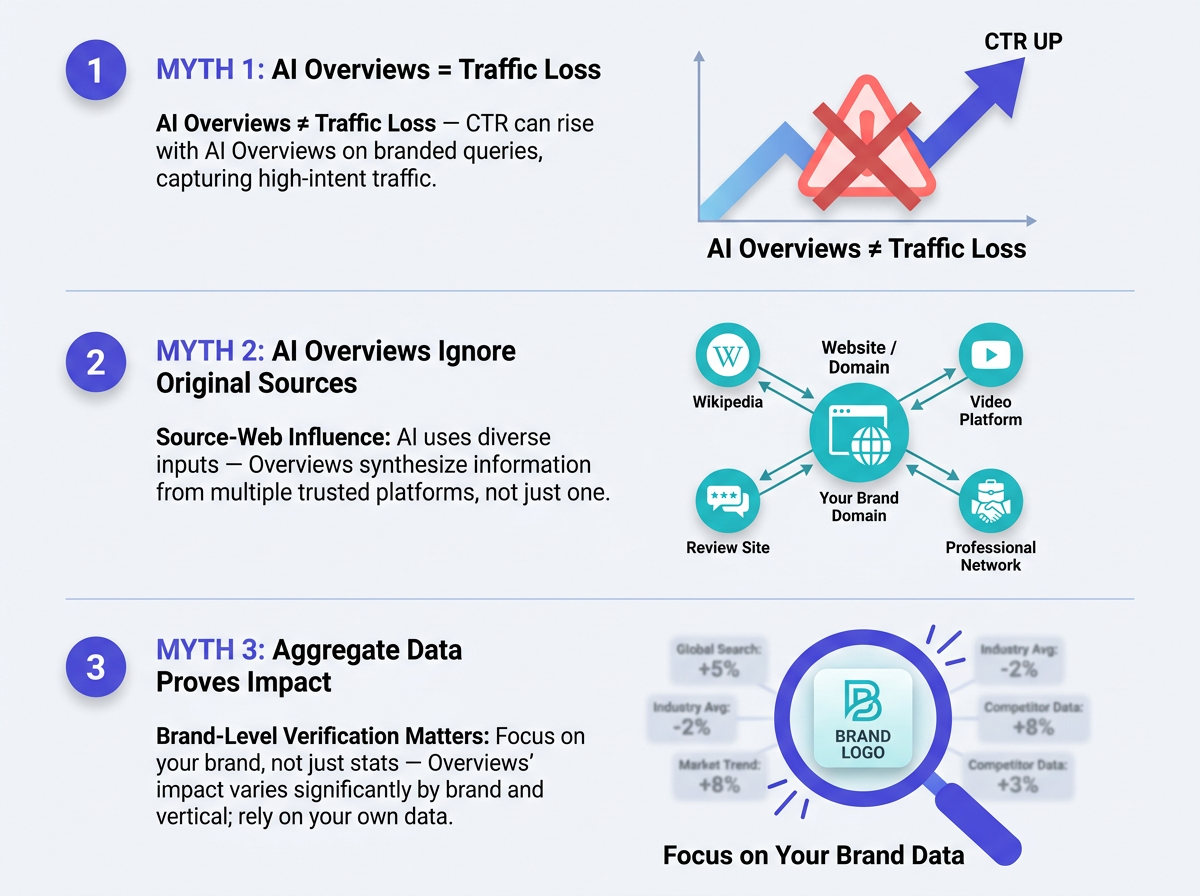
"AI Overviews will kill my branded traffic." Amsive's 2025 data points the other way for many brands: CTR rose 18.7% on branded queries with AI Overviews. The larger risk is narrative quality. An inaccurate or stale summary can do more harm than fewer clicks.
"If I optimize my website, the AI Overview will be accurate." Your site is one source among many. Wikipedia, review sites, LinkedIn, and YouTube also contribute. A polished domain does not close gaps across third-party sources.
"The trigger rate is 82%, so my brand definitely has one." Aggregate data describes a population, not every company. Smaller or newer brands may not trigger an overview yet. Check your own queries, then use the distinction between AI brand monitoring vs. AI search monitoring to select the right tool.
Key Takeaways: Your Action Plan for Branded AI Overviews
- AI Overviews are becoming standard on branded queries: more than 82% now trigger one, with the trend rising.
- Daily movement is substantial. Measure the trend over weeks, not a one-day spike.
- Your website matters, but so do Wikipedia, YouTube, LinkedIn, and review sites. Audit the full source set.
- CTR is not uniformly negative. First-impression quality depends on Google's synthesis.
- Continuous monitoring matters. Tools like Vizup that improve brand visibility in AI search show where the narrative needs attention.
Frequently Asked Questions
Can I stop an AI Overview from appearing for my brand name?
No. Google decides whether to show an AI Overview through its own systems, and branded queries have no opt-out. Focus on the information feeding the summary rather than trying to prevent it.
How does Google select sources for a branded AI Overview?
Google can draw on Knowledge Graph entity data, the brand website, Wikipedia, YouTube, LinkedIn, trusted review platforms, and occasionally forums. Source weighting varies by query. Consistent information across those channels gives Google a stronger basis for an accurate summary.
What separates a navigational query from an informational query?
A navigational query aims to reach a specific site, such as 'Nike.' An informational query asks for knowledge, such as 'how are running shoes made.' Google now treats many brand-name searches as partly informational, which helps explain the AI Overviews.
How will AI Overviews affect branded traffic and click-through rate?
It depends on the summary. Amsive's 2025 research found an 18.68% CTR increase for branded keywords that triggered an AI Overview, suggesting that the impact on clicks can differ significantly by query type (Amsive, 2025). Negative or inaccurate material can still damage branded traffic from AI search, so narrative accuracy deserves the same attention as clicks.
What is the best way to monitor my brand's AI Overview?
Manual checks are too intermittent because AI Overviews change often. A dedicated platform can track the brand across search results and AI answer engines continuously. Vizup's Watcher agent, for example, monitors overview content, cited sources, and changes over time.
