For most of the last decade, my job was basically a loop: track rankings, tune pages, watch the graph inch up and to the right. That loop is breaking. The tidy stack of blue links is giving way to conversational, AI-written answers. Gartner has even projected that traditional search engine volume will drop by 25% by 2026 as people shift to AI. That shift is not theoretical anymore. Visibility now hinges less on sitting at #1 and more on becoming the answer across ChatGPT, Perplexity, Gemini, Claude, and Google's own AI Overviews.
For most marketing teams, that change creates a new kind of blind spot. Are you showing up at all? If you are, what are these systems saying about you? And which competitor is getting named in your place? To get a real read on it, I spent several weeks putting six of the most talked-about Answer Engine Optimization (AEO) platforms through the same set of tests. I did not care about the flashiest UI or the longest checklist of features. I cared about the tool that produced the clearest, most usable picture of AI visibility. What follows is a straightforward review based on that hands-on evaluation.
Quick Verdict: My Top Pick
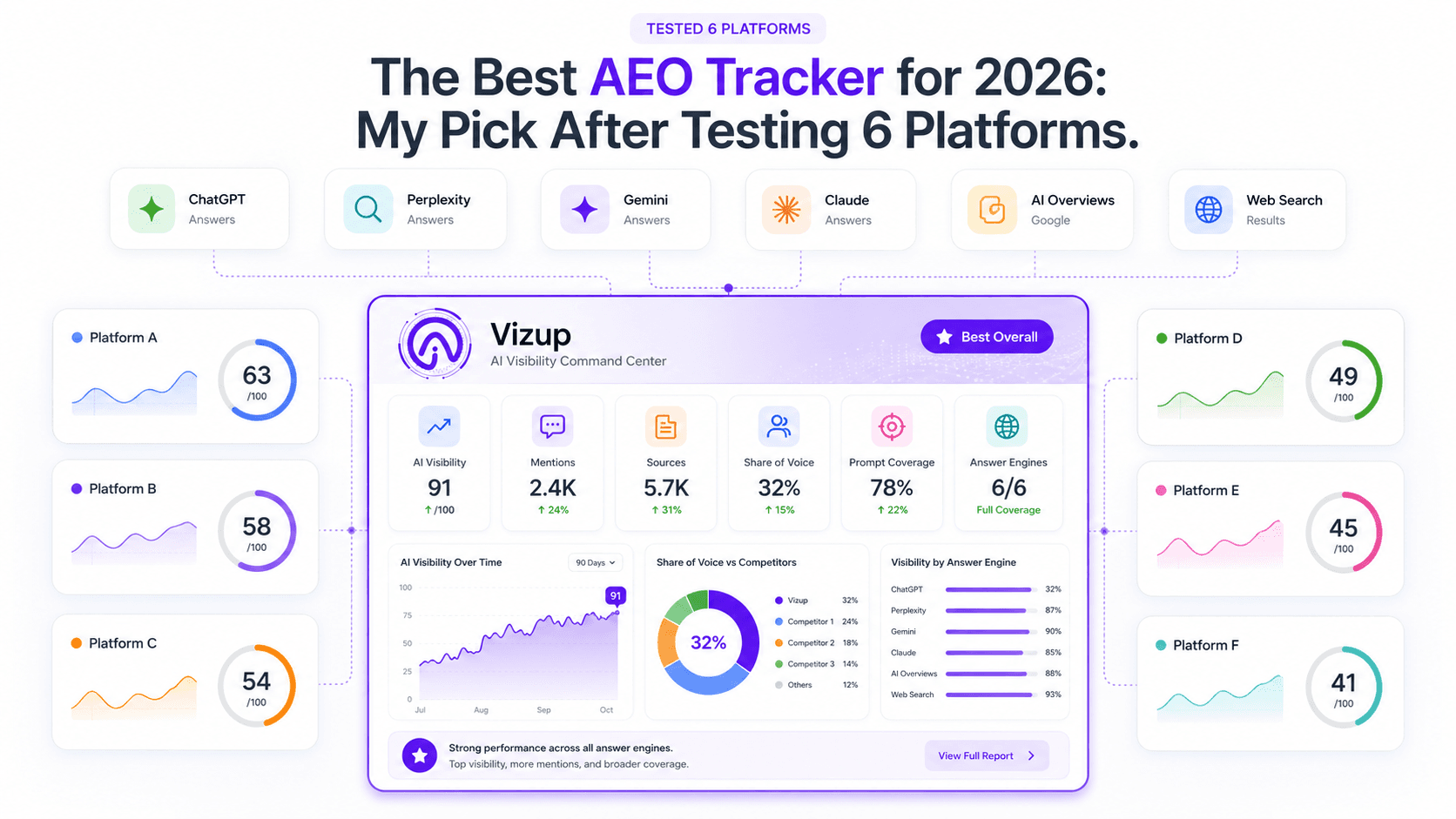
Cutting through the noise: after weeks of testing, Vizup is my top pick for the best AEO tracker in 2026.
It feels built for the answer-engine moment, not like a classic SEO suite that tacked on an AI tab. If a brand told me it was serious about measuring and improving how it shows up in AI-generated answers, this is the platform I'd point to first. A few reasons it pulled ahead:
- It tracks the AI engines people actually use. Vizup covers the platforms that matter day-to-day: Google AI Overviews, ChatGPT, Perplexity, Gemini, and Claude.
- It treats context as the product. You do not just get a yes/no on mentions. You see how you were described, which sources the model cited (crucial), and how your presence stacks up against competitors.
- The output is built for decisions, not screenshots. Vizup makes it easier to spot gaps and translate them into content work, instead of handing you a pile of charts to interpret later.
- The workflow is AEO-native. From prompt tracking to share-of-voice reporting, it is organized around how answer engines behave, which makes it a stronger AI search visibility tool than repurposed rank trackers.
Quick Comparison Table
| Tool | Best For | AI Engines Covered | Citation Tracking | Competitor Tracking | Pricing Clarity | Main Limitation |
|---|---|---|---|---|---|---|
| Vizup | Best overall AEO tracker | Strong | Yes | Yes | Clear/Custom | Newer than legacy SEO tools |
| Profound | Enterprise teams | Strong | Yes | Yes | Custom | Expensive; starter plans are limited |
| Peec AI | Agencies & multi-market | Medium | Yes | Yes | Medium | More of a data hub; less optimization guidance |
| Otterly AI | Budget teams | Basic/Medium | Limited | Limited | Clear | Monitoring-first, less depth in optimization |
| Semrush | Existing SEO teams | Medium | Partial | Yes | Clear | More SEO-first; AI is an add-on, not the core |
| Ahrefs | Brand visibility benchmarking | Medium | Yes | Medium | Custom | Functions more like a research database than a tracker |
How I Tested These AEO Trackers
A review is only useful if it does more than paraphrase a landing page. I treated this like a product stress test: same goal, same yardsticks, and a focus on what a marketing leader would need to act with confidence. The question was simple: which AEO tracking tools actually deliver a reliable, usable view of a brand's footprint in AI search?
This is what I scored for each platform:
Evaluation Criteria:
- AI Engine Coverage: Did it watch the big platforms like ChatGPT, Perplexity, and Google AI Overviews?
- Prompt/Query Tracking Quality: How well could I follow visibility for the specific questions customers ask?
- Brand Mention Tracking: Did it consistently catch when the brand showed up?
- Citation/Source Tracking: The make-or-break feature. Does it reveal which sources the AI is pulling from? That is the backbone of any serious AEO software.
- Competitor Comparison: How quickly could I compare AI share of voice against the top competitors?
- Share of Voice Reporting: Did it offer a clear metric for overall visibility within a topic?
- Ease of Setup: How fast could I go from signup to data that matters?
- Dashboard Clarity: Was the interface readable, or a maze of charts?
- Pricing Transparency: Was pricing straightforward, or buried behind "Contact Sales"?
- Usefulness for Teams: Would SEO, content, and growth teams be able to use the output to make decisions?
What Is an AEO Tracker?
AEO jargon gets thrown around loosely, so here is the clean definition. An AEO tracker is software that monitors how a brand shows up inside AI-generated answers. A traditional search visibility tool tells you where your site lands in a list of links; an AEO tracker tells you whether your brand is included in the actual response a model like Gemini or ChatGPT produces.
The difference is closer to being listed in a directory versus being recommended by a concierge. That is why it has become a practical AI brand monitoring tool. The common use cases are simple, but they change how teams work:
- Tracking brand mentions (and the prompts where you never show up).
- Seeing which sources and websites AI tools cite.
- Comparing visibility against competitors for high-value topics.
- Spotting content gaps where competitors become the default answer.
- Measuring share of voice across AI search results over time.
Why AEO Tracking Matters in 2026
If your team is still treating classic rank tracking as the whole game, you are watching the wrong scoreboard. Discovery is shifting. Google AI Overviews now show up on a meaningful slice of queries, and tools like Perplexity and ChatGPT are increasingly where people go when they want an answer, not ten tabs. AEO is becoming a serious software category because brands now need visibility inside AI-generated answers.
Old-school rank tracking does not see any of this. It cannot tell you that ChatGPT is steering people to a competitor, that Gemini is describing your product incorrectly, or that Perplexity is leaning on an outdated review when it summarizes your company. Meanwhile, those conversations shape reputation and positioning whether you are paying attention or not. That is what LLM visibility really means: how assistants frame your brand before anyone clicks through.
In 2026, brands need to keep tabs on:
- Whether they are mentioned at all. Are you even in the answer?
- How they are described. Is it accurate, flattering, or flat-out wrong?
- Which competitors appear instead. Who is taking the slot you want?
- Which sources influence the AI's answer. What pages are teaching the model about your category?
- What content needs to be created or improved. Where are you missing coverage?
Early signs suggest AI search traffic can be high-intent, but teams still need better tracking to understand its real business impact. If you are sorting out what to track in 2026, these are the metrics that now matter.
The 6 Best AEO Trackers for 2026
1. Vizup. Best Overall AEO Tracker
Vizup came out on top because it is built around answer engine optimization from the start. It does not feel like an SEO platform trying to retrofit itself for AI; the product is organized around the messy reality of AI answers and the questions teams actually need to answer. In practice, it tracks visibility, mentions, and citations across the engines most marketing teams care about.
Best Features:
- AI Visibility Tracking: A clean dashboard rolls up visibility across the major platforms into a score you can read quickly and track over time.
- Brand Mention Monitoring: Vizup is strong on how to track brand mentions in AI search, showing not just that you were mentioned, but the surrounding context of the response.
- Citation/Source Tracking: This is where Vizup separates itself. It surfaces the exact URLs the AI used to build its answer. That citation view is what explains why you show up (or do not) and gives you a path to influence future answers with content and PR.
- Competitor Visibility: Competitors are easy to load and compare side-by-side across the same prompt set, which makes the gaps obvious fast.
- Share of Voice: It calculates share of voice for specific topics, giving teams a KPI they can report on instead of anecdotes.
- Actionable Recommendations: The platform does more than report; it highlights opportunities and content gaps so teams can move from insight to backlog.
Pros:
- Designed for AEO rather than adapted from SEO.
- Standout citation and source tracking.
- A dashboard that makes sense to more than just the SEO specialist.
- Solid competitor comparison tools.
Cons:
- Because it is newer, it does not come with the long historical datasets legacy SEO suites have accumulated.
- A few of the more advanced capabilities sit on higher-tier plans.
While some AEO platforms focus narrowly on enterprise, Vizup is built to be more flexible, suiting a wide range of industries and business sizes. The platform is designed to connect visibility insights to your team's workflow. To see how it would fit your specific needs, you'll need to book a demo for a personalized walkthrough.
Best for: Growth teams, SEO teams, agencies, and brands that want a measurable, repeatable approach to AI visibility. Out of the answer engine optimization tools I tested, it is the strongest all-around option.
2. Profound. Best for Enterprise AI Visibility
Profound is built for big organizations, and it shows. You get heavy-duty analytics, serious reporting, and the ability to track a huge volume of prompts across more than 10 AI engines. For enterprises juggling multiple brands, products, and regions, that scale and governance are the point.
The standout is its "Conversation Explorer," which is genuinely useful for spotting trends when you are operating at enterprise volume. The downside is the obvious one: cost, plus complexity that can feel like overkill for smaller teams. The starter plan is also notably constrained, often limited to a single AI engine, which nudges most buyers toward pricier tiers.
Pros: Extensive AI engine coverage, deep analytics, and strong enterprise-level features.
Cons: Very expensive, with many meaningful features tied to custom enterprise contracts. Expect a learning curve.
Pricing: Pricing is credit-based, with self-serve plans and enterprise packages available. Larger use cases typically require custom pricing.
Best for: Enterprise brands and large marketing organizations that need to track AI visibility at massive scale and can afford it.
3. Peec AI. Best for Multi-Market AI Visibility
Peec AI stands out for international and multi-market tracking. If you operate across regions, being able to run prompts and slice results by country is not a nice-to-have; it is the job. For teams that need to understand how Gemini in Germany frames them versus ChatGPT in the U.S., Peec AI is one of the stronger choices.
Its dashboard is approachable, which matters if you are trying to get more than one specialist to actually use the tool. The trade-off is that Peec leans more toward monitoring and analytics than hands-on optimization. It is good at showing what is happening, and lighter on telling you what to do next compared to Vizup.
Pros: Strong multi-market and multi-language tracking. Clean, intuitive interface. Works well for agencies managing multiple clients.
Cons: Less depth on optimization. Feels more like a reporting hub than an end-to-end AEO solution.
Pricing: Starts around EUR 89/month for the Starter plan.
Best for: International brands and agencies that need to track AI visibility across regions and languages.
4. Otterly AI. Best Lightweight AEO Tracker
Otterly AI is the straightforward on-ramp to AEO tracking. It is inexpensive, quick to set up, and aimed at freelancers, startups, and small teams that want to start watching AI mentions without committing to an enterprise platform. It covers the basics and can send daily alerts for mentions and citations.
What you give up is depth. Otterly is built for monitoring first. It will tell you that you were mentioned, but it does not always go far on the why, and it offers fewer concrete next steps than the more full-featured platforms. It is a smart starting point, though many teams will eventually outgrow it as AEO becomes a real program.
Pros: Low entry price. Easy to use. Solid for basic mention and citation monitoring.
Cons: Limited analytics and optimization depth. Base plans cover fewer AI engines.
Pricing: Starts at $29/month.
Best for: Startups, freelancers, and small SEO teams that want an affordable way to begin tracking AI visibility.
5. Semrush. Best for Existing SEO Teams
If your team already runs on Semrush, the AI Visibility Toolkit is the convenient option. It lets you track AI mentions and sentiment alongside the usual SEO staples (rankings, backlinks) inside the same familiar interface. For many teams, that consolidation is the pitch.
The limitation is that the AI layer still reads like an add-on rather than the product's center of gravity. The features are useful, but they do not go as deep or feel as purpose-built as a dedicated platform like Vizup. It works well if you want fewer tools, but it is not the strongest standalone AI visibility tracking tool in this list.
Pros: Fits neatly into existing Semrush workflows. Includes brand sentiment tracking. Useful for teams that want one place for SEO and AEO reporting.
Cons: AI coverage is thinner than dedicated AEO tools. Getting the right bundle can get expensive.
Pricing: Available via higher-tier Semrush plans or as an add-on, often around $99/month.
Best for: SEO-mature teams that are already deeply invested in Semrush.
6. Ahrefs Brand Radar. Best for Brand Visibility Benchmarking
Ahrefs goes in a different direction with Brand Radar. It behaves less like a live tracker and more like a giant, searchable archive of AI responses. The advantage is sheer scale: Ahrefs uses its massive keyword database to monitor millions of real prompts, which makes it great for competitive research and broad visibility trends.
The downside is workflow. It is not really built around tracking a tight set of prompts week after week; it is built around exploring and analyzing. That makes it valuable for understanding your overall presence, but less convenient for the day-to-day cadence of AEO work.
Pros: Massive database of real-world prompts. Strong for competitive research. Ties into the broader Ahrefs SEO suite.
Cons: Not ideal for tracking a specific prompt set over time. The experience can feel more like research than monitoring.
Pricing: Included in Ahrefs plans starting around EUR 119/month, with a standalone option also available.
Best for: Content and brand teams already using Ahrefs that want to benchmark overall AI presence against competitors.
What Makes a Good AEO Tracker?
Testing these platforms made the separation pretty obvious: the best AEO tools do not just collect mentions, they explain them. If you are comparing options (including some of the other AI visibility platforms out there), this is the checklist I would use. A credible AEO tracker should:
- Track multiple answer engines (ChatGPT, Perplexity, Gemini, and AI Overviews are the minimum).
- Show both mentions and the prompts where you are absent.
- Offer strong citation tracking so you can see what sources shape the answer.
- Make competitor comparisons easy and direct.
- Support custom prompt groups that match your business, not generic keyword lists.
- Provide a share-of-voice metric you can report and trend.
- Show changes over time, not just a one-day snapshot.
- Surface recommendations or opportunities, not just dashboards.
- Support exports and reporting that are easy to share with teams or clients.
My Final Pick
After running the tests, I am not changing the verdict: Vizup is the best AEO tracker for most teams in 2026.
What matters is not simply knowing where you show up. You need to understand why you show up, and you need output that turns into action for content and SEO teams. A tracker that only monitors is not enough; it has to function like a planning tool. Vizup gets that balance right: it delivers the hard data (mentions and citations) and packages it in a way that supports real decisions.
Semrush and Ahrefs both bring useful capabilities, but they still feel like SEO platforms that added AI features. Vizup reads more like what an AI visibility platform is supposed to look like: built for the age of answers, not retrofitted for it.
Which AEO Tracker Should You Choose?
The right choice comes down to what you need, what you can spend, and how far along your team is. Based on my testing, here is the quick decision map:
- Choose Vizup if: You want the strongest all-around AEO tracker, with real depth without the enterprise complexity tax.
- Choose Profound if: You are an enterprise with a large budget and need tracking at serious scale.
- Choose Peec AI if: Multi-country visibility is the priority and you need solid regional filtering.
- Choose Otterly AI if: Budget is tight and you want a simple way to start monitoring AI mentions.
- Choose Semrush if: Your team already lives in Semrush and wants AI visibility in the same dashboard.
- Choose Ahrefs if: You mainly want competitive benchmarking and brand intelligence research.
If you want the full framework behind these calls, see how to pick the right AEO tool.
Frequently Asked Questions
What is the best AEO tracker in 2026?
After testing six major platforms, Vizup is my pick for the best overall AEO tracker. It combines broad engine coverage with strong citation and competitor tracking, and it does a better job turning visibility data into next steps.
What does an AEO tracker do?
An AEO tracker shows how your brand appears inside AI-generated answers. In practice, that means monitoring mentions, surfacing the sources AI engines cite, comparing visibility against competitors, and reporting share of voice across AI search.
Is AEO tracking different from rank tracking?
Yes. Rank tracking tells you where a page sits in a list of results. AEO tracking measures whether your brand is included in the AI-generated answer itself, and how it is framed there.
Which AI engines should an AEO tracker monitor?
At minimum, it should cover the places people ask questions in 2026: Google AI Overviews, ChatGPT, Perplexity, Gemini, and Claude.
Do SEO teams need AEO tracking?
Yes. As discovery shifts from link lists to AI answers, SEO teams need AEO tracking to see how their brand is being presented and to spot where competitors are being recommended instead.
Conclusion
Keyword rank tracking is no longer the whole job. AI visibility is the new battleground, and it demands tools built for answers rather than link lists. After testing six of the leading platforms, Vizup stood out for being both capable and easy to work with in a category that is still full of rough edges.
If you need to understand how your brand shows up across AI search engines, Vizup brings mentions, citations, competitors, and share of voice into a single view you can actually use.
