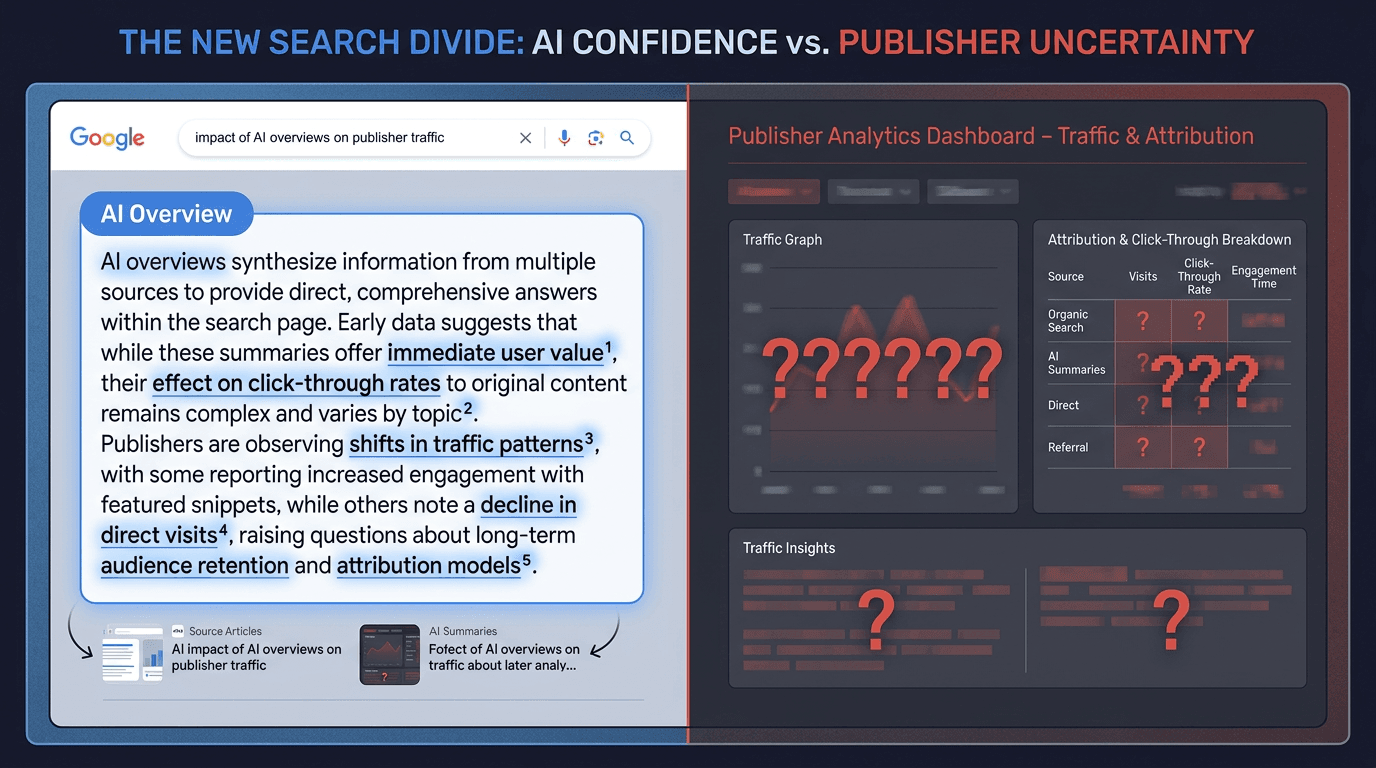
The ai mode inline links update is Google's October 2026 overhaul of source links inside AI Overviews and AI Mode. It makes citations more visible and more numerous, and Google says that will send more people to publishers. Google outlined five developments: more prominent inline links, a test of official-page links, wider availability of news carousels, improved related-article links with thumbnails, and a test of clickable creator and publisher names in video results. Google presented the changes as a way to make publisher links easier to discover and click, but it did not release traffic figures showing whether the update increases visits to websites.
Skepticism is understandable. Google has repeatedly introduced changes intended to make AI Search links more useful, while independent research continues to highlight the impact of AI Overviews on organic traffic. Ahrefs' February 2026 study found that the presence of an AI Overview correlated with a 58% lower average click-through rate for the top-ranking page. The google october 2026 ai mode update deserves attention because its mechanics are more specific than its rhetoric. News, product, video, and long-form publishers will encounter different surfaces and need different responses.
What Exactly Changed in the October AI Mode Update
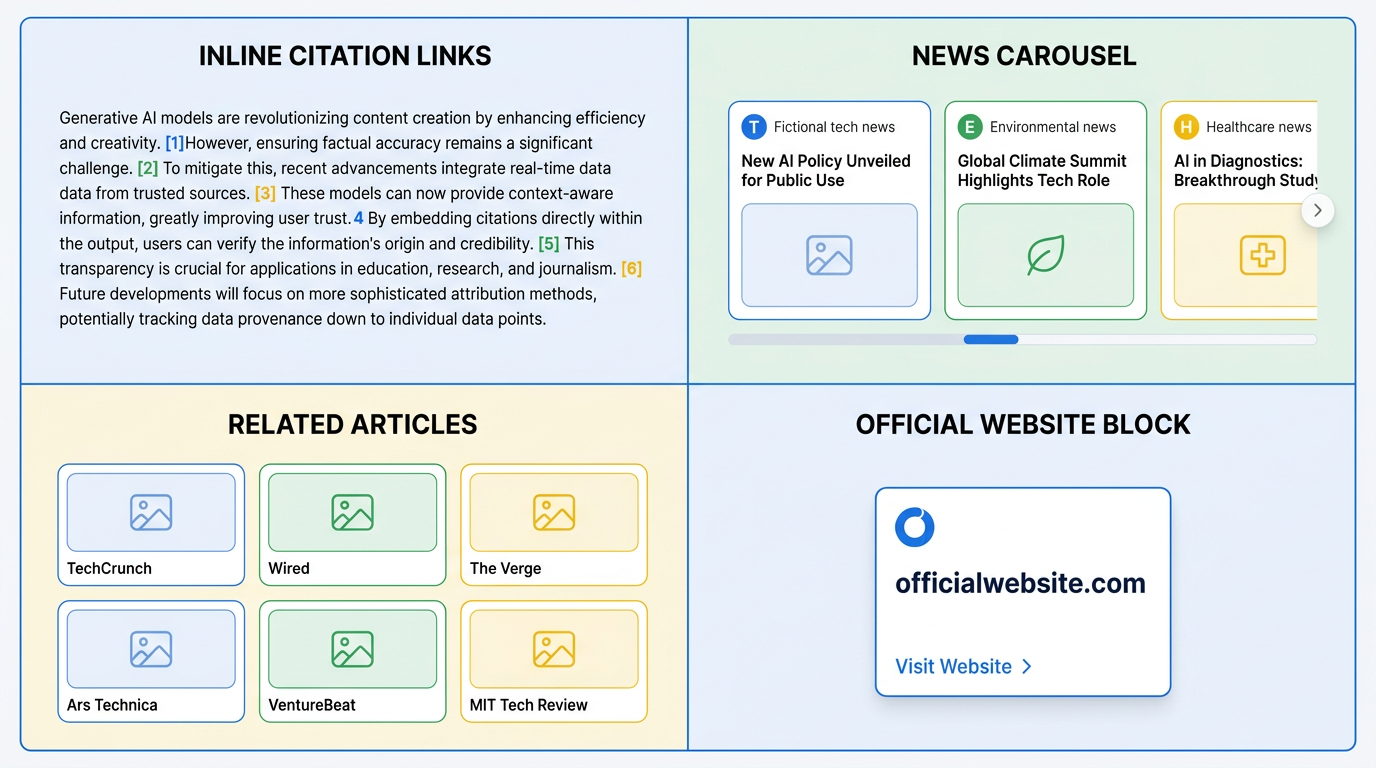
On October 15, 2026, Google said it would show inline links higher in AI Overviews and AI Mode responses, more often, to make key sources easier to click (Google, 2026). That description flattens several products into one promise. Google outlined five developments, combining interface improvements, expanded availability, and new tests. Each offers different potential benefits depending on the publisher and query type.
Inline Citation Placement: Higher, More Frequent, Still Passive
The headline change is to ai mode citation placement. Source links once clustered at the bottom of an AI Overview or showed up as small favicon chips beside paragraphs. Now they appear earlier and more often inside the response itself: a multi-paragraph answer may carry three or four mid-text citations rather than one cluster at the end. Google calls that greater ai overviews link prominence.
Publishers should care less about whether a link is easier to spot than whether anyone needs to click it after the surrounding prose has answered the question. Google has been testing clickable hyperlinks across AI search contexts for more than a year. Thus far, inline citations behave more like academic footnotes than invitations to continue reading. Moving a footnote upward changes its address, not necessarily its role.
News Carousels, Related Articles, and Official Website Blocks
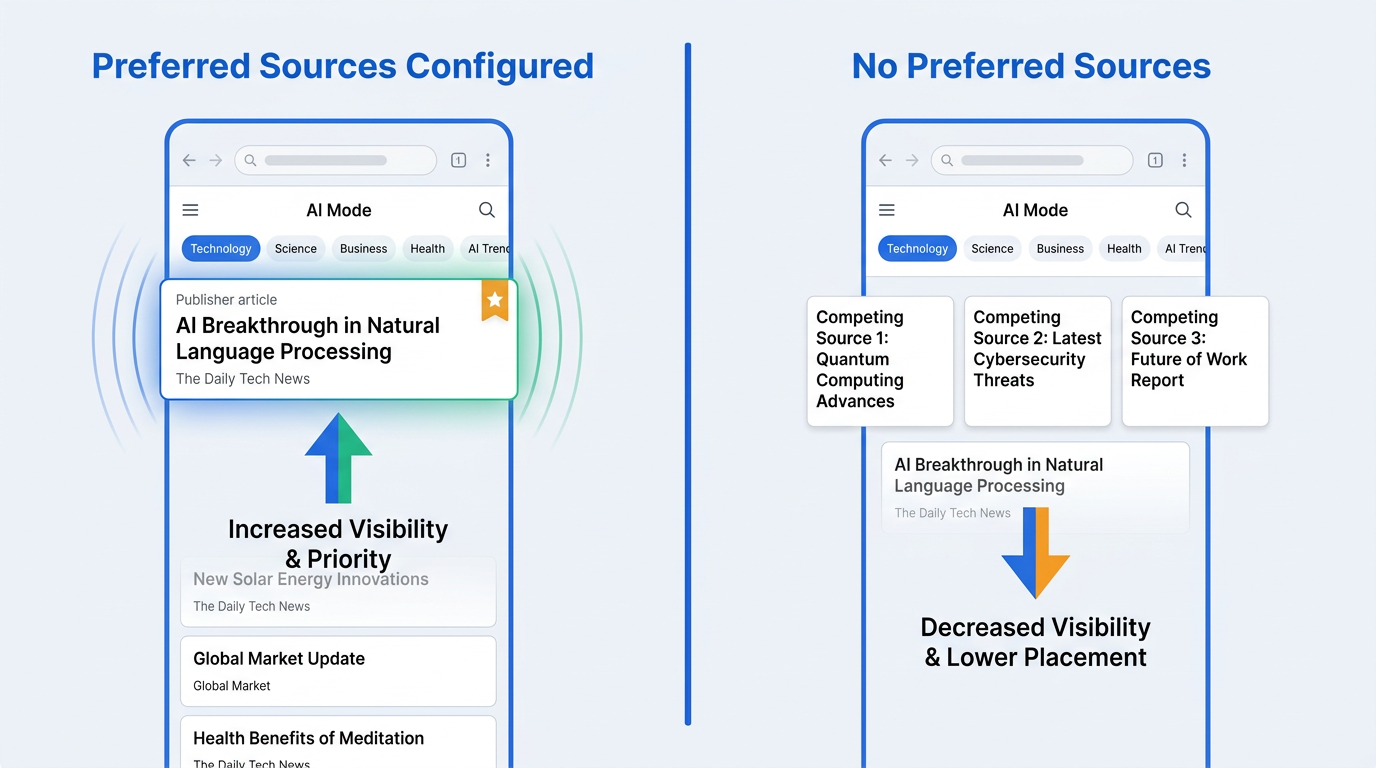
Three other link surfaces arrived with the inline changes. The ai mode news carousel serves queries with a strong recency signal, presenting recent articles in a horizontal scroll. It now incorporates the Preferred Sources carousel, so users who configured Preferred Sources see chosen publications prioritized. Google says Preferred Sources use grew 7x from the start of 2026 (BetaNews, 2026). That is enough to make it more than an experiment: news outlets that have not asked readers to choose them face a built-in disadvantage in AI results.
The google ai mode related articles module is the second surface. It pairs bigger thumbnails with article titles and publication names when a query calls for competing views or deeper reading. Compared with a text-only citation list, it gives publishers a visual chance to stand out. Strong featured images and plain, descriptive headlines matter more here.
Third are ai mode official website links: standalone blocks for branded and entity-specific queries. Ask about a company, product, or organization and AI Mode may show a prominent route to the entity's official site. That is useful for brand-owned searches, but Google still decides who counts as official. Entity recognition becomes another dependency in SEO.
Search Profiles and Video Links in AI Mode
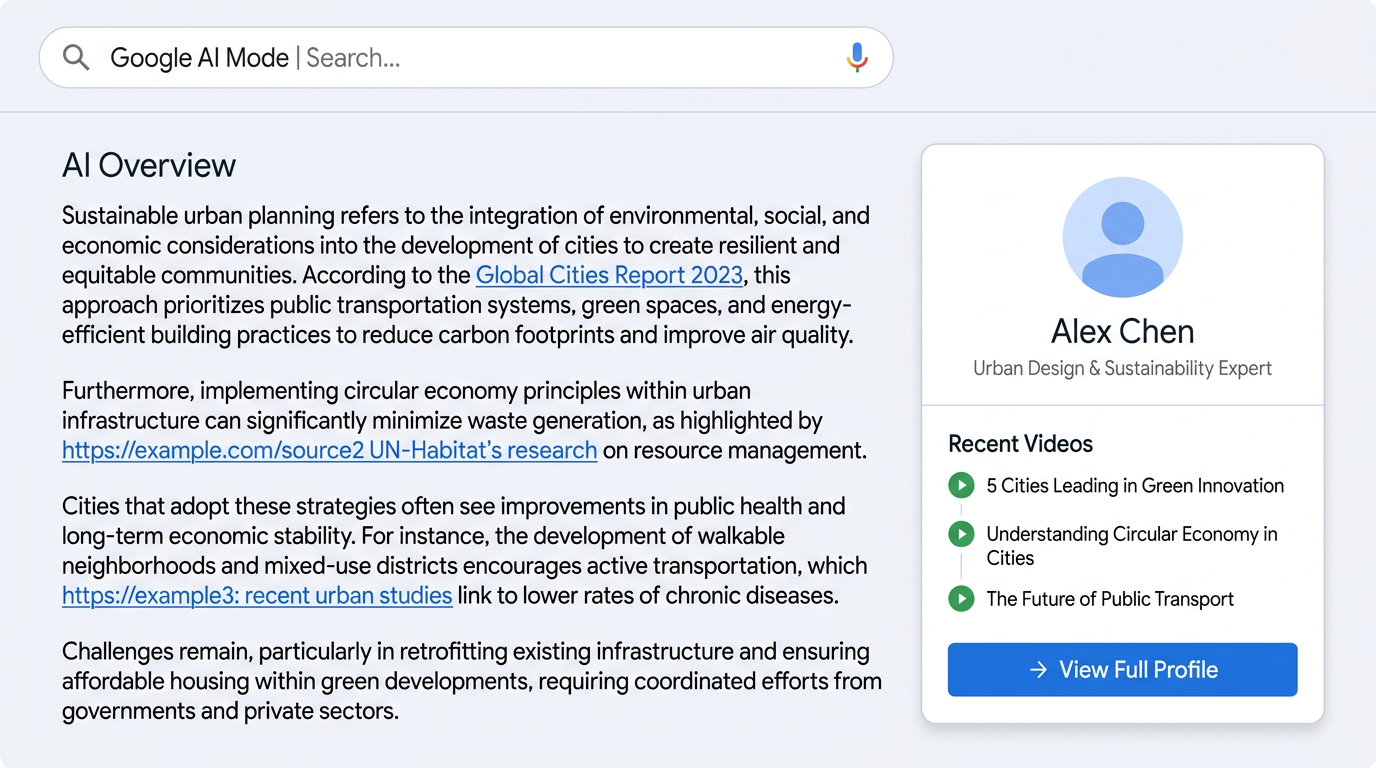
A smaller test covers search profiles video links ai mode. On creator-focused searches, Google can place a creator's Search Profile beside video results. Searches for a YouTuber, tech reviewer, or journalist may show a profile card with recent videos and a profile link. Google is testing clickable creator and publisher names that lead to Search Profiles from video results in AI Mode. Eligibility and availability depend on Google's supported profile functionality. It remains limited, but it shows Google treating individual creators as entities with their own link equity in AI results.
Why Google Still Will Not Release AI Search Click Data
The tension is straightforward. Google is holding up these changes as evidence of higher google ai mode traffic to publishers, while declining to provide the google ai search click data that could verify it. Google's dedicated generative AI reports became available globally by August 31, 2026. They provide visibility metrics such as impressions and appearing pages, but they do not separately report clicks from AI Overviews and AI Mode. Those clicks remain included in broader Search Console performance reporting.
Google already includes clicks from AI Search features in broader Search Console reporting, but its dedicated generative AI reports do not provide a separate click breakdown. Google has not publicly established why that additional breakdown is unavailable. The generous explanation is that attribution is messy across multiple sources, carousels, scrolling, and changing link positions. The harsher explanation is that disclosure would puncture the story. If AI Overviews cut organic CTR by a third to two-thirds, as studies repeatedly find, citation click data may show that more links do not yield more clicks.
The lack of ai overviews publisher referrals data leaves an unsatisfying workaround: match Google Search Console impressions against landing-page traffic and try to separate AI visits from ordinary organic search. It is directional at best, particularly given Google's reporting anomalies throughout 2026.
| Metric | Google's Provided Data | Publisher's Workaround |
|---|---|---|
| Clicks specifically attributed to AI Overview links | Not separately reported in dedicated generative AI reports; included in overall Search Console performance data | Match GSC landing-page traffic changes against keywords known to trigger AI Overviews |
| Impressions in AI Overview | Available since August 2026, blended with AI Mode impressions | Use GSC's generative AI filter; it does not split Overviews from AI Mode |
| Link position within AI Overview | Unavailable | Monitor SERPs manually or use third-party trackers that parse AI responses |
| Referral source breakdown (AI vs. organic) | Unavailable; grouped as google / organic | Compare organic landing-page sessions, referral information where available, Search Console performance trends, and AI visibility observations. These methods provide directional evidence but cannot reliably isolate every AI Overview click. |
| Preferred Sources impact on impressions | Unavailable | Compare traffic before and after configuration; causal attribution is not possible |
| As of October 2026, Google provides no click-level data specific to AI Overview or AI Mode citations. |
Is This Time Different? An Honest Assessment
Google has announced google ai overviews more links at least three times: at the broad AI Overviews launch, during the citation-chip redesign, and again in October 2026. Every announcement promised more traffic to the web. Independent analyses have not found a matching rise in publisher referrals, while the broader pattern of why clicks are falling has continued.
Two aspects are structurally new. One much larger fact has not changed.
What is structurally different this time:
- Multiple link surfaces, not just repositioned citations. Earlier revisions moved links Google already had. This one adds news carousels, related-article thumbnails, and official website blocks. More places to click mean more opportunities, even if each surface draws little engagement.
- Preferred Sources integration creates a personalization layer. Readers who explicitly select publications will see them more often, creating a feedback loop for outlets with loyal audiences. That mechanism is genuinely new.
Warning: The likely outcome remains familiar because the central dynamic remains intact: AI Overviews are built to answer a query without a click. Making the exits easier to see in a room designed to keep users inside does not alter the room's purpose. Until Google releases click data, "more links equals more traffic" cannot be tested. That is not a minor reporting gap.
The legal and competitive fight over SERP data access adds to the problem. Google's control over publisher reporting and the data third parties can scrape creates a structural information imbalance. Publishers are asked to optimize for a system whose performance measures they cannot inspect.
A Strategic Response for Publishers and Brands
Without direct measurement, publishers have to work from positioning. The job is to become both the source Google's systems select and the one users recognize when a link appears. Google's official AI search guide says the familiar fundamentals still apply: quality content and strong entity signals drive selection for AI-generated results.
Fortify Your Source Credibility
E-E-A-T signals carry particular weight when an AI system is choosing whom to cite. Give authors verifiable credentials. Make the About page a clear account of organizational expertise rather than a marketing brochure. In YMYL categories, awards, authoritative citations, and regulatory credentials can affect whether content enters AI Overviews.
Ask loyal readers to add you as a Preferred Source. Google provides a dedicated publisher guide explaining how websites can encourage readers to select them as Preferred Sources. Publishers can also implement Google's Preferred Sources button to make that process easier. Newsletter audiences and app users are valuable here: they already know the publication and are the most plausible candidates to opt in.
Structure Content for AI Ingestion and Citation
AI systems favor content they can parse. Use a clear heading hierarchy, answer the section's question early, and apply markup that identifies the content type. Article schema, VideoObject schema, and Organization schema matter for the news carousel, related-articles module, and official-website block, respectively.
The rise of zero-click queries, documented across European markets, leaves a simple requirement: give people something the summary cannot provide. Original data, proprietary analysis, interactive tools, and gated depth work when an AI Overview can state the finding but not deliver the method behind it.
For brands tracking AI answer engines, traditional search, and social discovery at once, Vizup's Watcher agent offers cross-channel monitoring that does not depend on Google's reporting. When attribution is withheld, independent measurement is the useful signal.
Common Misconceptions About the October 2026 Update
"More links means more traffic." No. Link volume and click-through rate are separate measures. Six inline citations can produce fewer visits than ten blue links if the AI response resolves the query before a reader reaches them. Google's framing treats visibility as traffic; without click data, those are impossible to disentangle.
"This update affects all publishers equally." It does not. News outlets gain the carousel; video creators gain Search Profile integration; e-commerce sites gain official-site blocks; long-form editorial benefits from related-article thumbnails. A publisher in one format may have only one relevant change to optimize.
"Preferred Sources is a minor feature." Its 7x growth this year makes that hard to sustain. For publishers with engaged audiences, it is becoming a real distribution channel. In the ai mode news carousel, personalization can now determine display order.
Key Takeaways
- Google's October 2026 update covers five developments: more prominent inline links, official-page link testing, expanded news carousels, enhanced related-article links, and clickable creator and publisher names in video results.
- Search Console includes AI Search clicks in aggregate performance reporting but does not separately identify clicks from AI Overviews or AI Mode, making it difficult to evaluate the traffic impact of individual AI Search features.
- Preferred Sources usage grew 7x in 2026 and now shapes AI Mode news carousel visibility.
- Search Profiles for video creators are in testing, adding a surface many publishers have not configured.
- Optimize for selection: E-E-A-T, structured data, and entity recognition matter more than attribution Google will not provide.
- Independent traffic monitoring is necessary when Google's own reporting leaves the central question unanswered.
Trust, but Verify Where You Can
The google october 2026 ai mode update follows a familiar pattern: more visible publisher links, no data showing whether those links drive traffic. More surfaces are welcome. The opacity is not. Until Google reports clicks for AI Overviews and AI Mode, claims of increased referrals remain assertions rather than facts.
Treat the four changes as real surfaces worth earning, but do not confuse that with evidence of traffic. Configure a Search Profile. Ask readers to opt into Preferred Sources. Use structured data for each content type. Publish work that offers more than the summary. Then use monitoring that does not require Google to grade its own system. The publishers best positioned for this shift will neither take Google's promise on faith nor ignore the product changes; they will build a way to measure what is actually happening.
Frequently Asked Questions
Will Google release click data for AI Overviews?
Google has not announced when separate click metrics for AI Overviews and AI Mode might become available. Search Console already includes clicks from AI Search features in its broader performance reporting, but dedicated generative AI reports focus on visibility metrics rather than isolated click data. Publishers should use these reports alongside broader traffic analytics while recognizing the current attribution limitations.
How can I tell whether new AI Mode inline links send traffic to my site?
Search Console cannot isolate AI Mode clicks. Identify queries that trigger AI Overviews through GSC's generative AI impressions filter, then compare those queries with landing-page trends in your analytics. Changes on pages ranking for those queries are only directional evidence, but that is the available method.
What is Preferred Sources, and how can my publication appear there?
Preferred Sources lets users favorite publications in Google Search. Chosen outlets can appear more prominently in AI Mode news carousels and search results. Publishers cannot add themselves. Users opt in through Search settings, so publishers can ask loyal readers through newsletters, on-site banners, or app notifications to select them.
Do I need a Google Search Profile for my brand to appear in AI Overviews?
No. A Search Profile is not required for AI Overviews generally. The search profiles video links ai mode test uses profiles for creator-focused queries, making one useful for video creators, journalists, and individual thought leaders. Brands and publishers appear in official website blocks through entity recognition, not Search Profiles.
Is the update good or bad for publishers overall?
It depends on format and setup. News publishers with Preferred Sources and strong imagery gain carousel and thumbnail opportunities; video creators with Search Profiles gain another placement. Yet AI Overviews still reduce click-through rates, and Google will not release click data. It is a visibility improvement within a system designed to reduce outbound clicks.
