
Google began rolling out its September 2026 spam update on September 24. It is the fourth global, all-language spam update of the year, using SpamBrain to enforce existing spam policies. Unlike the prior three updates, which finished within days, this rollout could last up to two weeks (Search Engine Journal, 2026). That timing matters more than any single ranking swing during the rollout.
For site operators, agencies, and anyone answering to a traffic dashboard, the next fourteen days require restraint. Volatility will be visible, and reacting while deployment is underway is tempting. Separate confirmed information from speculation, then use the interval to collect evidence rather than chase each daily movement.
What Makes This Spam Update Different?
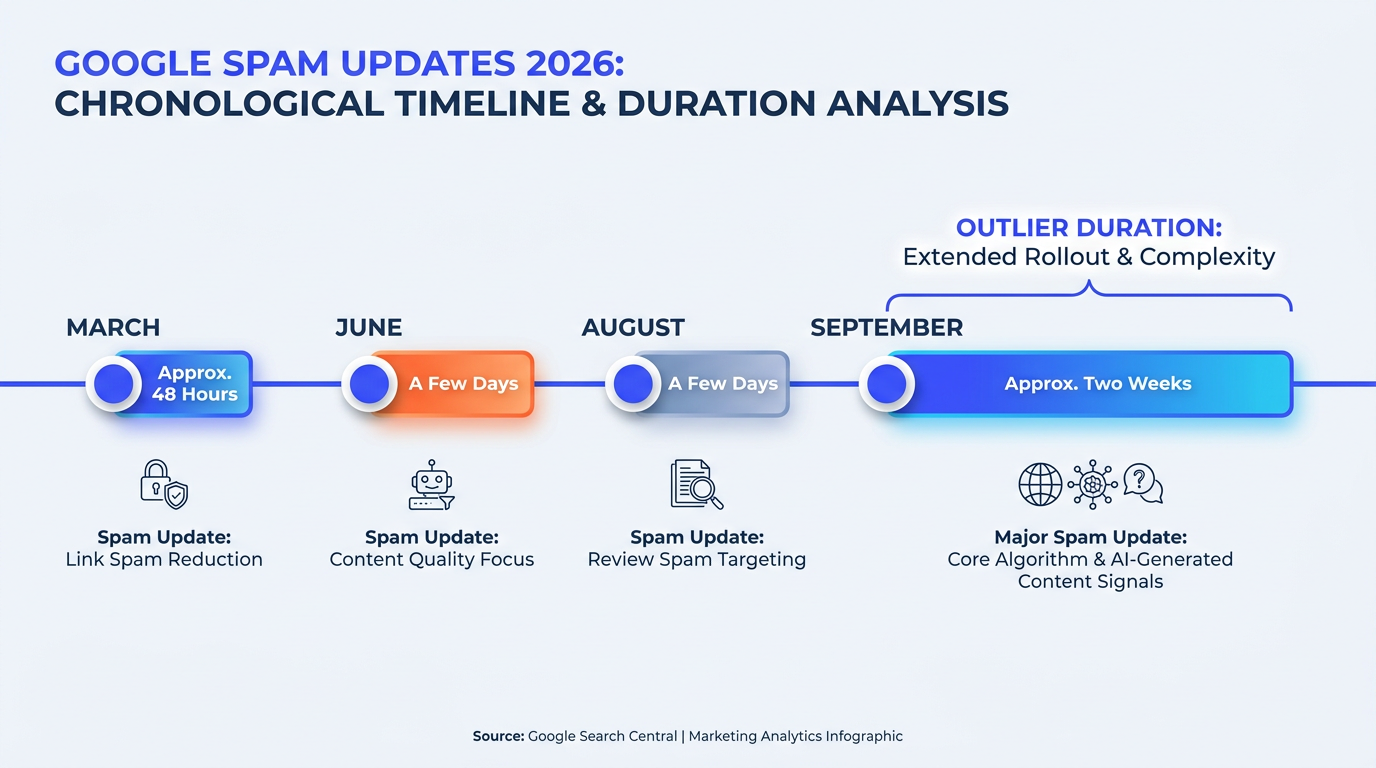
Three spam updates have already shipped in 2026. The March 2026 spam update took roughly 48 hours, while the June and August spam updates each ended after a few days. September breaks that rhythm: Google confirmed a rollout window of up to two weeks. Daily rank checks are a weak basis for decisions while deployment continues across data centers.
Google introduced no new spam policies with this update. The rules have not changed; the update applies Google's existing spam policies. For background on how Google's SpamBrain works, the practical point is simple: Google has not disclosed a special policy focus or technical retraining details for this rollout.
My Rankings Are Tanking. Is It the Spam Update?
A visibility drop during a spam update is not proof that the update caused it. Seasonal demand, other algorithm changes, crawl failures, and Google Search Console reporting bugs can produce the same chart. Rule out those alternatives before assigning a cause.
Step 1: Confirm the Rollout Status
Start with the Google Search Status Dashboard. It shows whether the rollout remains active or is complete. While it is in progress, observed positions are provisional and can move either way. Check the dashboard daily; third-party commentary is not a substitute for Google's status.
Step 2: Differentiate the Damage
Manual actions and algorithmic demotions demand different responses. In Google Search Console, open the Manual Actions report. A notice identifies a violation and gives you a reconsideration path. A clean report points to an algorithmic demotion: there is no notice, and there is no reconsideration button.
| Characteristic | Algorithmic Hit (Spam Update) | Manual Action |
|---|---|---|
| Notification | None in GSC. | A clear notice in the GSC Manual Actions report. |
| Scope | Often affects sections, templates, or topic clusters. | Specific pages or the full site, as the notice states. |
| Cause | No specific cause is disclosed; review the site's compliance with Google's spam policies. | A human reviewer confirmed a policy violation. |
| Recovery Path | Improve the issue and wait for a future re-evaluation. | Correct the violation and submit a reconsideration request. |
| The distinction determines the next decision. |
For a sudden impressions drop, diagnose a site visibility drop before treating it as an update-related loss. The guide covers common platform-side causes.
Step 3: Wait for the Dust to Settle (The Hardest Part)
Mid-rollout changes create bad evidence. A page down on day three can return by day ten without intervention. If you delete pages, replace copy, or disavow links while the system is still propagating, later movement becomes impossible to interpret. Preserve the ability to see what the update actually did.
Tip: Add September 24 as an annotation in GA4, Vizup, or your analytics platform. Once the rollout ends, that date provides a clean before-and-after reference point.
Agency leads can frame the pause as evidence gathering, not inaction: "We are gathering evidence so that any changes we make are targeted and effective, rather than guessing during an active rollout." A defined timeline is easier for stakeholders to accept than unexplained silence.
What Should I Be Auditing While I Wait?
Use the interval for a content audit against Google's spam policies. No policy changes were announced, so the checklist is familiar. The enforcement level, not the rulebook, is the moving part.
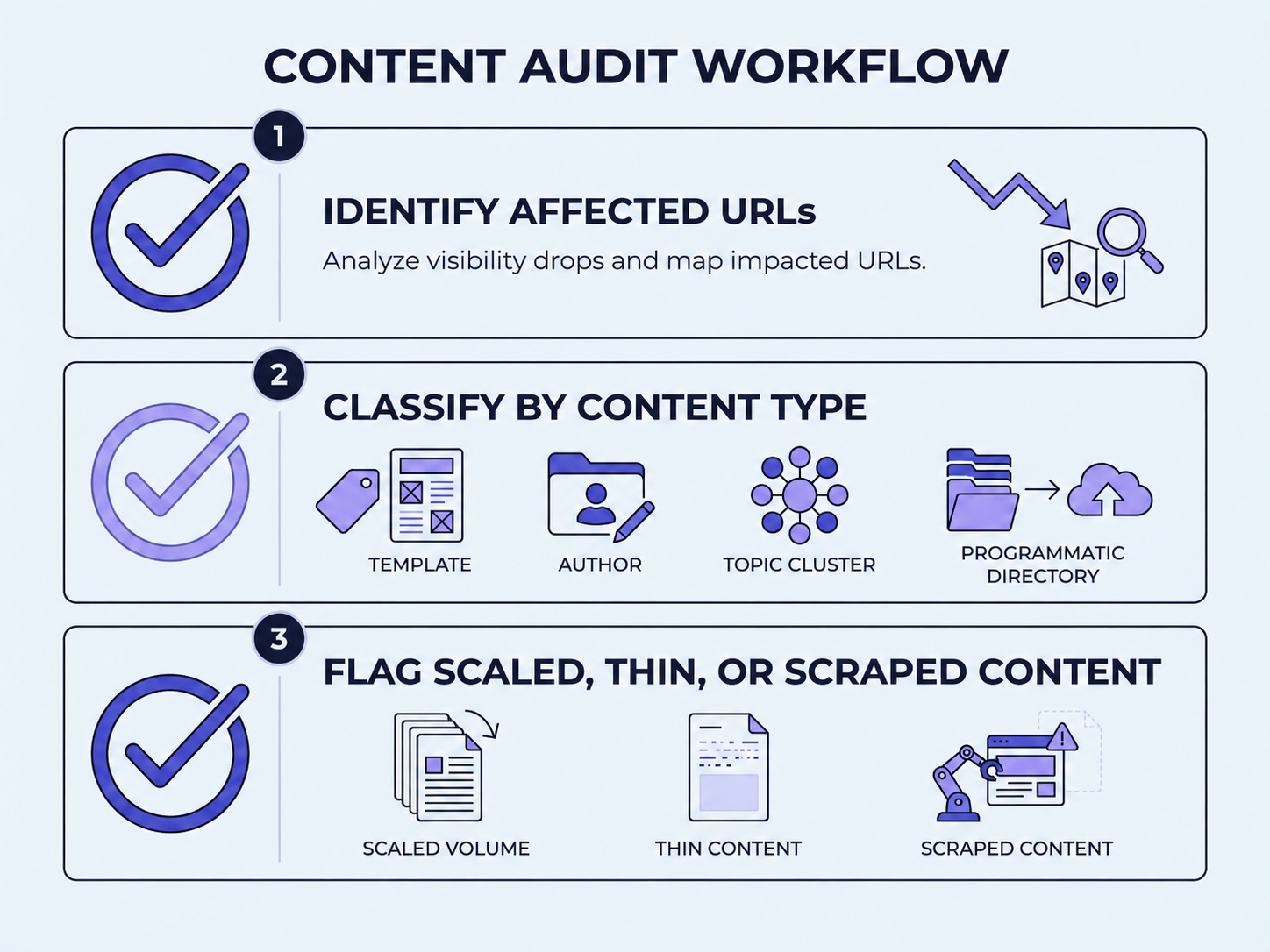
First, identify the URLs that lost visibility. Then group them by template, author, topic cluster, or programmatic directory. Inspect sections produced at volume with little editorial oversight for possible scaled content abuse. Thin affiliate pages and scraped or lightly rewritten material also deserve scrutiny. Google's spam policies documentation names each category.
What Does Spam Update Recovery Actually Look Like?
Recovery is rarely quick. Google says affected sites should review their spam policies and that automated re-evaluation can take months after meaningful improvements. Algorithmic hits have no reconsideration request. Remove or improve the offending material, then allow time for Google to recrawl affected pages and for its automated systems to re-evaluate the changes.
That is a difficult timeline for clients expecting a turnaround in days. Set the expectation early: removing low-quality pages, substantially rewriting thin content, and consolidating duplicate templates are investments that can take time to be reflected in search results.
Key Takeaways: Your Two-Week Survival Plan
- Do not panic. Volatility is expected during a two-week rollout. One day's data says very little.
- Diagnose before acting. Confirm the rollout status, then check GSC for manual actions before blaming the September 2026 spam update.
- Collect evidence, not conclusions. Audit against existing spam policies and group affected URLs by template, author, and topic cluster.
- Plan in months, not days. Meaningful content improvements need time to be recrawled and reassessed. Explain that timeline early.
- Tag your analytics. Annotate September 24 in each reporting tool so you have clean comparison data when rollout ends.
Frequently Asked Questions
How long does it take to recover from a Google spam update?
Algorithmic recovery depends on Google recrawling affected pages and its automated systems re-evaluating meaningful improvements, so measure the timeline in months rather than days. A manual action can resolve sooner if you fix the violation and receive approval on a reconsideration request.
Is the September 2026 spam update the same as a core update?
No. Spam updates target violations of Google's spam policies, including scaled content abuse, cloaking, and link spam. Core updates reassess content quality and relevance more broadly. Both can shift rankings, but their causes and remedies are different.
Will disavowing links help me recover from this spam update?
Only if link spam is the actual issue. Google has not identified scaled content abuse as the special focus of the September update. Disavowing links will not fix a content-quality problem. Review your GSC link report for anomalies, but do not make disavow your default response.
My site was not hit. Does this update affect me at all?
It might. When spammy pages lose positions, space opens in the results. Sites with strong, policy-compliant content can gain during or after the rollout. Watch for pages moving upward and consider supporting those gains.
How can I tell if my AI-generated content is considered scaled content abuse?
Google does not ban AI-generated content outright. It prohibits content made at scale, by any method, chiefly to manipulate rankings and offering little original value, editorial oversight, or reader usefulness. Repetitive pages built mainly to capture long-tail queries fit that definition. Review Google's policy language on scaled content abuse.
