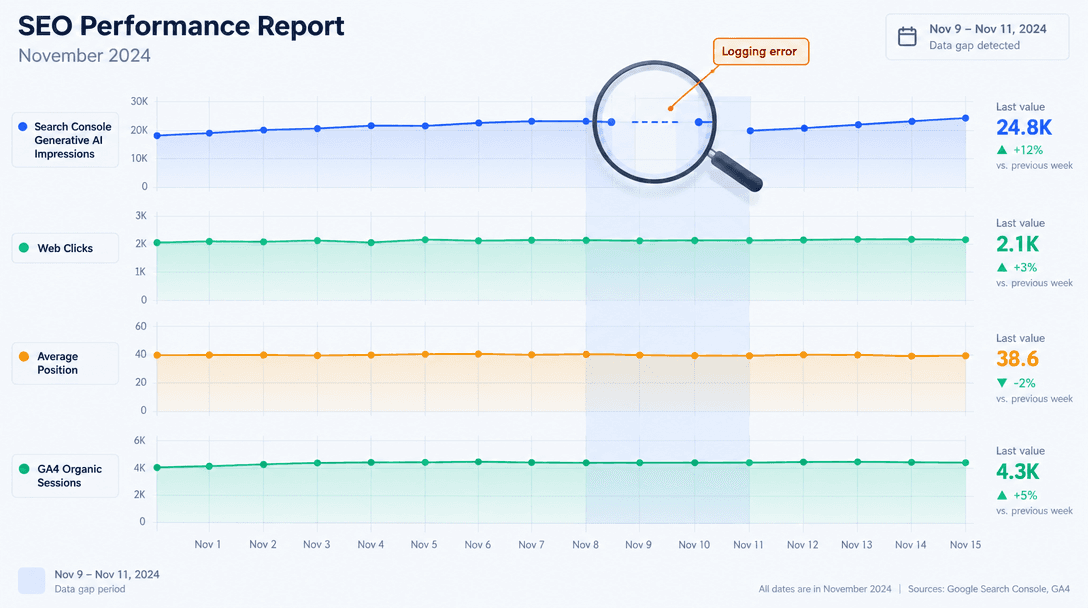
Google confirmed that a logging error caused an artificial decrease in reported Generative AI impressions from November 9 to 11, 2026. The slide already says "core update impact." But the Google November 2026 core update and that dip are largely separate stories: a logging bug accounts for the missing impressions. Calling it ranking damage sends the team looking for a fix to a problem the chart hasn't established.
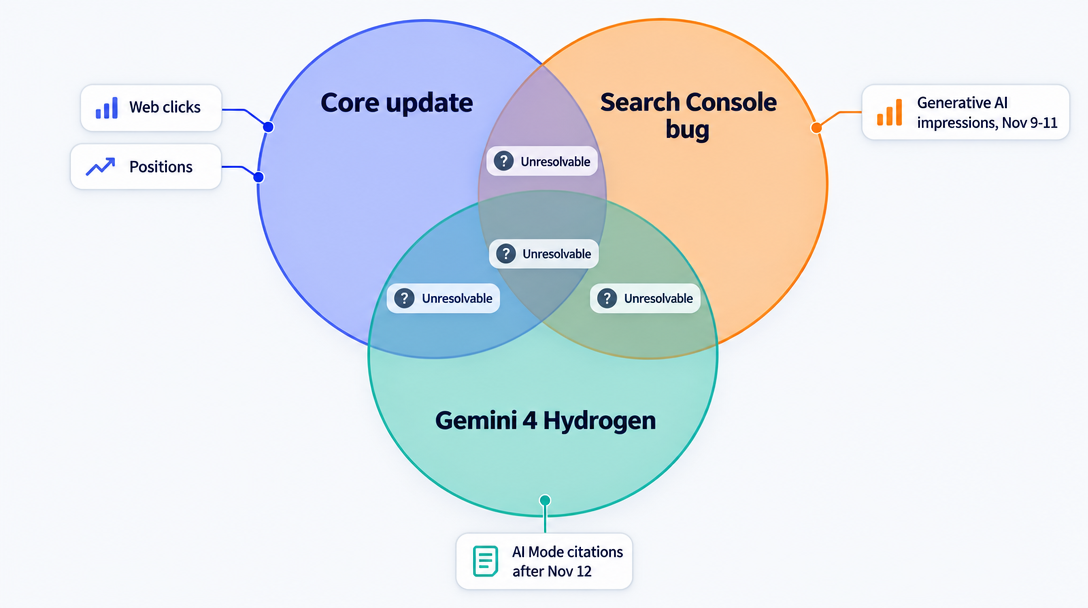
The reporting problem is attribution. SEO, agency and growth leads need to explain three overlapping changes before the rollout finishes, without turning a provisional observation into a content brief.
For brands monitoring visibility across traditional search and AI-driven discovery, the challenge is knowing which changes need action and which need further investigation. Vizup helps teams connect monitoring, analysis and organic growth execution through its Organic Autopilot, rather than making content decisions based on a single fluctuating metric.
Three changes, one 72-hour window: the November 10 timeline
Trackers and forums reported ranking movement around November 9. Google confirmed the core update on November 10, per Search Engine Roundtable's coverage. Separately, a Search Console bug suppressed Generative AI impressions for November 9 to 11, as reported by Search Engine Roundtable. Gemini 4 Hydrogen then became AI Mode's default model on November 12, also covered there.
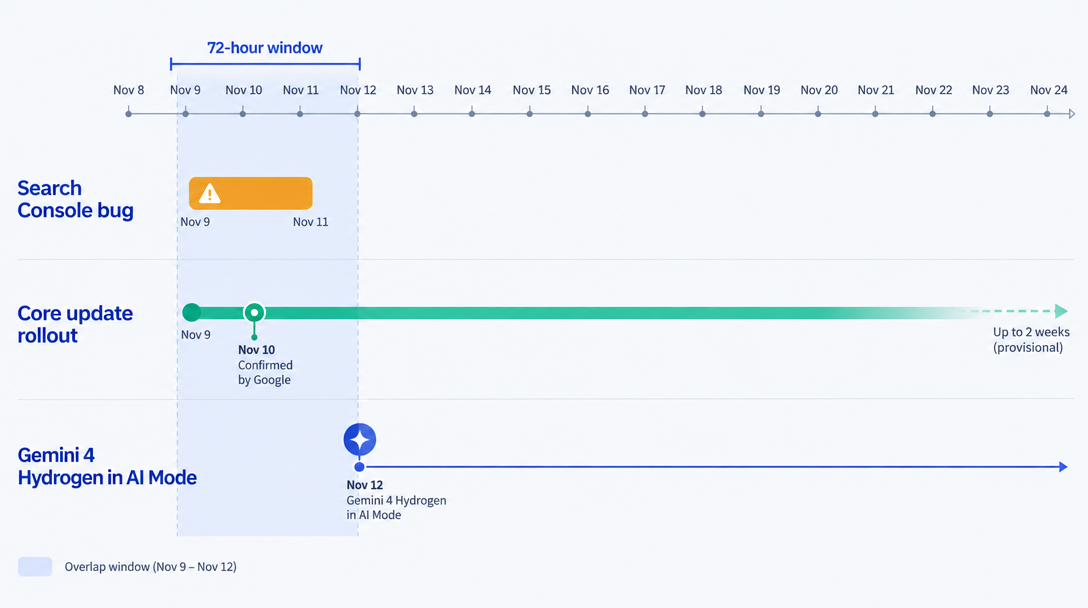
A broad core update reassesses content quality and relevance across Google's index; it isn't a penalty aimed at one tactic. Google allows up to two weeks for rollout, making conclusions before late November provisional. For the report's mechanics, see our guide to Search Console's generative AI performance reports.
Note: Already annotated those dates? Start with the comparison below.
Core update vs reporting bug: how to read the November 2026 core update data
| Row | Core update | Search Console bug | Gemini 4 Hydrogen switch |
|---|---|---|---|
| Report that shows it | Web search performance, rank trackers | Generative AI performance report | AI Mode citations, AI surface monitoring |
| Affected dates | Movement around Nov 9; confirmed Nov 10; up to two weeks | Nov 9 to 11 | From Nov 12 |
| Shape of the line | Step-change or slope by page group | Gap, then a return | Gradual citation shifts |
| Clicks and positions move too? | Yes, on affected pages | No; counter only | Not necessarily |
| Rank trackers corroborate? | Often, directionally | No | No; classic rankings are separate |
| Reliability for weekly reports | Trust clicks and sessions; qualify trackers | Quarantine | Quarantine until late November |
| Action | Annotate, segment, await completion | Exclude dates; footnote | Log without attribution |
| Match the anomaly, not the explanation you're worried about. |
Start with a ten-minute check. Compare Generative AI impressions for November 9 to 11 against web clicks, average position and GA4 organic sessions. If the AI impression drop is isolated to the affected dates, it is consistent with Google's confirmed logging error. A genuine ranking change may also affect clicks or positions, but those metrics do not always move together.
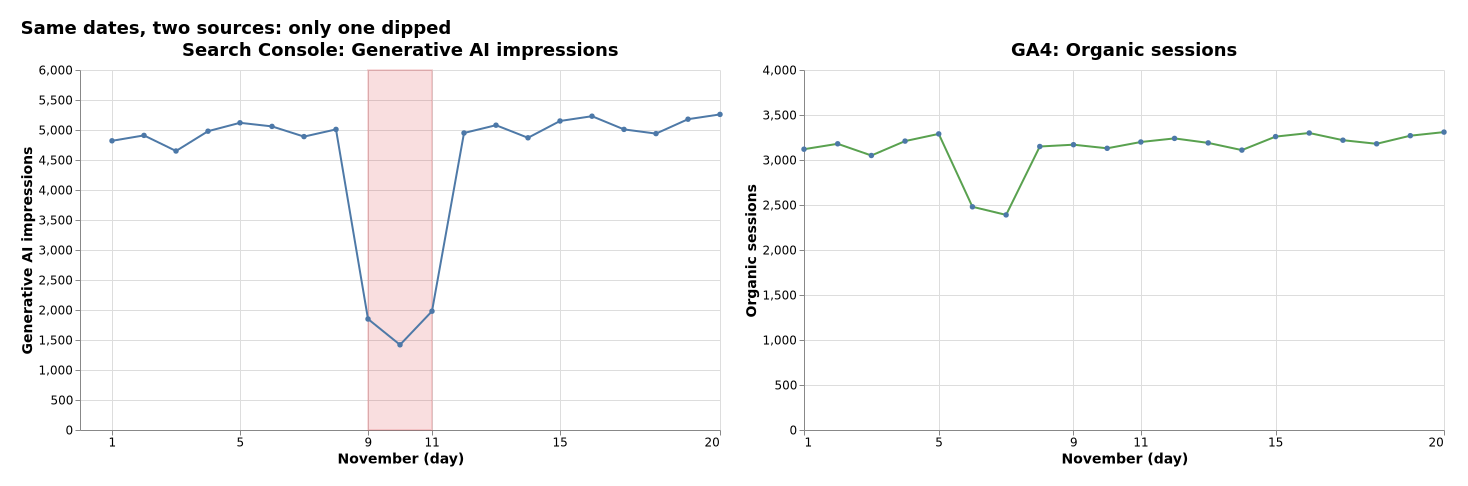
There is precedent. Our GSC data anomalies library and an earlier impressions drop caused by a GSC bug show the pattern. Check Google's Performance report documentation before assuming what a metric measures.
Which reports can you trust during the November 2026 core update rollout?
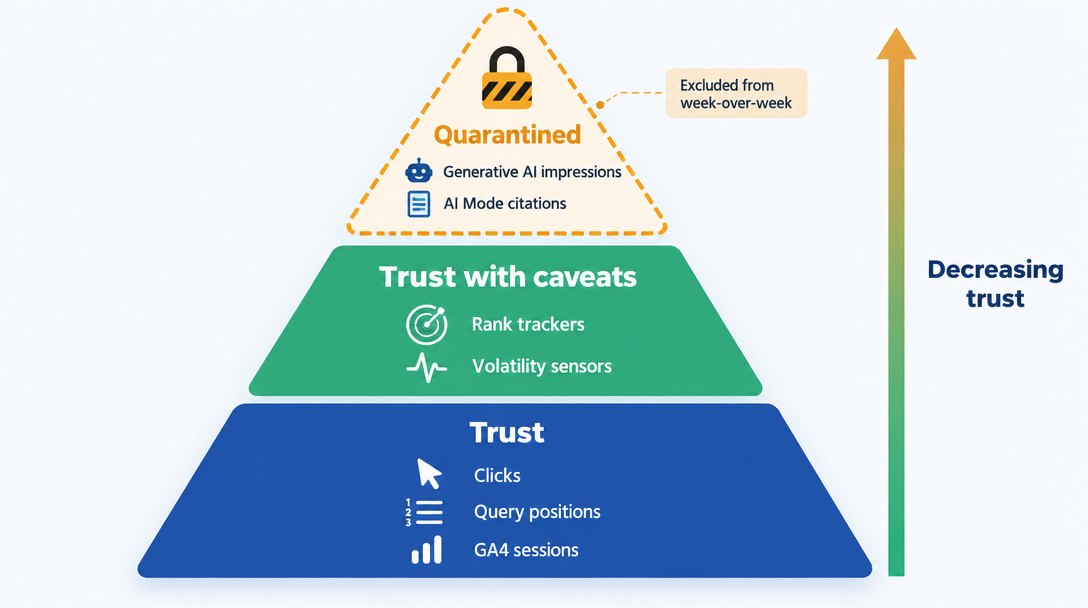
Trust: clicks, classic web search queries, and your own analytics
Build the report around web clicks, query-level positions, GA4 or server-side organic sessions, and conversions. Google identified the issue as an impression-logging error in the Generative AI report. Continue checking clicks, query-level positions, organic sessions and conversions for separate performance changes. Compare query clusters and page templates, not just sitewide totals: gains can conceal losses elsewhere on the same site.
Trust with caveats: rank trackers and volatility sensors
Third-party SERP volatility tools can indicate broader ranking movement, but they cannot establish the cause of a performance change on an individual website. Personalization, AI layouts and polluted results complicate tracker readings. Run our poisoned SERPs audit checks before presenting those deltas to leadership.
Quarantine until late November: Generative AI impressions and AI Mode citations
Exclude November 9 to 11 Generative AI impressions from week-over-week calculations; put the footnote beside the numbers. Log AI Mode citation changes from November 12 without assigning a cause. Vizup's Watcher agent monitors brand visibility across search and answer engines, helping teams identify changes in mentions and citations. As part of Vizup's Organic Autopilot, these insights can be reviewed with the Strategist and Operator agents and human experts to prioritise useful SEO, AEO and GEO actions instead of reacting to isolated reporting anomalies.
What to do mid-rollout when the pressure to act won't wait
Rewriting pages in week one is an expensive response to an unconfirmed diagnosis. Keep the work tied to what the data can establish.
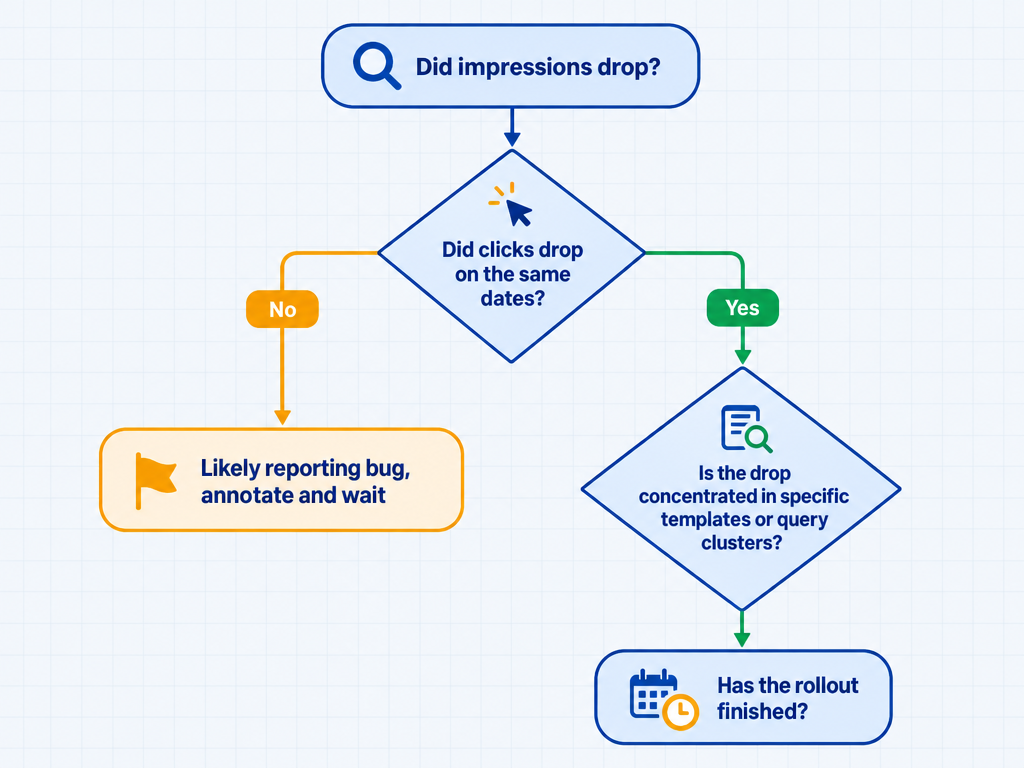
Days 1 to 5: annotate, segment, and freeze the narrative
Before the next stakeholder meeting:
- Annotate November 9 movement, November 10 confirmation, the November 9 to 11 bug and November 12 model switch on shared dashboards.
- Set page groups now so later comparisons use the same segments.
- Agree that this week's report won't declare a root cause.
Days 6 to 14: watch query clusters, not totals
Look for losses concentrated in an intent type, such as informational versus commercial, or a template. That's useful diagnostic evidence. Repair indexing errors, 5xx errors and broken canonicals now; leave rewrites, pruning and consolidation alone.
After Google marks the rollout complete: compare clean windows
Compare two full post-completion weeks with two comparable weeks before November 8. Exclude bug dates rather than smoothing them away. Then assess content quality, an intent shift or noise.
The client email I'd send this week
Send the explanation before the client opens the dashboard:
Subject: What you'll see in Search Console this week Google confirmed a core update on November 10; rollout can take two weeks. A separate Search Console bug understated Generative AI impressions for November 9 to 11. That dip reflects reporting, not lost performance. Google also changed AI Mode's model on November 12, potentially changing cited sources. We'll assess the update after rollout. Until then, we're tracking clicks, query-level positions and organic sessions by page group. Google confirmed that the November 9 to 11 issue affected Generative AI impression logging. We are separately reviewing clicks, query-level positions, organic sessions and conversions for any actual performance changes.
Don't attach a recovery date or a specific cause. Neither is established.
Gemini 4 Hydrogen is the confound nobody's attribution model handles
The model switch and core update aren't one system. Gemini 4 Hydrogen changes AI Mode's source selection and answer synthesis independently of ranking changes. For citations that moved after November 12, "we can't separate these yet" is an honest answer.
Warning: Don't backdate confirmation: November 9 volatility could reflect early rollout, testing or unrelated noise. Start the before-window on November 8 or earlier, never November 9.
Opposite movements across traditional search and AI Mode suggest that visibility is changing differently across surfaces. However, they do not prove that the model switch caused the citation changes. Matching movements are harder to attribute. Wait for the clean-window comparison.
If the drop is real, core update recovery runs on Google's clock
Set realistic expectations. Google says some improvements can affect Search results within days, while others may take several months. Additional ranking updates can also influence recovery, so avoid promising a specific recovery date. Our March 2026 core update analysis and May 2026 core update breakdown cover the earlier rollouts.
For confirmed losses:
- Improve losing page groups, not the entire site.
- Measure from post-rollout baselines.
- Expect partial movement between updates, not a tidy rebound.
FAQ: Google November 2026 core update
When will the Google November 2026 core update finish?
Google said the November 2026 core update could take up to two weeks to roll out. Check the official Google Search Status Dashboard for confirmation of completion. Google recommends waiting at least one additional week before analysing Search Console results, so use the confirmed completion date rather than a fixed late-November deadline.
Did the core update cause the Generative AI impressions drop?
Mostly no. The November 9 to 11 gap matches the logging bug, with clicks, positions and GA4 sessions flat. Verify that pattern using the table.
Will Google backfill the missing November 9 to 11 impressions?
The reviewed reporting offered no confirmed backfill commitment. Check Search Engine Roundtable and Google's documentation before promising restored data. Plan for a permanent gap and footnote it.
Should content changes wait until rollout ends?
Yes for rewrites, pruning and consolidation; no for technical breakage. Editorial changes now muddy the before-and-after comparison.
Does this update affect AI Overviews and AI Mode citations?
Possibly, but November 12's Gemini 4 Hydrogen switch independently changes AI Mode, preventing attribution for now. Log changes and revisit after rollout; see our AI search monitoring guide.
Key takeaways for your next weekly report
Keep these distinctions in the report:
- November 9 to 11's AI impression gap is a reporting bug.
- The core update was confirmed November 10.
- November 12's model switch confounds AI attribution.
- A settled diagnosis must wait until late November.
- Recovery usually arrives with a future core update.
Monday's checklist:
- Annotate all four dates on dashboards.
- Exclude November 9 to 11 from AI impression comparisons.
- Segment by template and intent.
- Hold content changes; fix technical breakage.
- Book the review for two clean weeks after completion.
Turn Search and AI Visibility Changes Into Smarter Organic Growth
A sudden impression drop does not always mean lost visibility. The important step is to identify what changed, validate the evidence and decide what needs attention. Vizup is an Organic Autopilot for modern discovery, helping brands monitor, create, optimise, publish and learn across Search, Social, Communities, AI Answer Engines and Local Discovery. With AI agents, human experts and SEO, pSEO, AEO and GEO tools, Vizup helps teams move from visibility insights to organic growth actions. Paid advertising is available as an optional amplification add-on. Explore Vizup and book a demo to see how connected monitoring and execution can support your organic growth strategy.
