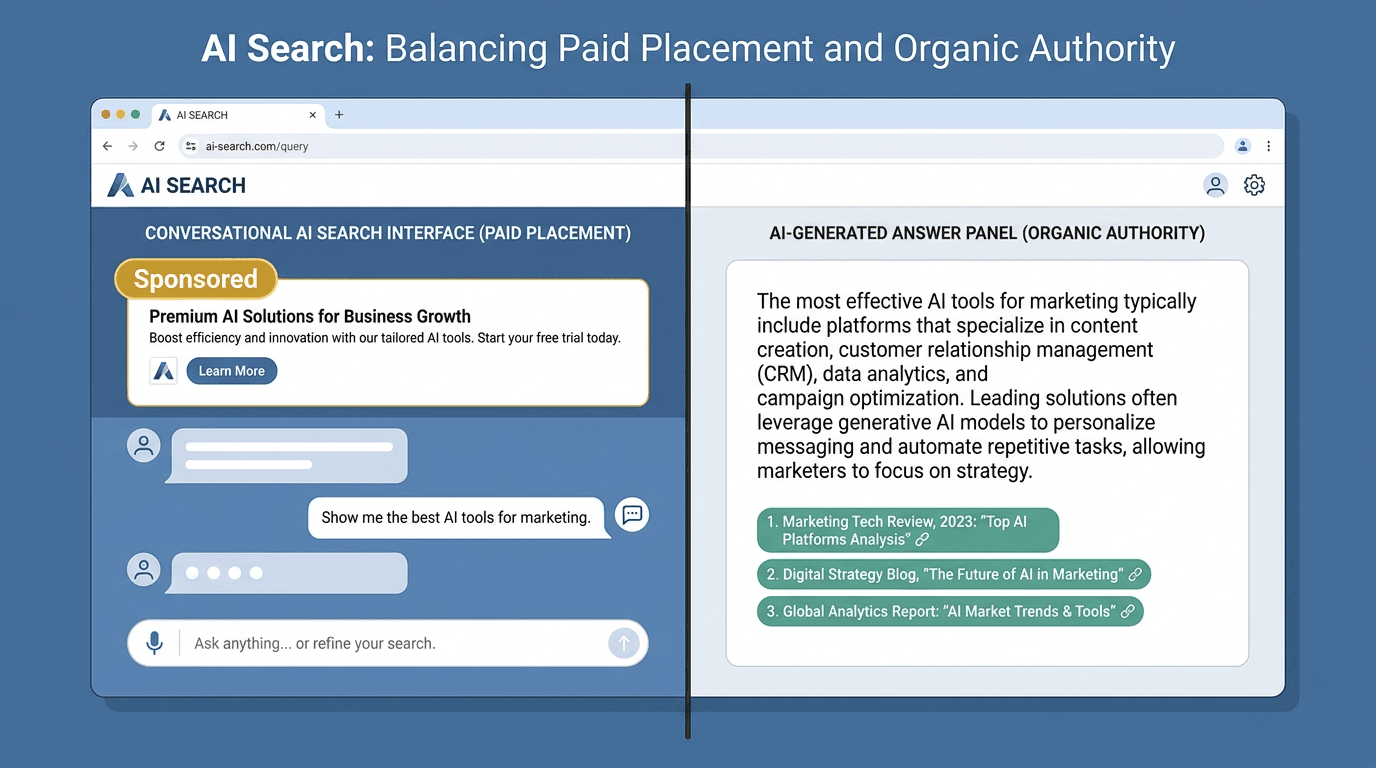
AI Mode ads are paid placements that appear inside Google's generative AI search experience. SE Ranking's July 2026 study of 50,032 ad-eligible US commercial keywords found that text ads appeared in 29.45% of the queries tested. Crucially, paid placements and organically selected citations operate through separate systems, so paying for an ad does not directly earn a citation in the AI-generated answer.
Conversational AI search was initially presented as a cleaner experience with fewer traditional blue links and less clutter. Ads are now being introduced into these interfaces, but their role is often misunderstood. AI Mode effectively creates two separate scoreboards: paid exposure and organic authority. Understanding how frequently ads appear—and what that exposure does and does not provide—is essential for allocating budget sensibly. For a closer look at Conversational Discovery, Highlighted Answers and other emerging placements, read our breakdown of Google AI Mode ad formats.
How Often Do Ads Really Appear in AI Mode?
One of the clearest public studies of Google AI Mode advertising comes from SE Ranking's analysis of 50,032 ad-eligible US commercial keywords across 20 niches. Google returned a text ad in 14,733 cases, representing 29.45% of the tested queries. When an ad appeared, two competing offers were displayed in the same block 71.1% of the time, indicating that competition already exists within this emerging inventory.
Info: Methodology note: The keywords were pre-selected as commercial terms capable of triggering text ads, rather than drawn from a random sample of all Google searches. AI Mode results can also vary between sessions, meaning the same query may show an ad at one time and no ad at another. Treat 29.45% as a large-scale snapshot of this ad-eligible commercial keyword set, not as a settled rate for every commercial query or all of Google Search.
For commercial queries in AI Mode, that baseline changes the conversation. Ads are no longer an isolated experiment; they are becoming a meaningful part of the AI-assisted search experience for high-value queries. Separately, a Semrush study found that the share of commercial queries triggering AI Overviews increased by 71% over six months. Although AI Overviews and AI Mode are different surfaces, the findings point in the same direction: Google is expanding generative search experiences while creating more opportunities to monetise them.
What Triggers an Ad? CPC Is the Strongest Signal
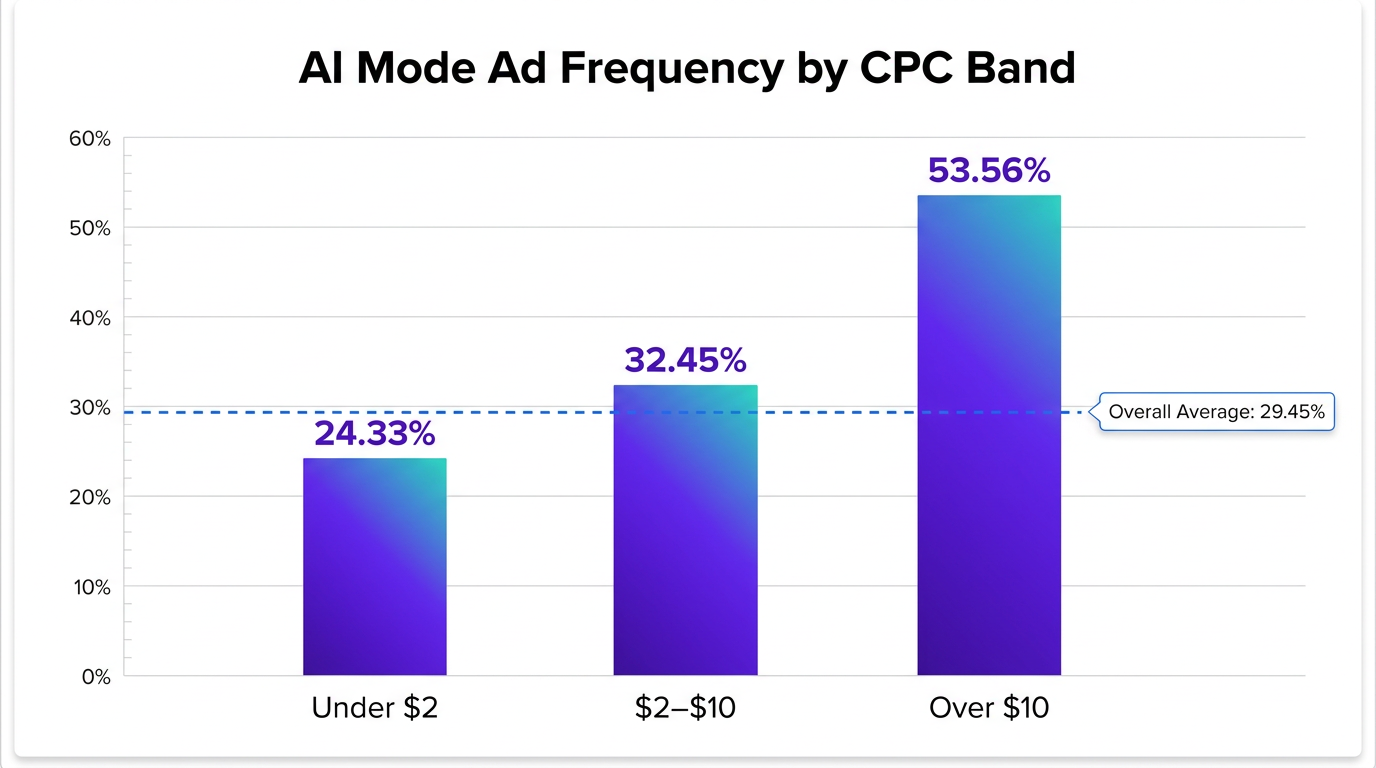
SE Ranking's dataset points to one lever above the rest for cpc ad presence ai mode: cost per click. The higher the CPC, the more likely the AI answer included an ad. Search volume and keyword difficulty didn't show anything close to the same relationship. For planning, the takeaway is blunt: if your business competes on high-value, high-CPC terms, you should assume AI Mode is part of the paid battlefield and budget accordingly.
| Keyword CPC | Ad Frequency in AI Mode | Key Implication |
|---|---|---|
| Under $2 | 24.33% | About one in four queries; ads show up, but they are not the default |
| $2 to $10 | 32.45% | Above the overall baseline; plan for ads on roughly a third of queries |
| Over $10 | 53.56% | Most queries include an ad; paid competition is heavy |
| Source: SE Ranking, 50,032 US commercial keywords, June 2026. Per-band sample sizes were not published, so treat these as correlations in the data, not proven predictive thresholds. |
Category Variation Is Extreme
The headline average hides substantial variation between categories, ranging from 72.38% in Pets to 2.64% in Healthcare within the study. This means that a finance, property, retail or healthcare team should not build its strategy around the overall average alone. The study identifies the category differences but does not establish one definitive cause for them; CPC levels, advertiser competition, query mix, policy constraints and Google's treatment of sensitive topics may all contribute. Defensible planning therefore requires continuous visibility monitoring across search and AI answers, rather than reliance on a generic benchmark.
Do Ads Affect AI Citations? The Data Says No
This is where most teams need to update their mental model of paid vs organic ai visibility. SE Ranking tested whether advertisers that showed up as AI Mode ads also appeared as cited sources in the AI-generated text. The overlap was tiny.
Citation rates for advertisers in AI Mode:
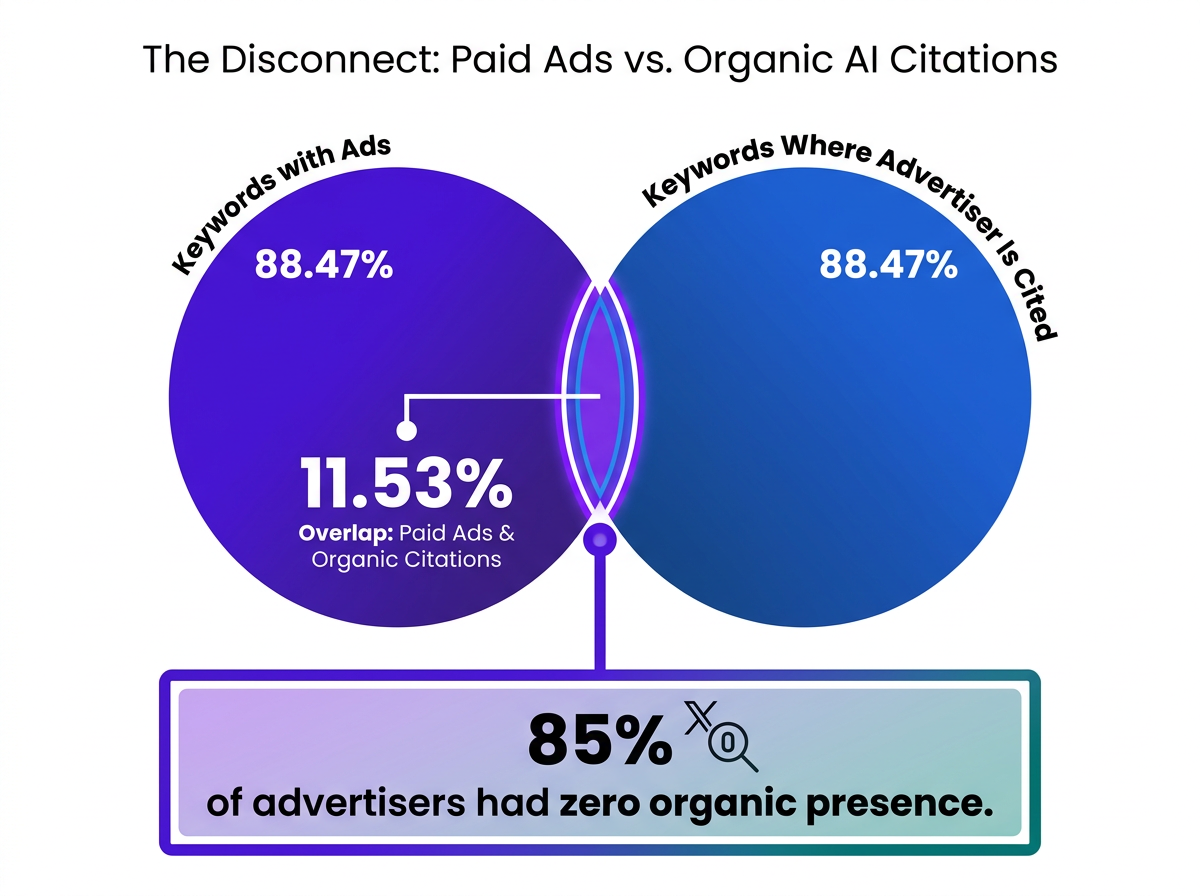
- The advertiser's domain showed up in AI Mode's cited sources for only 11.53% of ad keywords.
- At the exact-URL level, the overlap fell to 1.95%.
- For roughly 85% of keywords where an ad appeared, the advertiser's site did not show up in organic results at all.
Read those numbers plainly: buying an ad placement does not buy an organic citation. The paid placement is selected through Google's advertising systems, while citations are chosen through retrieval, relevance and synthesis processes. Google explains that advertising payments do not affect organic search rankings, and SE Ranking's findings indicate that a similar separation exists between advertisers and cited sources in AI Mode. Our complete guide to improving brand visibility in AI search explains how brands can strengthen the signals that support organic mentions and citations.
The Two-Contest Rule: Measure Paid and Organic Separately
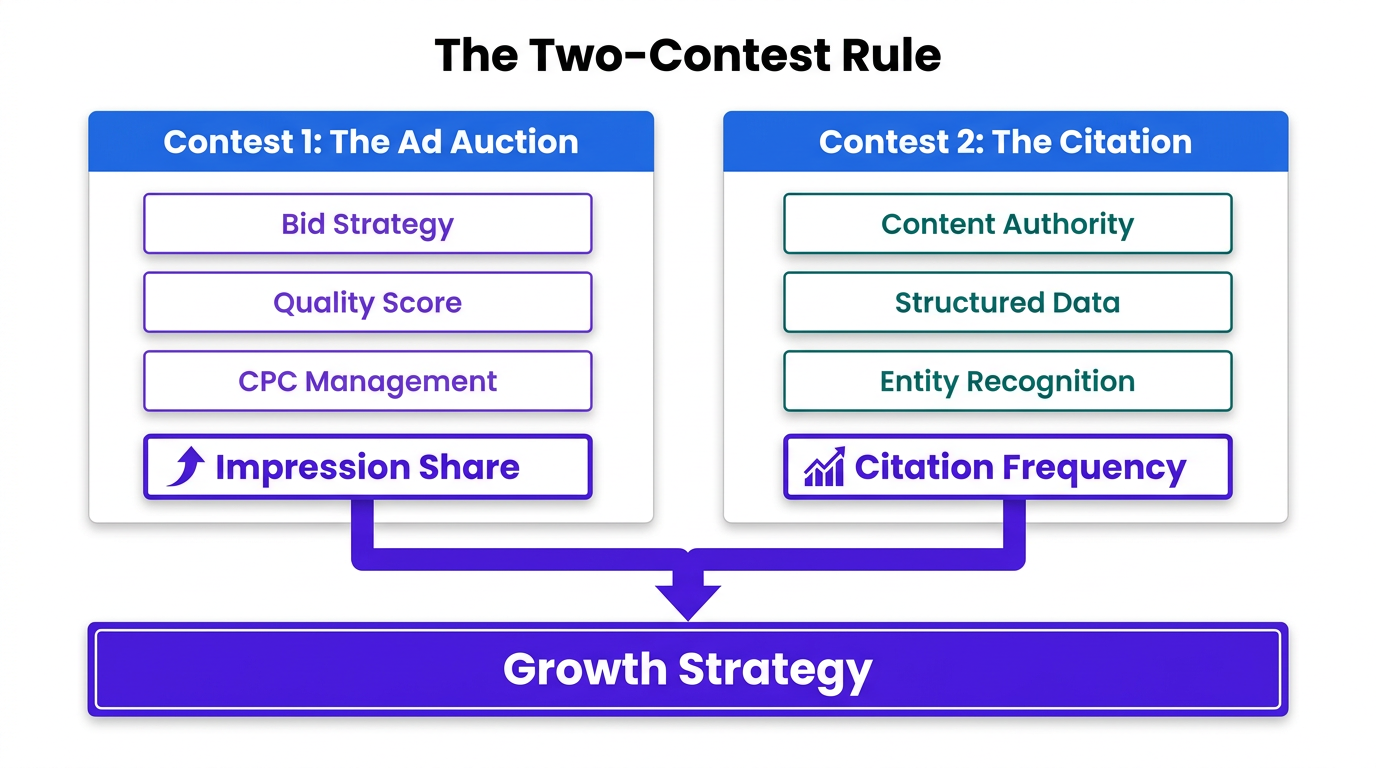
Once you accept that AI Mode is two independent contests, measurement has to follow. Rolling everything into one "AI visibility" score is how budgets get misallocated. A brand can win the auction and still be invisible in the citations, or earn the citation without ever bidding on the term. Those outcomes have different inputs, different costs, and different next steps.
Winning the ad slot comes down to bid strategy, quality score, and CPC management. The metric to watch is impression share in AI Mode, which you can track via the Google Ads search terms report in AI Mode. This is paid media work, solved with paid media controls.
Winning the citation comes down to organic authority, content depth, structured data, and entity recognition. The metric to watch is citation frequency across AI engines. That's an AEO and SEO problem, not a bidding problem. The playbook for earning citations is covered in our complete guide to improving brand visibility in AI search.
Combining paid exposure and organic citations into a single visibility score can lead teams to celebrate the wrong result. Paid teams should report advertising reach, clicks, conversion quality and available impression metrics, while organic teams should track citation frequency, brand mentions, content coverage and source inclusion. Vizup's Organic Autopilot for modern discovery connects this organic measurement with execution. Its AI agents and human experts help brands monitor, create, optimise, publish and learn across Search, Social, Communities, AI Answer Engines and Local Discovery, supported by live SEO, programmatic SEO, AEO and GEO tools. Its AI Mode citation monitoring keeps organic performance separate from paid reporting, while paid ads remain available as an optional amplification add-on.
Key Takeaways for Your Next Strategy Meeting
- Ads show up in AI Mode on nearly 30% of commercial queries, and on more than 50% of queries where CPC is over $10.
- Buying an ad does NOT increase your odds of being cited in the AI answer. The auction and the citation pipeline are separate systems with separate winners.
- For about 85% of keywords that triggered an ad, the advertiser had no organic visibility. Paid is an amplification layer, not a replacement for authority.
- Category spread is huge (72% in Pets, 3% in Healthcare), so you need vertical-specific monitoring.
- Keep paid performance (ad impressions, impression share) and organic performance (citation frequency) on separate dashboards so budget decisions stay defensible.
Frequently Asked Questions
How did SE Ranking measure AI Mode ad frequency?
SE Ranking ran 50,032 US commercial keywords and logged whether a text ad appeared inside the AI Mode response. The 29.45% figure is a large snapshot, not a permanent "rate," because AI Mode can change session to session and the same query may show an ad one time and not the next. The keyword set was also pre-selected as ad-capable, so treat the number as a floor for commercial terms, not an average across all of Search.
Does bidding on a keyword guarantee my ad will show in AI Mode?
No. Even in the highest-CPC band (over $10), ads appeared on 53.56% of queries, not 100%. AI Mode ad serving still depends on auction dynamics, query context, and session-level volatility. Bidding gets you into the auction; it does not guarantee consistent placement.
If my ad shows, will I also be cited as a source in the AI answer?
Almost always, no. SE Ranking found the advertiser's domain cited on only 11.53% of ad keywords, and the exact URL matched just 1.95% of the time. The ad auction and the AI citation pipeline are separate systems. Citations come from organic authority, content quality, and structured data, not ad spend.
Why does ad frequency vary so much between categories like Pets and Healthcare?
SE Ranking reported 72.38% ad frequency in Pets versus 2.64% in Healthcare. Lead-generation and e-commerce verticals tend to cluster around higher CPCs and heavier advertiser competition, which correlates with more ads. YMYL verticals like Healthcare face stricter content policies and often have lower advertiser density on AI surfaces, which keeps ad frequency low.
Should my paid and organic teams work together on AI Mode visibility?
Coordinate, yes. Measure and report separately, also yes. Paid teams own impression share and bid strategy. Organic teams own citation frequency and content authority. Mashing those into a single "AI visibility" KPI hides which lever is actually moving results. Share keyword intelligence; keep the scoreboards separate.
