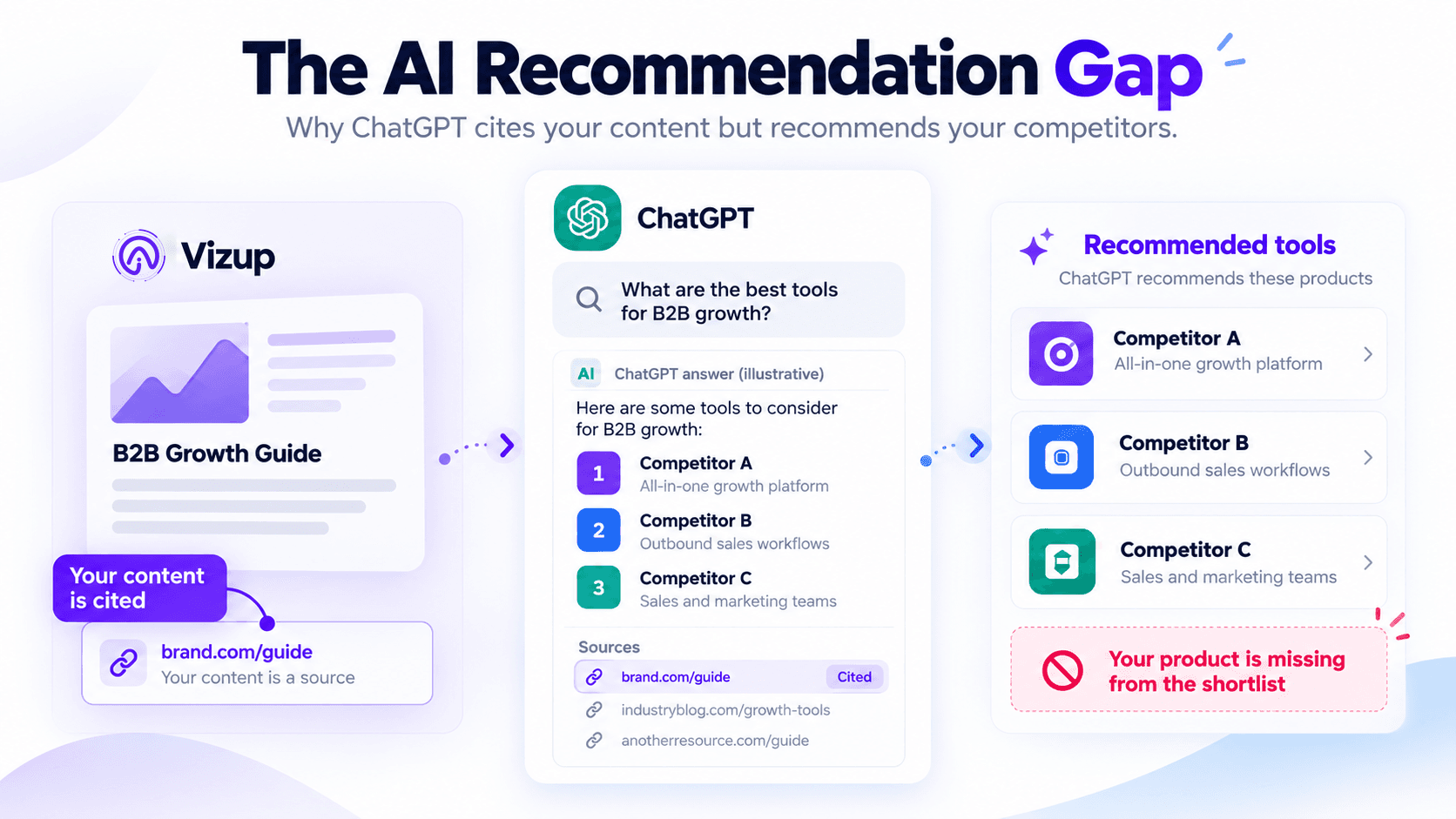
Consider a 60-person scheduling SaaS with ranking guides on no-shows and lead routing. Its Head of Sales asks ChatGPT for scheduling tools for a mid-size agency. Three competitors make the shortlist. Her company's round-robin routing guide gets cited; its product gets nothing.
Your content can help ChatGPT answer a question without giving it enough reason to recommend your product. A scheduling guide might explain round-robin routing perfectly but say little about whether the company's software fits a 40-person agency, integrates with its CRM, or meets its buying requirements. ChatGPT may cite that guide for its explanation while recommending products with clearer evidence of fit. That's the AI Recommendation Gap: being useful enough to cite but not compelling enough to appear on a relevant product shortlist.
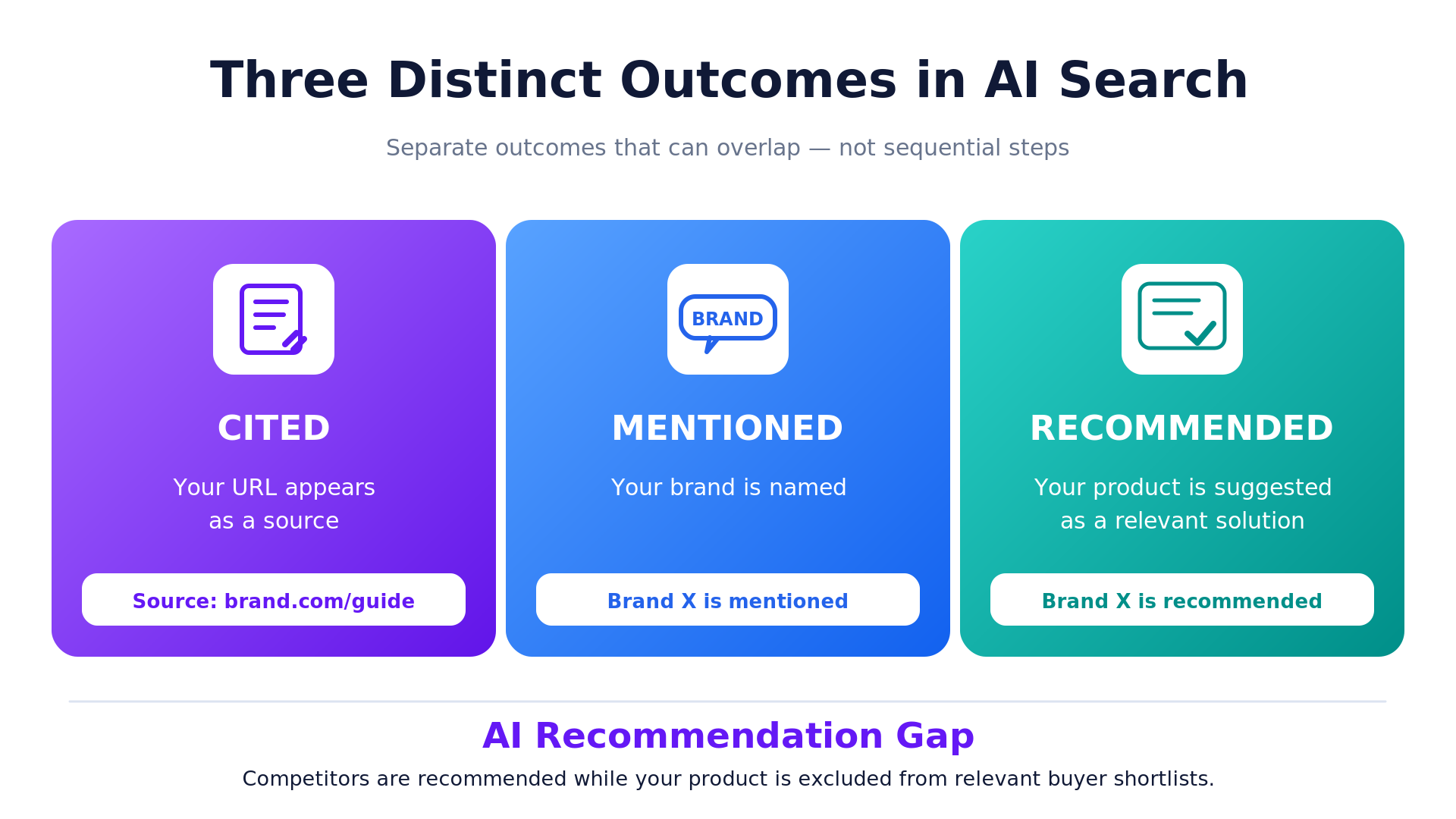
Cited, Mentioned, Recommended: Three Different Outcomes in AI Search
A citation puts your URL in the sources. A mention names your brand, even negatively. A recommendation presents it as a fit for the buyer: a shortlist entry or 'best for agencies.' Report these separately.
Semrush's Ghost Citations study analyzed 3,981 domain appearances across four AI search experiences and found that 61.7% were citations without brand mentions. The study highlights an important distinction: AI systems can reference a website as a source without naming the company behind it. However, the research measured citations and brand mentions, not product recommendations. For SaaS companies, that makes recommendation visibility a separate question worth investigating.
Being useful evidence doesn't make your product a buying recommendation.
Google's documentation on AI features specifies no extra technical requirements beyond SEO best practices; Search Console combines AI traffic with overall performance. Neither rankings nor that reporting establishes recommendation visibility. Our separate analysis covers AI search citations in Google AI Mode.
The AI Recommendation Gap: A Diagnostic Framework for AI Search Brand Visibility
The AI Recommendation Gap measures how often AI-generated answers recommend competing products but leave yours out of relevant buyer shortlists. It is calculated from a defined sample of buyer-intent responses that recommend at least one product. For SaaS teams, it helps identify where their brand is visible as an information source but missing from product consideration. This is a proposed diagnostic metric, not an independently validated industry standard, an AI ranking factor, or a measure of lost revenue.
Use one consistent sample:
- Citation rate: responses citing your domain ÷ all tested responses.
- Mention rate: responses naming your brand ÷ all tested responses.
- Recommendation rate: responses recommending you ÷ eligible responses.
- AI recommendation share of voice**:** responses recommending your product ÷ total tracked-brand recommendation appearances across eligible responses. Count each tracked brand once per response and disclose which competitors are included.
- AI Recommendation Gap: (eligible responses recommending competitors but not you ÷ all eligible responses) × 100.
- Citation-to-Recommendation Gap: (responses citing your domain without recommending you ÷ all responses citing your domain) × 100.
For the AI Recommendation Gap calculation, eligible responses are buyer-intent answers that recommend at least one product. Count each response recommending competitors but excluding your product once, even when several competitors appear. Exclude responses that recommend no products from this calculation and report them separately. Calculate results by AI engine and buyer intent rather than relying on one combined figure. Vizup's guide to AI search brand visibility provides broader context for interpreting visibility across AI-powered discovery.
Why Would ChatGPT Cite You but Recommend a Competitor?
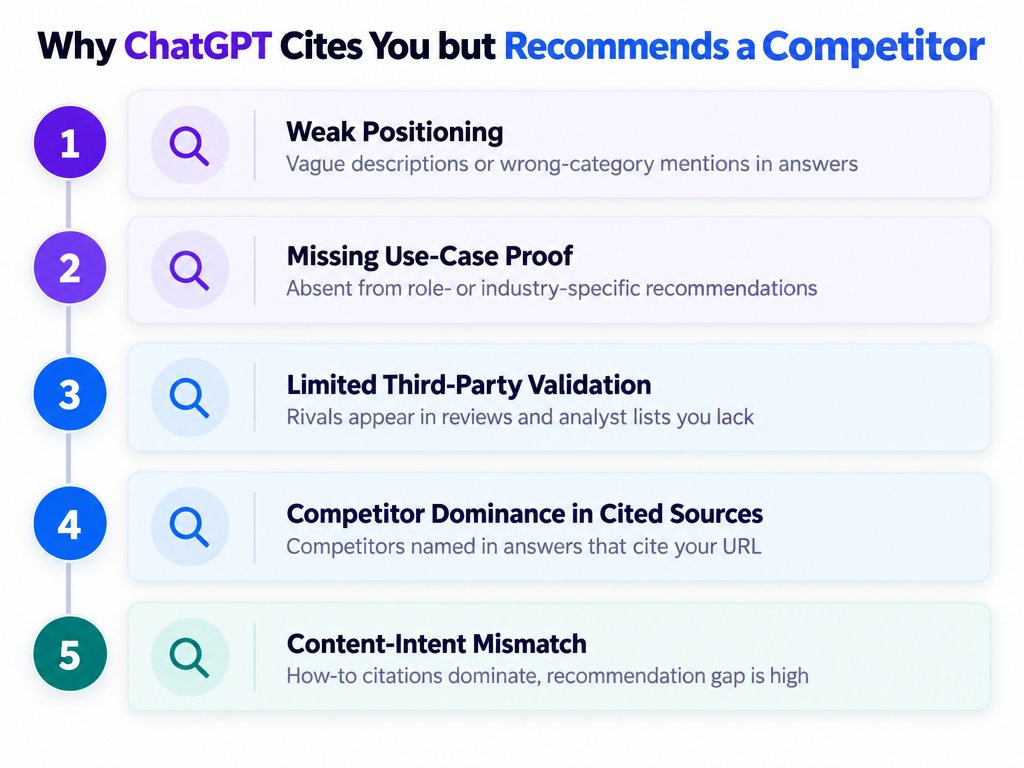
Test five hypotheses, not presumed ranking factors. Knowing how AI search engines retrieve and cite content helps interpret the evidence.
- Weak positioning: vague descriptions or wrong-category mentions.
- Missing use-case proof: your brand appears in broad searches but disappears from relevant role- or industry-specific recommendations; thin industry pages, integration details, or named outcomes.
- Limited third-party validation: rivals appear in reviews, analyst lists, and coverage you lack.
- Competitor dominance in cited sources: competitors repeatedly appear in relevant third-party sources and recommendations. Map targets with a competitor analysis prompt.
- Content-intent mismatch: how-to citations dominate; citation rate and Citation-to-Recommendation Gap are high.
The content-intent problem deserves scrutiny. Answer engine optimization that neglects commercial pages supplies explanations without establishing product fit. Don't expect the model to articulate a fit your own guide never states.
How to Run an AI Search Visibility Audit Across ChatGPT, Gemini, and Perplexity
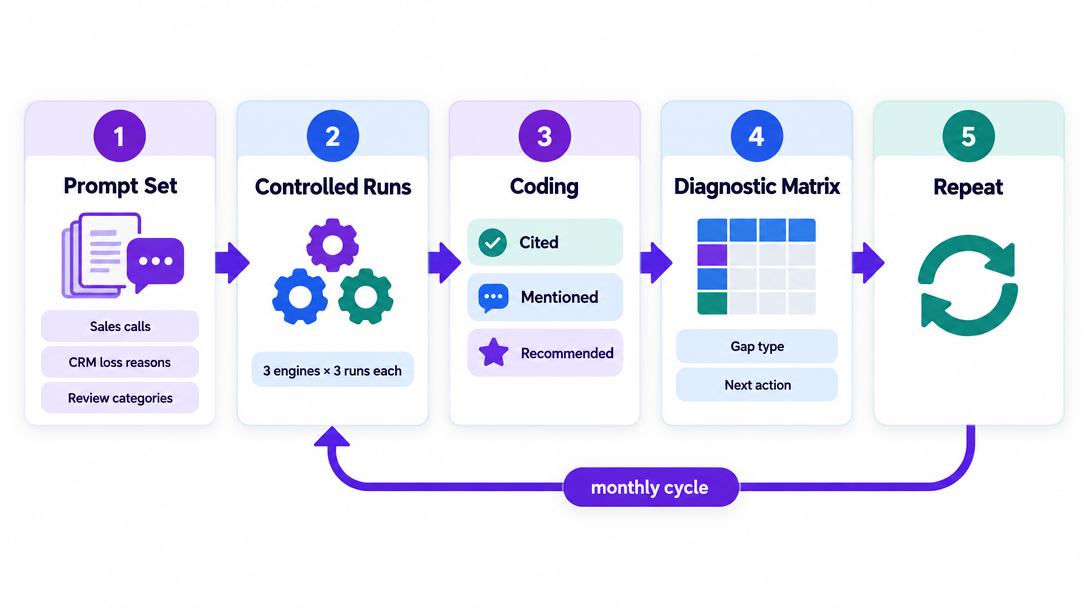
A practical starting point is 25 prompts covering both informational and buyer intent, tested across three AI engines with three runs per prompt. That produces 225 responses to review for citations, brand mentions, recommendations, and competitor appearances. Calculate the AI Recommendation Gap using only buyer-intent responses that recommend at least one product. Keep informational prompts in the audit to understand where your content earns citations without generating product consideration. The time required depends on the testing tools, response complexity, and whether responses are classified manually or with assistance. If your team already monitors AI visibility, check whether its measurement rules distinguish mentions from genuine product recommendations.
Step 1: Build a 20 to 30 Prompt Set From Real Buying Conversations
Pull language from sales calls, CRM loss reasons, review categories, Search Console, and interviews. Keep most prompts unbranded: inserting your name inflates mentions without testing discovery.
- Discovery: 'best X for Y'
- Problem: 'what tool fixes Z'
- Comparison: 'A vs B'
- Alternatives: 'alternatives to [competitor]'
- Use case: 'for a 40-person agency'
- Validation: 'is [brand] good for...'
Step 2: Control the Testing Conditions
Use fresh or temporary sessions where available, disable personalization when the platform permits, and keep language, location, and prompt wording consistent. Record the AI engine, model or mode, retrieval settings, region, date, and any testing conditions you cannot control. Run comparable tests within a defined window to reduce variation, but don't assume identical prompts will produce identical answers. Where possible, distinguish answers using live web retrieval from responses primarily based on existing model knowledge, because content updates may affect them differently.
Step 3: Log Every Response in a Diagnostic Matrix
Log prompt, intent, engine, run, cited sources, domain citation, mention, recommendation and position, competitors, likely gap, and action. Save dated verbatim responses for auditability.
Agree on what counts as a recommendation before reviewing the results. A named product that appears without a clear endorsement counts as a mention, not necessarily a recommendation. An unnamed alternative does not count as a brand mention. Changing that rule rewrites your baseline.
Step 4: Repeat Runs to Reduce Sampling Bias
AI answers vary across runs and engines. Repeat each prompt three times per engine, randomize the testing order, keep prompt wording consistent, and have a second reviewer independently classify 10% to 20% of responses. Report the variation across runs, not just one average. Treat the results as a directional diagnostic based on your selected prompts, not a representative measure of every AI recommendation in your market. When comparing external studies, check how they define citations, mentions, and recommendations.
[Not sure where AI recommendations are excluding your brand?
Worked Example: What the Matrix Revealed for a Fictional Scheduling SaaS
Slotwise, CalPilot, MeetGrid, and every figure below are fictional; this demonstrates arithmetic, not test results.
| Buyer Prompt & Intent | AI Engine | Own Domain Cited? | Brand Mentioned? | Product Recommendations | Likely Visibility Gap & Recommended Action |
|---|---|---|---|---|---|
| 'How do I reduce meeting no-shows?' (informational) | ChatGPT | Yes | No | Neither | Ghost citation. Add a product path. |
| 'Best scheduling software for a 40-person agency' (category) | ChatGPT | No | No | Competitors | Recommendation gap. Publish agency-specific proof. |
| 'Alternatives to CalPilot for round-robin routing' (alternatives) | Perplexity | Yes | Yes | Competitors | Slotwise is named but not recommended. Clarify routing positioning. |
| 'Scheduling tool for HubSpot SDR teams' (use case) | Gemini | No | Yes | Own brand + CalPilot | Winning. Maintain integration documentation. |
| 'CalPilot vs MeetGrid for clinics' (comparison) | Perplexity | No | No | Competitors | Poor fit. Drop unless clinics fit. |
| Illustrative only. Include source URLs, model versions, dates, runs, and positions in the downloadable scorecard. |
Across 225 fictional AI responses, Slotwise received 61 citations (27.1%) and 54 brand mentions (24%). Of the 150 buyer-intent responses, 132 recommended at least one product. Competitors appeared without Slotwise in 89 of those 132 responses, producing a 67.4% AI Recommendation Gap. Slotwise was recommended in 31 eligible responses (23.5%) and accounted for 14.5% of 214 tracked-brand recommendation appearances. Meanwhile, 48 of the 61 responses citing Slotwise did not recommend its product, resulting in a 78.7% Citation-to-Recommendation Gap. These fictional figures demonstrate the calculations, not actual market performance.
The fictional results suggest several areas worth investigating. Slotwise earns informational citations but frequently misses agency-related recommendations, so the team should first check whether its product pages clearly explain agency use cases, routing capabilities, and integrations. If credible customer evidence is available, it could strengthen an agency-specific page and relevant comparisons. The team should also review third-party category coverage and add useful links from cited guides to relevant product pages. Clinic-related prompts should be deprioritized unless that market genuinely fits the product. None of these changes guarantees AI recommendations, but each addresses a plausible weakness that can be tested in subsequent audits.
Prioritize by Pipeline Potential, Not Prompt Count
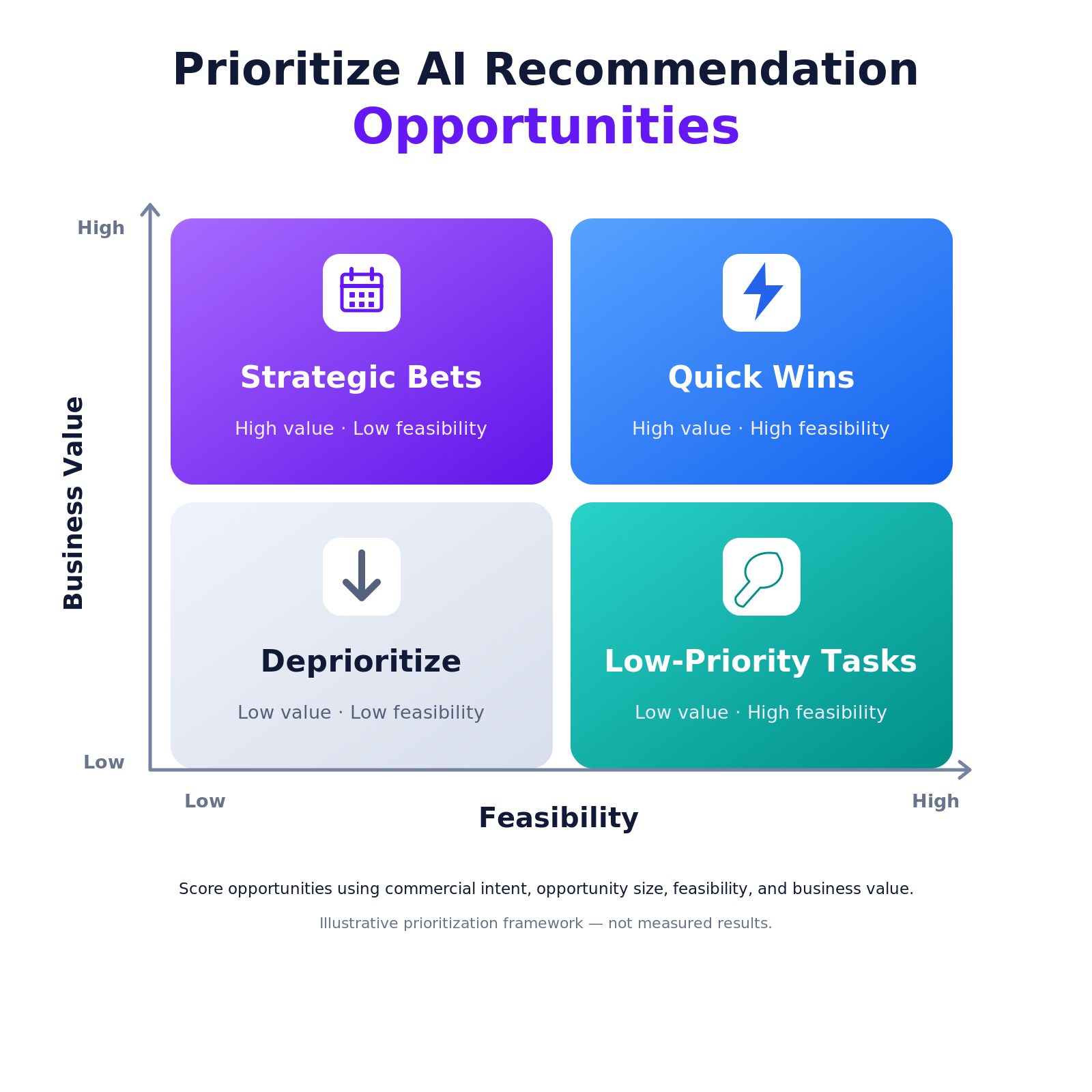
Score clusters such as 'agency scheduling' from 1 to 5 on each criterion; plot value against feasibility.
| Criterion | Scores 1 when... | Scores 5 when... |
|---|---|---|
| Commercial intent | Research; no product needed | Shortlisting or comparing vendors |
| Opportunity size | Rare question; one rival recommended | Frequent question; several rivals recommended |
| Feasibility | No proof, assets, or source access | Existing proof; reachable sources |
| Business value | Off-ICP; small deals | Core ICP; strong deal size |
| Opportunity size combines recommendation counts with a qualitative assessment of buyer-question frequency. |
High value with low feasibility belongs in quarterly planning. Exclude poor-fit prompts: irrelevant recommendations risk churn, not qualified pipeline.
The 30-Day Plan for SaaS Growth Teams and Agencies
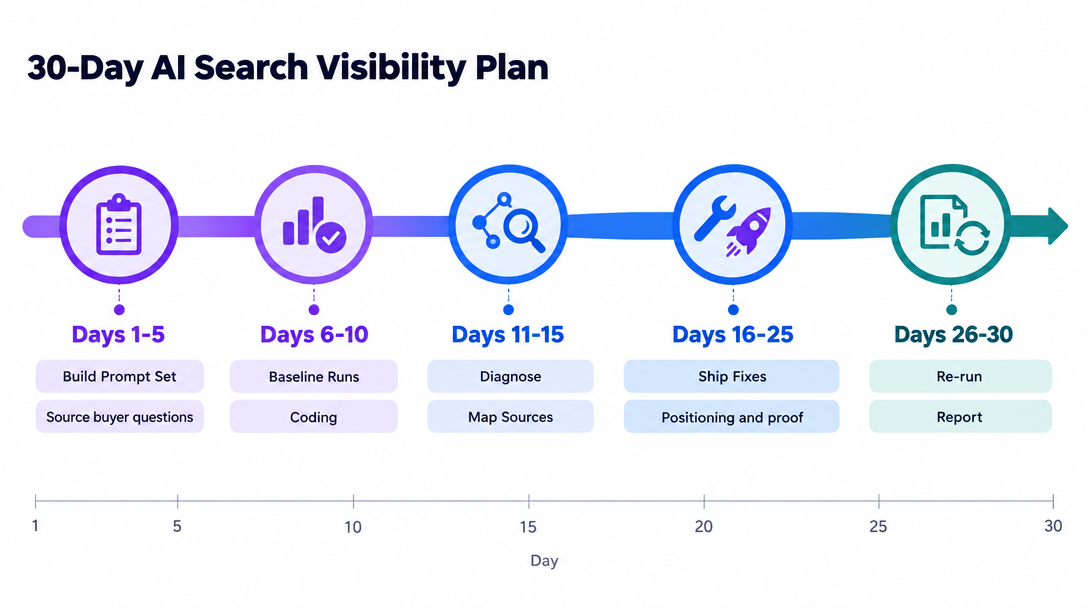
- Days 1 to 5: source prompts with sales and customer success; prepare the matrix or AI brand monitoring tool.
- Days 6 to 10: baseline runs, coding, second-coder check.
- Days 11 to 15: diagnose clusters; map competitors' sources.
- Days 16 to 25: fix positioning, use-case/comparison proof, reviews, listings, outreach, and guide-to-product paths. Use an SEO content audit prompt to identify retrofit candidates.
- Days 26 to 30: repeat the tests, document observed changes, and establish a monthly monitoring schedule. Avoid attributing changes to individual fixes without further evidence.
For agencies: standardize the matrix, customize client prompts, and deliver client-facing reports. Aim to establish a baseline and implement feasible fixes in the first 30 days, not changed outputs, especially for training-based answers.
A spreadsheet is enough to start. The harder part comes after the baseline: monitoring the same buyer questions, identifying why your brand is missing, and turning those findings into better content and a stronger digital presence.
That's where Vizup's Organic Autopilot fits. Its Answer Engine Monitoring helps teams understand visibility across AI answers, while its wider workflow combines visibility intelligence, content creation, optimization, and publishing. AI agents and human experts help connect the findings to execution.
Monitoring alone fixes nothing. The value is in knowing what to improve, making the changes, and checking whether buyer consideration improves.
Frequently Asked Questions
Will strong Google rankings get ChatGPT to recommend us?
Not reliably. SEO supports retrieval, but it doesn't guarantee recommendations. Semrush found most citations lacked brand mentions, but the study measured mentions, not recommendations. That finding does not establish how often cited brands get recommended. Test buyer prompts directly to see whether your brand makes the shortlist.
When should changes affect recommendations?
No dependable timeline exists. Live retrieval can reflect updates quickly; model knowledge depends on training cycles. Review results over several testing cycles without assuming a fixed timeline, and make pages discoverable in AI engines.
How often should we repeat the audit?
Monthly; refresh wording quarterly as buying conversations change. Retest after launches, pricing changes, or visible model updates. Freeze wording within cycles.
Can ChatGPT recommend our product without citing our website?
Yes. ChatGPT can recommend a product without citing that company's website. Depending on the model and search mode, recommendations may draw on existing model knowledge, retrieved third-party content, or other available information. That's why website citations, brand mentions, and product recommendations must be measured separately. A missing citation doesn't necessarily mean your product is absent from the shortlist, just as a citation doesn't guarantee a recommendation.
What should leadership see?
High-intent cluster gaps and share of voice, by engine, as trended ranges. Include shipped fixes, demo requests, and AI-naming attribution responses. These are intermediate signals, not revenue.
From AI Citations to Buyer Consideration
Getting cited in an AI-generated answer means your content contributed useful information. It doesn't mean your product was recommended. The commercial opportunity is to find where your brand is helping answer buyer questions but missing from relevant product shortlists, then improve the positioning, evidence, and discoverable content that could support buyer consideration.
Checklist:
- Separate citations, mentions, recommendations.
- Test 20 to 30 prompts across informational and buyer intent, keeping most discovery prompts unbranded.
- Identify recurring rivals and sources.
- Prioritize by value and feasibility.
- Repeat consistently; track ranges.
Target questions your product deserves to win. Connect recommendation visibility to qualified leads, demos, and acquisition wherever attribution permits.
