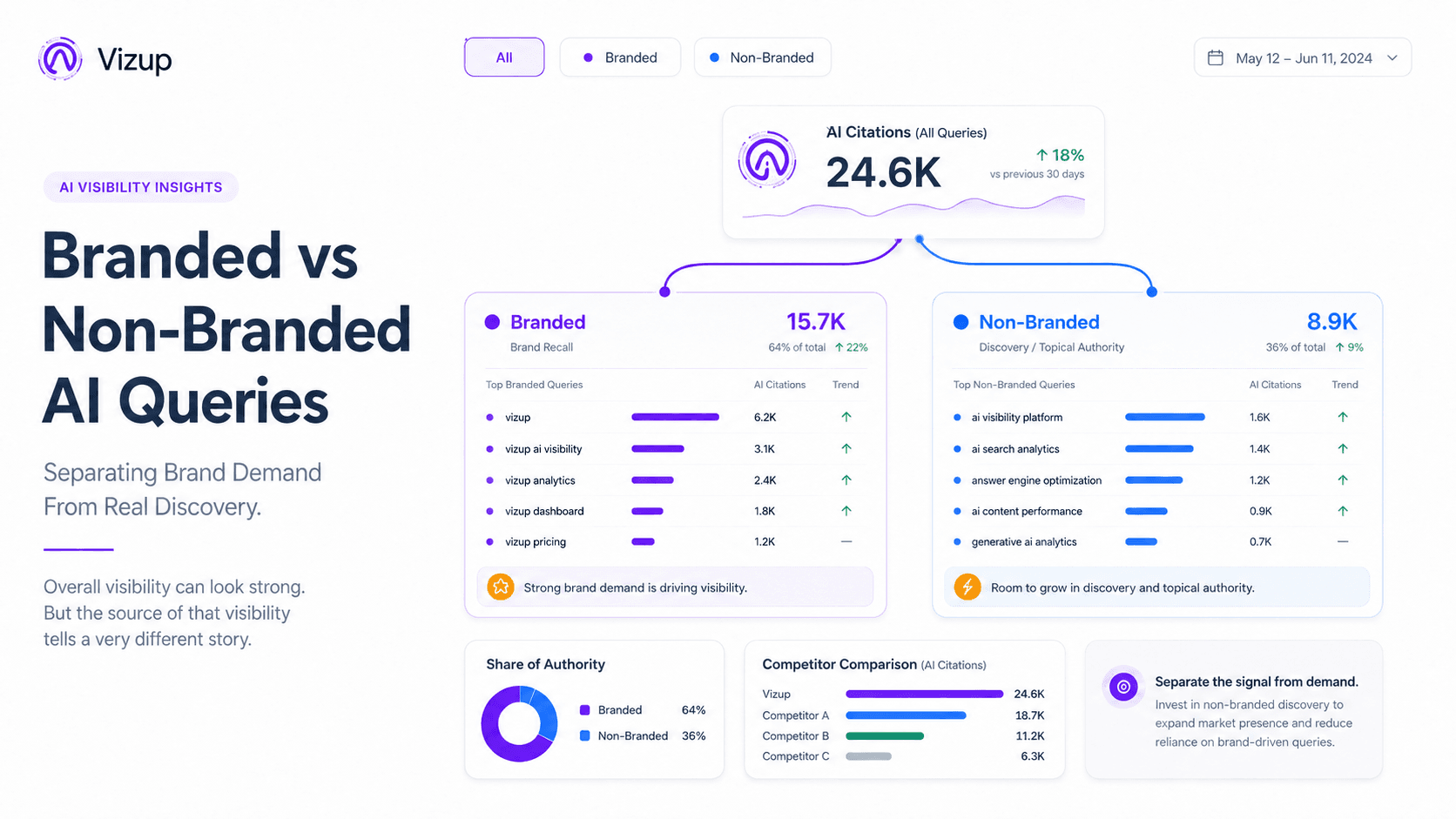
One aggregate metric can tell a reassuring but incomplete story. In Microsoft Clarity's AI Citations dashboard, a total citation count has long obscured a useful question: is AI citing your brand because people already know it, or because your material holds up on the subject? That is the difference between brand recall and genuine discovery. Before Microsoft introduced branded query segmentation in August 2026, those signals were harder to separate within the Citations dashboard.
Use the clarity branded vs non-branded ai queries filters to inspect those two signals separately. These are grounding queries: lookups an AI system runs while gathering information, not phrases a user enters into a search box. That distinction changes the reading of the report. A 2025 Amsive study found that non-branded keywords saw substantially lower CTRs in searches involving AI Overviews, while branded keywords that triggered an AI Overview saw an average CTR increase; this highlights how differently the two query types behave, though the study focused on Google's AI Overviews, not Clarity's grounding queries.
The workflow is straightforward:
- Open the AI Citations dashboard and establish a baseline.
- Spot-check the queries Clarity calls 'branded'.
- Compare the branded and non-branded views.
- Use the brand-versus-discovery framework to diagnose the pattern.
- Choose an action plan that matches the gap.
What You Need Before Starting
No additional code or configuration is required. A credible comparison does require enough data, a short list of your brand terms, and familiarity with the AI Citations dashboard.
- A verified domain in Microsoft Clarity: Your domain needs to be verified for the Citation dashboard to be available, and you need enough citation activity during the selected period to make the branded/non-branded comparison useful.
- A list of brand terms: Include the official name, common abbreviations, product lines, and frequent misspellings. You will use these to test Clarity's labels.
- Familiarity with the dashboard: You should know the main citation count, the Queries card, and the Share of Authority card.
Step 1: Open the AI Citations View and Set a Clean Baseline
Start with the unfiltered view. Open your Microsoft Clarity project and navigate to AI Citations, then choose a date range with a healthy citation volume, such as the last 30 or 90 days. This is the control for every comparison that follows.
Record total citations, overall Share of Authority, the five leading competitors, and leading topics. Keep the date range and competitor set fixed through the exercise. Otherwise, a change attributed to ai citation segmentation may simply reflect a different baseline.
Step 2: Verify What Clarity Has Labelled as Branded
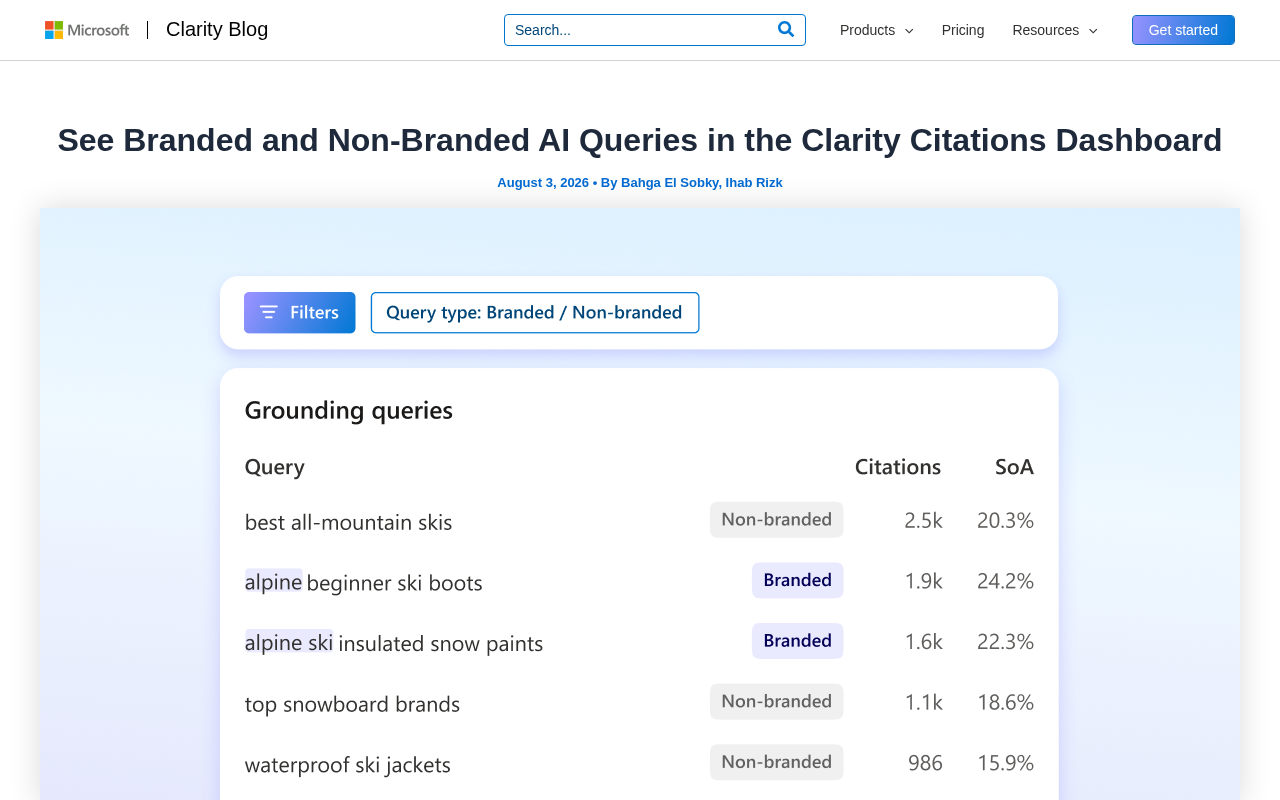
The Queries card now assigns each query a 'Branded' or 'Non-branded' label. Check those assignments before treating the split as fact. A grounding query containing your name does not mean a person searched for you; it means the AI looked up your brand while assembling information. Bing AI grounding works differently from traditional search, and that mechanism matters here.
Warning: Limitation: Microsoft does not currently explain the detailed classification logic it uses to determine whether a grounding query is branded or non-branded. For brands with common-word names, product names, abbreviations, or competitor comparison queries, spot-check the classification before drawing conclusions from the split.
Step 3: Compare Clarity Branded vs Non-Branded AI Queries
Apply the 'Branded' filter at the top of the dashboard and record total citations and Share of Authority. Switch to 'Non-branded' and capture the same measures. You now have three useful views: total visibility, visibility when the query names you, and visibility on broader topical queries.
Share of Authority can also be analyzed by query type, letting you compare where authority is strongest across branded versus broader queries. Follow Microsoft's guidance: citations are reference counts, not rankings. Citations and brand mentions in AI search are separate measurement concepts.
Step 4: Diagnose Brand Demand Versus Real Discovery
Now ask the question the aggregate count could not answer: which half of visibility is moving? Relative branded and non-branded citation strength reveals whether the advantage comes from recall or topical authority. That is brand demand vs discovery AI performance. A 2026 Clutch survey found that roughly 44% of consumers surveyed had already discovered a brand through an AI tool, showing that AI is becoming a meaningful brand-discovery channel.
Read the Four Branded/Non-Branded Patterns
Every profile lands in one of four broad patterns, each with a different diagnosis. Judge the relationship between the two segments rather than raw volume alone: the important comparison is branded performance against non-branded performance.
| Visibility Pattern | Likely Diagnosis | What to Verify in Clarity | Recommended Action |
|---|---|---|---|
| High Branded / Low Non-Branded | Strong recall, weak topical authority. You appear when named but miss discovery. | Do competitors dominate non-branded queries? Are you absent from key informational topics? | Build authoritative content for category, problem, and use-case queries. |
| Low Branded / High Non-Branded | Strong topical authority, weak brand conversion. The content is found, but the brand is not memorable or clearly attributed. | Does the cited material name your brand? Is the connection between content and brand clear? | Strengthen brand attribution, entity consistency, and memorable owned claims in the content. |
| High Branded / High Non-Branded | Broad authority: strong recall alongside topical discovery. | Which competitors lead in each segment? Are new topic threats emerging? | Defend the position with competitive intelligence and reinforced authority in core areas. |
| Low Branded / Low Non-Branded | A foundational visibility gap in AI grounding. This is an issue of overall AI brand visibility. | Is citation volume low everywhere? Are you cited on any queries? | Start foundational AI search visibility work around core brand and topic queries, which may involve both AEO and GEO. |
| Use this table to translate your specific branded/non-branded citation pattern into a concrete next step. |
Step 5: Turn the Diagnosis into the Right Visibility Plan
The Step 4 diagnosis should determine the response. A blended total invites a generic push for more citations. The segmented view tells you where that push belongs.
- For strong branded, weak non-branded performance: Prioritize discovery. Build topical authority so models find you for concepts, not only your name. Use Microsoft Clarity's Topic Insights to identify gaps around problems, use cases, and comparisons where you do not appear.
- For strong non-branded, weak branded performance: The content is working, but the brand is not sticking. Tighten entity consistency and attribution so the AI can connect an authoritative answer to your identity. This is not keyword stuffing.
- For competitive context: Apply the same filters to competitors' Share of Authority data to benchmark LLM visibility. Their strength may sit precisely where yours does not.
Make the split part of ongoing reporting. Tracking branded and non-branded citations as separate KPIs in a Vizup dashboard keeps a blended total from masking opposite, offsetting movements.
Common Mistakes That Corrupt the Comparison
The extra dimension is useful only if the comparison stays clean. Watch for these errors:
- Reading grounding queries as user intent. They are the AI's research queries, not a direct record of what users type.
- Comparing different settings. Do not compare branded results from one month with non-branded results from another. Lock dates, topics, and competitor sets.
- Equating citations with rankings or mentions. A citation is a reference, not a rank, a guarantee of inclusion in the final answer, or a sentiment measure.
- Ignoring ambiguous labels. A query containing your brand and a competitor, or a mislabeled product name, creates noisy data. Flag it in the analysis.
Frequently Asked Questions
What does Microsoft Clarity call a branded AI query?
It is a lookup an AI system, such as Bing Chat, performs that includes your brand or product name. The label indicates the system sought information about your company directly, a signal of brand recall.
Are Clarity's AI grounding queries typed by users?
No. Grounding queries are background searches the AI runs to gather and verify information before responding. They are different from the prompts or questions an end user types.
How should I read high branded citations and low non-branded citations?
It usually indicates strong name recognition but weak topical authority. AI can find you when it already knows the name, yet may omit you in broader problem-oriented discovery.
How does Share of Authority change when filtering branded and non-branded queries?
The card recalculates for the filtered query set. 'Branded' shows your share on queries naming you; 'non-branded' shows the share on topical queries. It also breaks out the split for each competitor.
How accurate is Microsoft Clarity's branded query labelling?
Accuracy varies. Microsoft has not published its matching rules, so spot-check misspellings, competitor names, and product lines before relying on the data. Treat the labels as a useful starting point, not a definitive classification.
