If you run a local business, your Google reviews aren't just nice to have. They shape how you show up in local search, they set expectations before someone ever walks in, and they do a lot of the trust-building for you. So when Google starts pressing users on how those reviews were earned, that's not background noise - that's a warning shot.
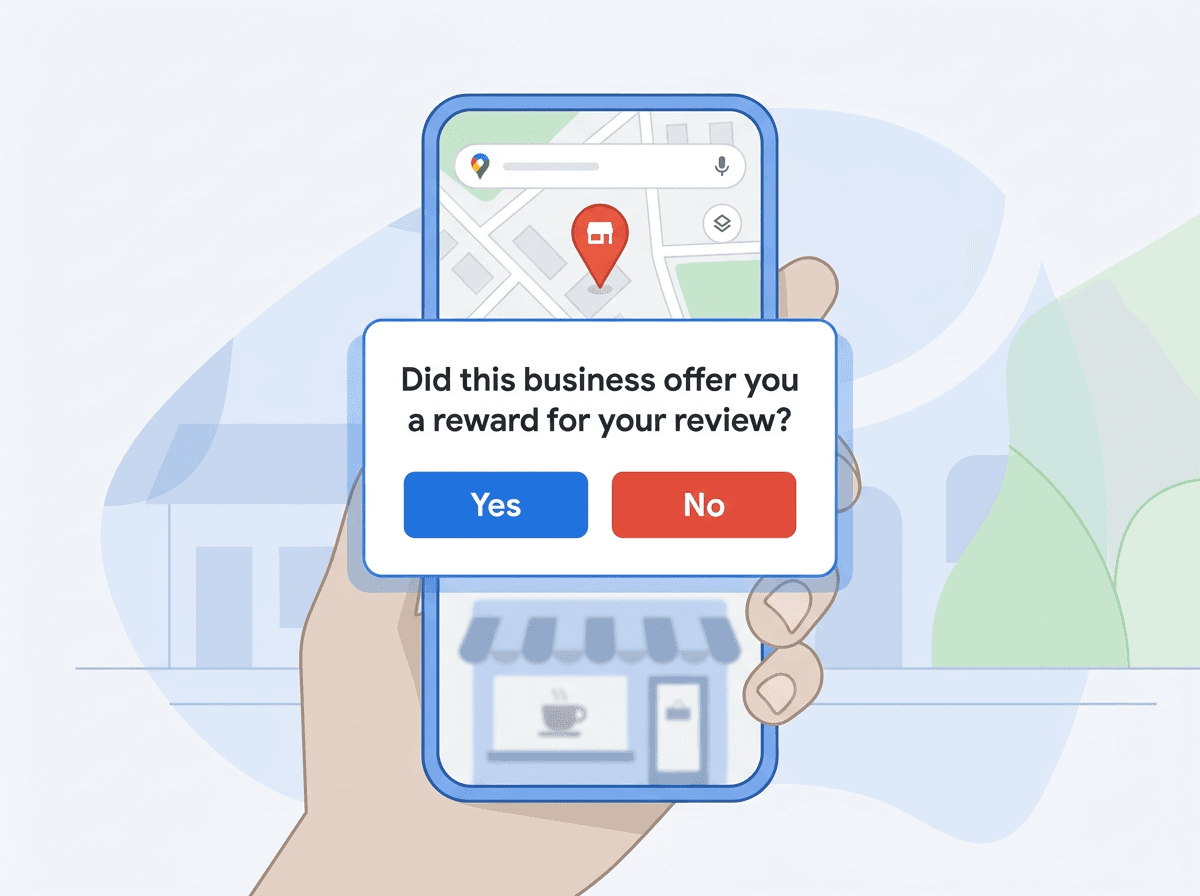
Lately, screenshots have circulated of a new Google Maps prompt. After someone visits a location, Google asks a blunt question: did the business offer a reward in exchange for a review? To anyone who's spent time around local SEO, the subtext is obvious. Google isn't just publishing rules and hoping for the best; it's testing a way to enforce them at scale. If your review playbook has leaned on freebies or discounts, this is where things can get uncomfortable fast.
What is Google asking users?
It looks like an experiment, but the message is hard to miss. Some users are seeing a card that asks whether a business offered rewards, discounts, or any other incentive for leaving a review. This isn't a broad satisfaction survey. It's a narrowly aimed question meant to surface policy violations from the people who would know: customers.
For a long time, the downside of offering Google review incentives felt abstract. Most owners knew it wasn't allowed, yet plenty of businesses treated it like a gray area. A free coffee for a five-star rating. A small discount if you show the server you posted feedback. It happened everywhere. This prompt changes the dynamic. Google isn't waiting to stumble onto bad behavior; it's asking patrons directly whether you tried to buy their praise.
What Google's policy officially says
Bluntly: this has never been allowed. Under Google's "Fake Engagement" policy, offering or accepting payment, discounts, free goods, or services in exchange for a review is prohibited. It doesn't matter if you're fishing for a glowing rating or insisting you just want an "honest" take. Once a reward enters the picture, the review is no longer treated as authentic.
The rules also cover a common cleanup attempt: asking someone to revise or remove a negative review in exchange for something. If you need a broader view of how Google handles review-related enforcement, see our guide to Google's review and listing removal guidance. Offering a refund only if they delete that one-star complaint is a straight violation. And the stakes extend beyond Google. The U.S. Federal Trade Commission (FTC) regulates deceptive endorsements, and undisclosed paid reviews can bring serious fines. This isn't merely a platform slap on the wrist; it can become a legal and financial problem.
Why this matters for local businesses
So what does this look like when it goes wrong? When a business ends up on the wrong side of Google's review rules, the fallout tends to be immediate - and it rarely stops at a single deleted comment.
Here's what's at stake:
- Review Removal: The most common outcome is simple: reviews disappear. Google can, and does, remove reviews it believes were incentivized. Businesses can lose a large number of reviews quickly if Google determines they violate review policies. One day they were there; the next day, they weren't.
- Profile Suspension: If the behavior is severe or repeated, Severe or repeated policy violations may create broader Business Profile risk, including restrictions or enforcement actions. That means vanishing from Maps and taking a huge hit to local discovery. For businesses that depend on nearby customers, it's catastrophic, especially when Google Business Profile optimization is a major part of how they earn nearby demand.
- Loss of Trust: Customers notice patterns. A sudden run of generic five-star reviews reads like a billboard, not a recommendation. If people learn you're effectively buying feedback, the credibility damage can outlast any Google penalty. Nearly all consumers read reviews now, and many can spot something off quickly.
What businesses should do instead
The fix isn't to stop asking for reviews. It's to stop trying to manufacture them. The most reliable path is still the least glamorous one: run a better operation, then make it easy for satisfied customers to say so.
Start with the obvious move: ask. Happy customers often won't leave a review unless someone prompts them. Train staff to make a simple, human request at the right moment. Something like, "If everything was great today, we'd really appreciate a Google review - it helps other people find us," works because it sounds like what it is: a favor, not a transaction.
Next, remove the friction. Put QR codes on receipts, table tents, or business cards that jump straight to your Google review page. Send a follow-up email or SMS a day after the visit with the direct link. Reviews drop off with every extra tap, so treat the flow like checkout: fewer steps, higher completion.
Last, write it down. A clear internal policy for how your team requests reviews keeps things consistent and keeps you out of trouble. If questions ever come up about your practices, having a documented, compliant process matters.
Where AI tools fit in
AI doesn't belong in the part where reviews are created. It does belong in the part where you keep up. As Google pulls Business Profile details into AI search results, the way your reviews and reputation show up is increasingly part of the product. You need to know how your Business Profile appears in AI search.
Used responsibly, AI tools can speed up the work that actually helps customers: responding well. They can help draft replies that sound specific rather than copy-pasted, which signals that someone is paying attention and can nudge others to leave feedback. And on the monitoring side, platforms like Vizup are built for the new reality of AI-driven discovery. Vizup's Answer Engine Monitoring can track how your business and reputation are being presented in AI Overviews and other conversational search results. That broader view — search visibility, AI mentions, and how your brand is framed — helps you manage reputation without sliding into tactics that Google is clearly trying to stamp out.
None of this replaces the basics. You still need a policy-safe workflow, and you still need to deliver the kind of service people want to talk about. What AI can do is help you keep watch at scale and respond faster without sounding like a robot. Use the tech to monitor and communicate, not to manufacture reviews.
Don't chase stars, build experiences
Google tightening the screws on review incentives is, on balance, good news for businesses that play it straight. It pushes the market back toward the thing customers actually care about: the experience they had. Discounts-for-reviews are a short-term gimmick with a long tail of risk. Service, quality, and real relationships take longer, but they compound.
Skip the shortcuts. Build something people want to recommend, then make leaving feedback easy and routine.
Frequently Asked Questions
Can I offer a discount for any review, not just a positive one?
No. Google's policy bars incentives tied to any review, whether it's positive, negative, or neutral. Once a reward is involved, Google treats the review as compromised.
What is 'review gating' and is it allowed?
Review gating means encouraging only happy customers to leave public reviews while routing unhappy customers elsewhere. Google advises businesses not to discourage or prohibit negative reviews or selectively solicit positive reviews, so this practice is risky and should be avoided.
What happens if a competitor is buying reviews?
If you believe a competitor is violating Google's policies, you can report the business or specific reviews in Google Maps. Google uses community reports as one of the ways it identifies abuse.
Can I ask employees to review my business?
No. Google treats employee reviews as a conflict of interest and a form of rating manipulation. Reviews are supposed to come from unbiased customers.
How can I recover from a penalty for incentivized reviews?
First, stop any incentive program immediately. Then rebuild the right way: earn reviews through strong service and compliant requests. Recovery can take time, but the only durable path back is legitimate, policy-safe practices.
