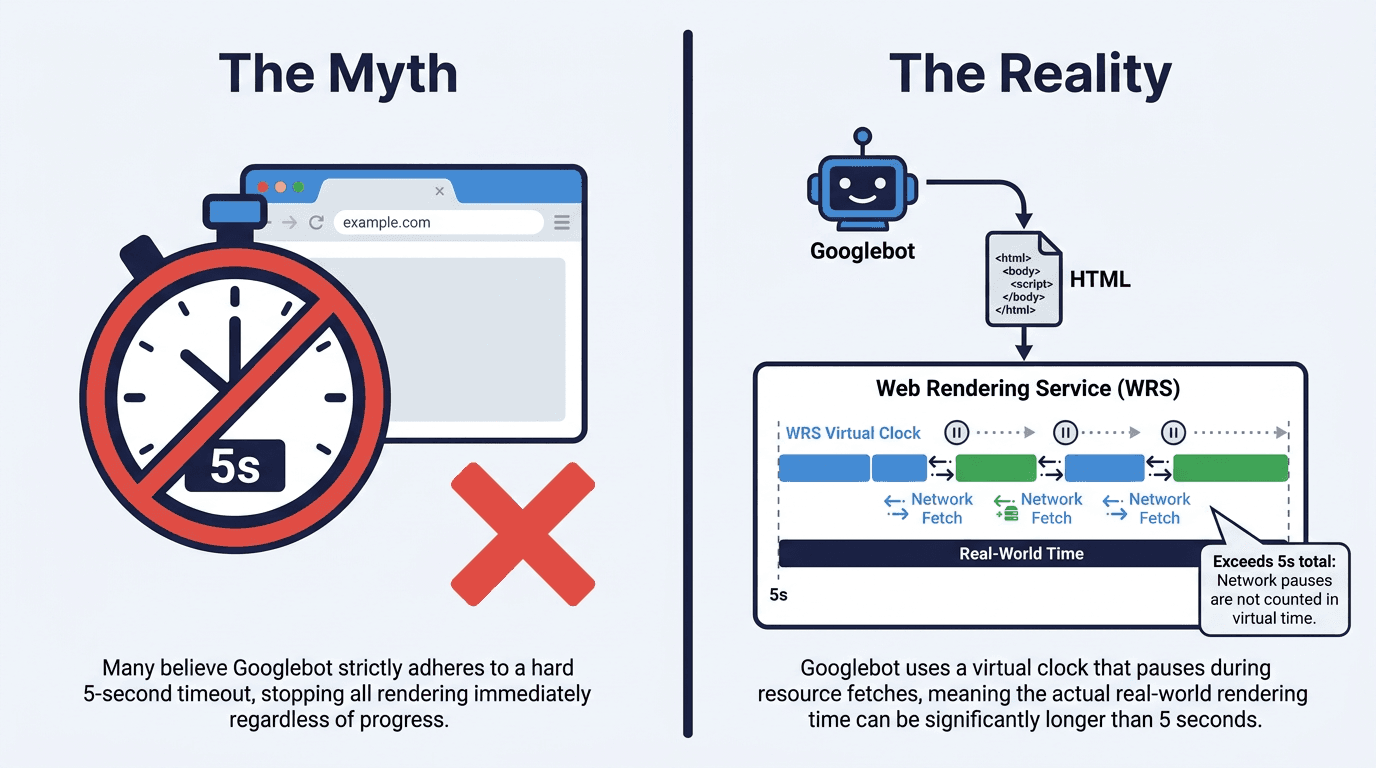
The "google 5 second render limit" is not a real timeout in Google's Web Rendering Service (WRS). The five-second number traces back to a statement about median queue time before rendering starts, and recent community testing shows Google can render JavaScript content after tens of seconds of real time.
This matters because teams have been making architecture decisions around a deadline Google never set. If you build JavaScript-heavy pages, the right question is not "How do I fit into five seconds?" It is "What actually constrains rendering, and how do I design for users and for reliable indexing?"
Where the five-second myth came from (and why it felt true)
The origin is a classic SEO telephone problem: a precise metric gets repeated without its context until it hardens into a rule. The five-second figure came from Martin Splitt at Chrome Dev Summit 2019 describing the median queue time before a page begins rendering -- not a deadline for executing JavaScript or capturing the DOM. Dave Smart's 2026 analysis traced the myth back to a misreading of Google's statement about median rendering-queue time.
Three reasons the conflation stuck:
- Five seconds sounds plausible because it aligns with performance culture, so it passed the sniff test without rigorous measurement.
- Many people tested with a simple timer (like a delayed DOM injection) and saw behavior that looked like a cutoff, because of how WRS measures time.
- The two-wave model (crawl HTML first, render later) already feels like a "budget," so a single number was easy to latch onto. Google explained this two-stage processing in their Google I/O 2018 talk on JavaScript-powered sites (Greenaway and Mueller, 2018).
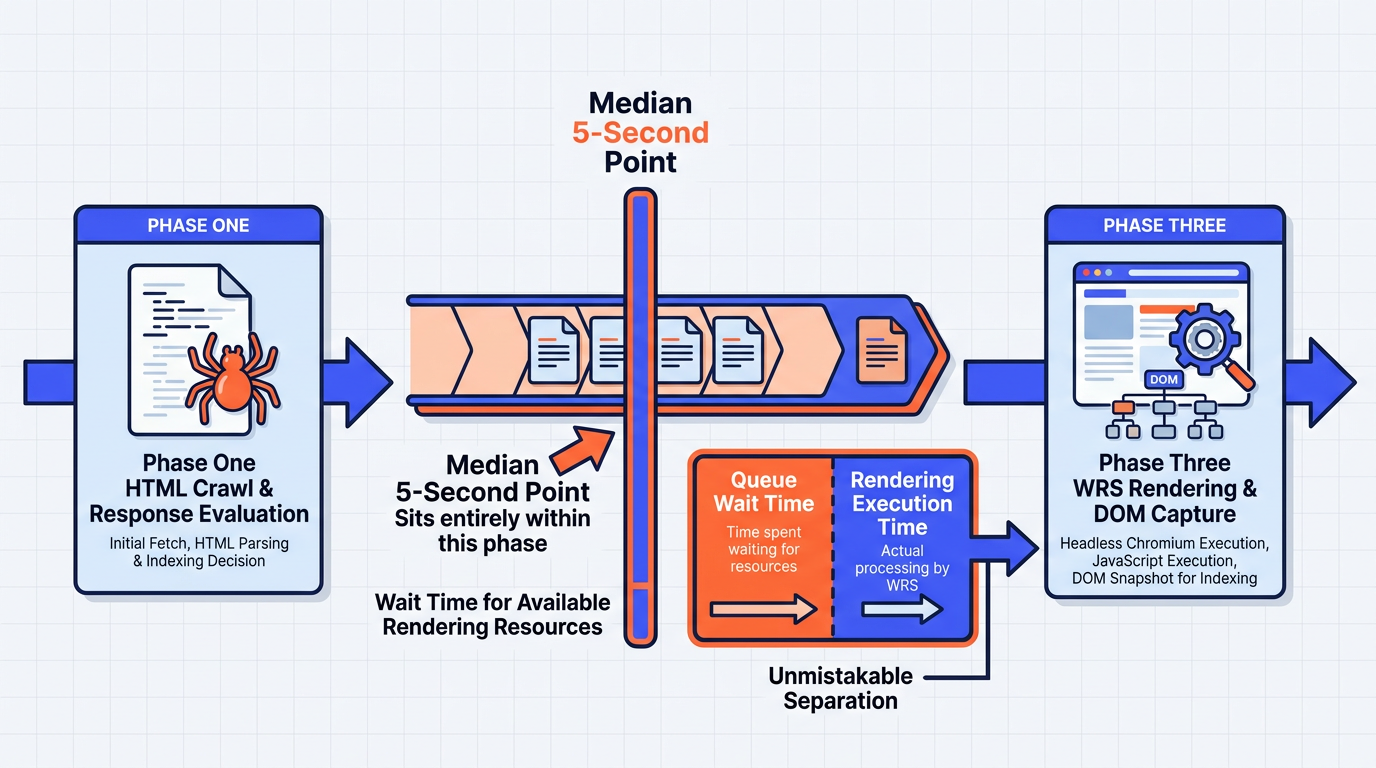
Note: If you want a single sentence to kill the myth: the five seconds was about when rendering starts, not when rendering must stop.
What Googlebot actually does: crawl first, render later
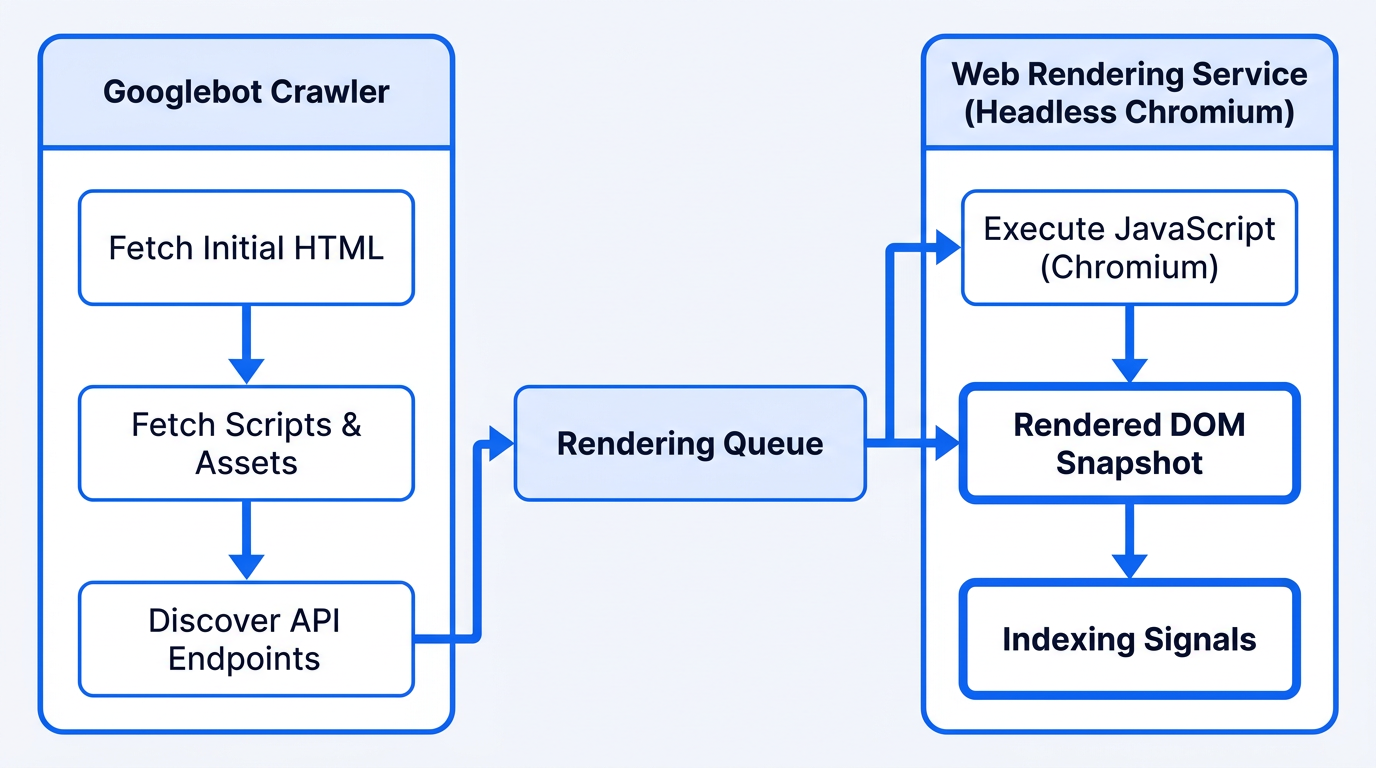
Google's documented model is still the best mental frame: Googlebot fetches the initial HTML, then the URL can be placed into a rendering queue, and later the Web Rendering Service runs a headless Chromium instance to execute JavaScript and produce the rendered HTML snapshot used for indexing. Google lays out the basics in Understand the JavaScript SEO basics.
That first wave is not a formality. Before any rendering happens, Google has already made crawl decisions based on the server response. If your origin returns the wrong status code, blocks resources, or chains redirects, you can fail before WRS even gets involved. That is why technical teams still need to treat the response layer as a first-class SEO surface, including The Essential Guide to HTTP Status Codes for SEO.
The mechanism that breaks the "timeout" story: WRS does not experience time like your browser
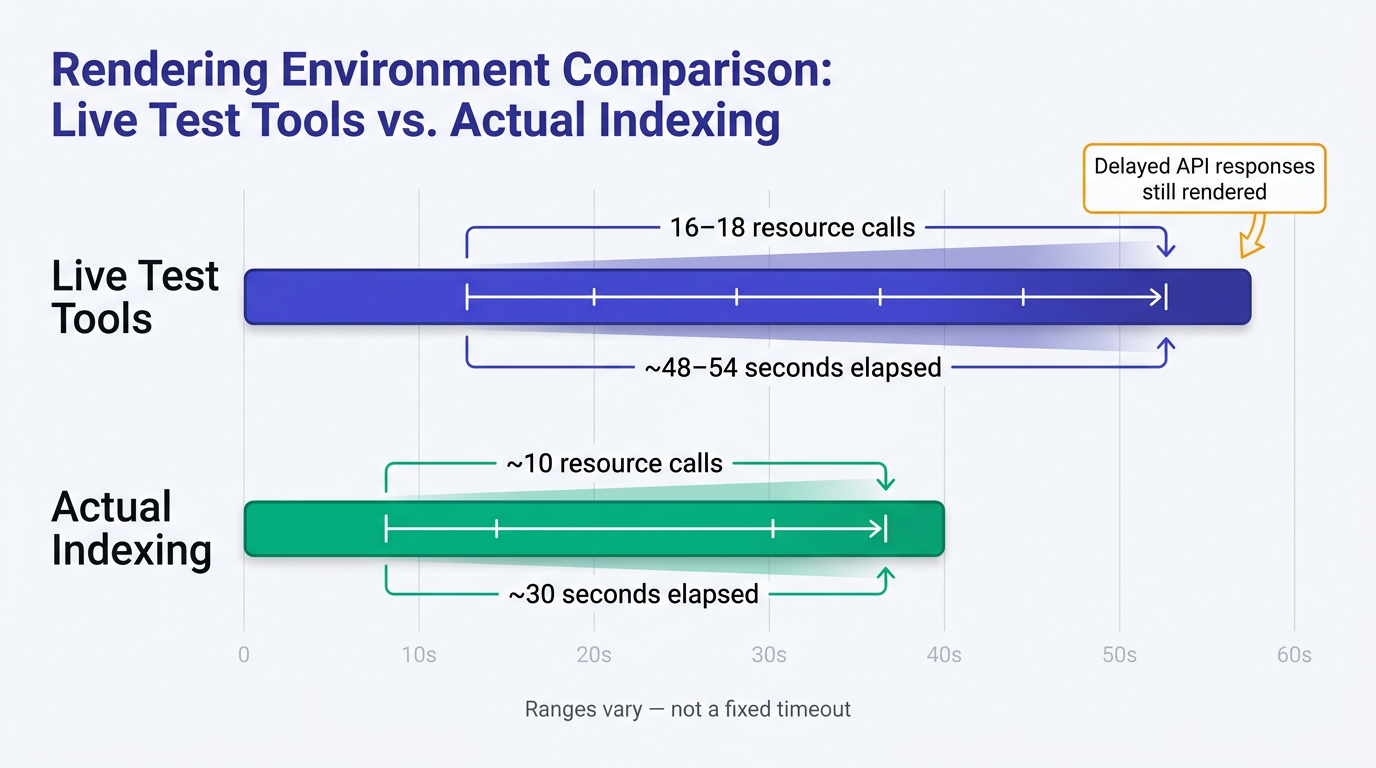
Dave Smart's July 2026 independent tests provide public evidence against a fixed five-second WRS cutoff. Because this was an independent experiment rather than a published Google specification, its exact resource and timing figures should be treated as test-specific observations. Smart delayed server-side API responses by roughly six to twelve seconds and still saw that content included in the rendered output. In his live testing tool runs, the process commonly stopped after about 16 to 18 resource calls (roughly 48 to 54 seconds of real time), and actual indexing of the test page completed after about 10 calls or about 30 seconds. The important part is the variability: it behaved like a capacity and complexity budget, not a hard clock deadline (Smart, 2026; covered by Search Engine Journal, 2026).
The WRS virtual clock (why your timers "prove" the myth)
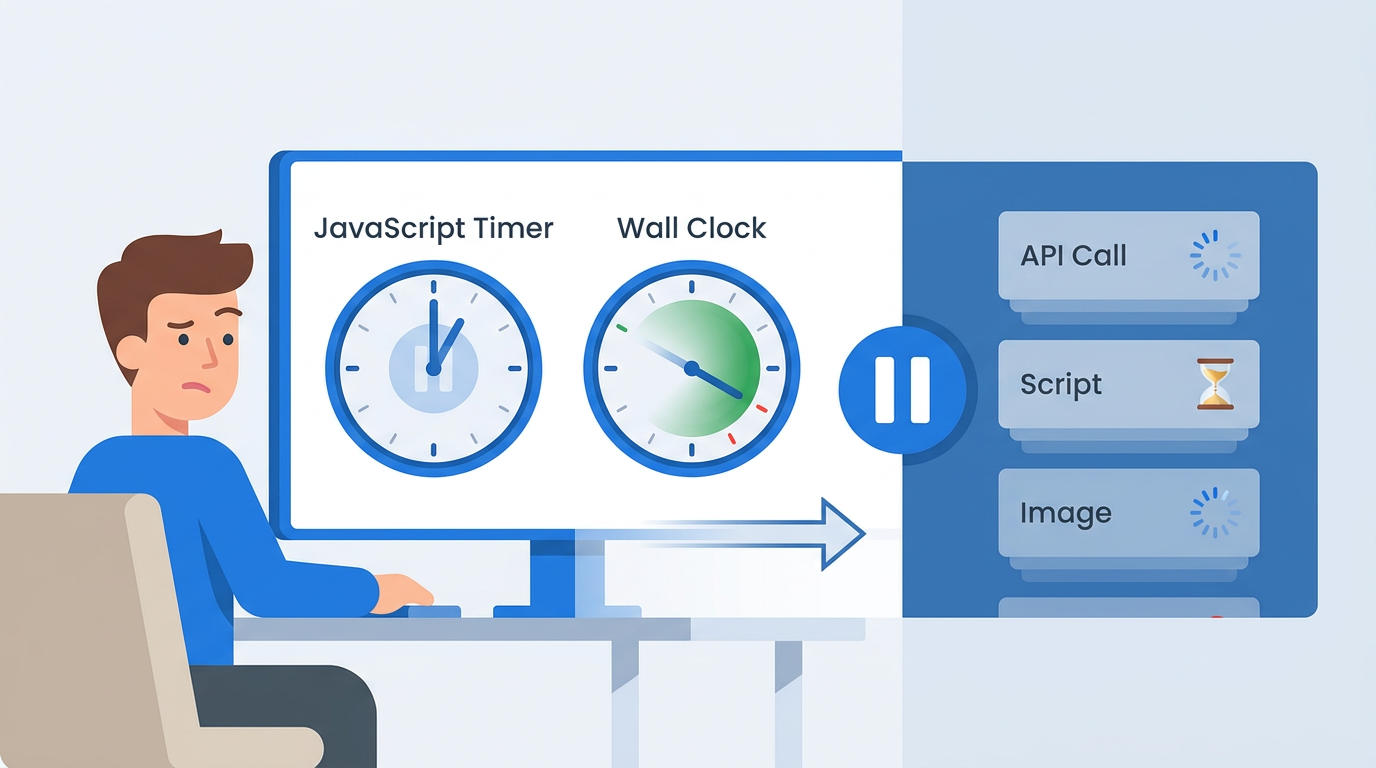
WRS runs headless Chromium, but it is not a normal browser session. The renderer uses a wrs virtual clock that can pause while network requests are pending. JavaScript-visible time -- what your page sees via timers -- can sit near five seconds even while far more real time elapses.
This is why the myth is so durable. A common test is: start a timer, wait five seconds, then inject content. If the renderer's virtual clock is paused during fetches, your code can appear to "hit" a five-second wall even though Google is still waiting in real time for resources to resolve. The test seems to confirm the story -- but only because you measured the wrong clock.
Resource fetching is handled by crawling infrastructure, not by Chromium
One more detail that changes how you should interpret tests: in WRS, resources are fetched by Google's crawling infrastructure and passed back to the renderer, rather than fetched directly by Chromium the way a user browser would. That separation helps explain why "time" and "requests" behave differently than your local Lighthouse run, and why Smart's results looked more like a cap on resource activity than a strict time cutoff.
Tip: If you are debugging googlebot javascript rendering, log and correlate both sides: server access logs (what the crawler fetched) and rendered HTML output (what WRS produced). A single client-side timer is not a reliable probe.
So what is the real constraint, if not five seconds?
Smart's testing suggests the practical limit behaves like a moving target: a variable ceiling on work done, often visible as a cutoff in the number of resource calls, not a fixed time budget. That is closer to a javascript seo rendering budget based on complexity, fetch patterns, and system capacity at the moment your URL is rendered.
What tends to push you toward the edge of that budget:
- Many dependent fetches before meaningful content appears (waterfalls of API calls, chained script loaders, client-side routing that blocks rendering).
- Heavy main-thread work before DOM stabilization (large bundles, expensive hydration, long tasks).
- Render-blocking resource failures that keep the system waiting for a state that never arrives.
If you are seeing "Crawled, currently not indexed" and suspect rendering, treat it as a diagnostic branch, not a verdict. Rendering can fail, but so can quality evaluation after rendering. Vizup's breakdown of Crawled Currently Not Indexed: The New Content Quality Warning in GSC is a useful reminder that indexing outcomes are not only about JavaScript.
What this does and does not mean for performance and architecture
None of this means slow rendering is acceptable. It means Google's patience outlasts the five-second myth by a wide margin -- which is a different claim entirely. Real users don't sit through 30-second blank screens waiting for primary content to appear, and Google's ranking systems pull from field data that captures exactly that impatience. Google Search Central has been consistent on this point for years: rendering is resource-intensive, speed still matters for users, and the fact that Googlebot will wait does not change the bar you're designing to (Google Search Central, 2020). The practical shift is in what you're optimizing against.
Stop engineering around a phantom hard limit. Design to measurable constraints instead: time-to-first-byte, LCP, INP, and the moment your main content becomes visible without fragile client-side dependencies. If you need a place to situate this work inside a broader program, rendering audits are a standard component of What Are Technical SEO Services?.
Engineering moves that age well even if WRS behavior shifts:
- Deliver meaningful HTML early using SSR, streaming SSR, or prerendering for critical routes, then layer JavaScript on top rather than relying on it for initial content.
- Cut blocking network round trips before content appears, including unnecessary cross-origin API calls.
- Build render-critical content to survive partial failure with timeouts, fallbacks, and cached responses.
- Use structured data and stable internal linking so discovery never depends on client-side navigation completing successfully.
Rendering is only one part of modern discovery. Vizup's Organic Autopilot helps brands monitor, create, optimise, publish, and learn across Search, Social, Communities, AI Answer Engines, and Local Discovery using AI agents, human experts, and live SEO, pSEO, AEO, and GEO tools. Paid ads are available as an optional amplification layer. If you care about how rendered content is used downstream, connect it to how Google's AI search works and to Google's content quality systems, because the renderer can successfully produce content that later fails quality or trust checks.

Common misconceptions that keep teams stuck
- "Google only renders for five seconds." The five seconds was a median queue time before rendering begins, and Smart's 2026 tests show real-world waits of 30 to 50+ seconds depending on request patterns and capacity.
- "If the live test tool stops, indexing will stop at the same point." Smart observed different cutoffs between live testing tools and actual indexing, which is consistent with different environments and budgets.
- "If Google waits longer, I can ship slower pages." Users still bounce, CWV still suffers, and crawl capacity is still finite. The myth being false does not remove the business cost of slow delivery.
Frequently Asked Questions
Does Google wait for JavaScript to load?
Yes, within resource limits. Googlebot can render JavaScript using WRS and will often wait well beyond five seconds of real time, particularly when network requests are involved (Smart, 2026; Search Engine Journal, 2026).
What is Google's Web Rendering Service (WRS)?
WRS is Google's rendering system that uses headless Chromium to execute JavaScript and produce a rendered HTML snapshot for indexing. Google describes the two-wave crawl-then-render model in its JavaScript SEO basics documentation.
Is there a JavaScript SEO rendering budget?
Google has not published a single JavaScript rendering budget. Smart's experiment suggests that WRS stops after a variable amount of work rather than at a universal five-second deadline, but the observed resource-call limits should not be treated as official Google thresholds.
How long does Googlebot wait to render a page?
Google has not published a universal rendering duration. In Smart's specific test, which repeatedly made server-delayed requests, live tools processed approximately 16 to 18 calls, while the indexed version contained 10. These are experimental observations, not guaranteed Googlebot limits.
If the 5-second render limit is a myth, do I still need to worry about page speed?
Yes. Googlebot may wait longer than five seconds, but users do not, and Core Web Vitals are grounded in real user experience. Treat the myth as permission to stop cargo-cult engineering, not as permission to ship slow pages. For delivery context, see Google AMP Direct Links: Why Search Stopped Serving the Cached Version.
Key takeaways (what to tell your dev team)
If your org has been enforcing a five-second JavaScript deadline for SEO, update the policy. Credit where it is due: Dave Smart of Tame the Bots generated the community evidence that finally matches the mechanics many suspected.
- The google 5 second render limit is a myth, rooted in confusing median queue time with a rendering deadline (Splitt, 2019; summarized by Rabbit Rank, 2026).
- WRS uses headless Chromium, but time inside the renderer is shaped by a virtual clock that can pause while requests are pending, so timer-based tests can mislead (Search Engine Journal, 2026).
- Googlebot JavaScript rendering is constrained by variable capacity and complexity, often visible as a cap on resource calls rather than a fixed timeout (Smart, 2026).
- Speed work still matters for users, CWV, and crawl efficiency. Google being more patient than five seconds does not change user expectations.
- Design for robust delivery: meaningful HTML early, fewer blocking fetches, and resilient rendering paths, then validate with server logs and rendered output.
If you are also troubleshooting bot behavior at the edge (verification, spoofing, or access control), pair rendering diagnostics with how Googlebot identifies itself so you do not optimize for the wrong traffic.
