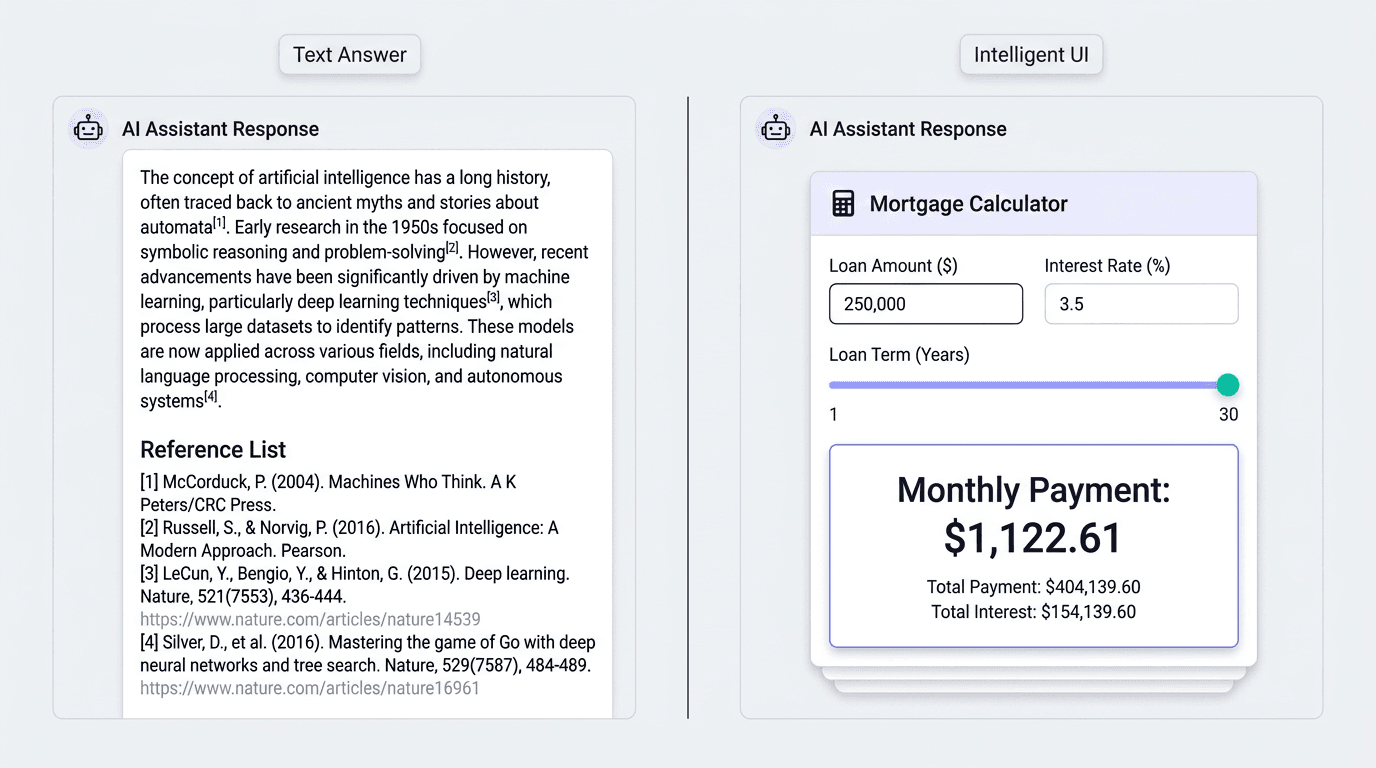
GPT-6's Intelligent UI is OpenAI's interface layer for rendering answers as calculators, charts, forms, and mini-apps rather than static text. That matters because cited prose gave publishers and brands a visible place to appear. According to OpenAI's official GPT-6 announcement, OpenAI began rolling out GPT-6 Intelligent UI on October 7, 2026.
Google had already introduced generative UI in AI Mode in November 2025 and described broader interactive Search experiences in Google's May 2026 Search announcement. Both developments show how AI platforms are moving toward more interactive answers. This is not a feature release to watch from the sidelines. Two dominant platforms are redesigning the answer surface.
The traffic impact is not yet settled. Interactive answers may reduce the need to visit external websites for some queries, but the actual effect on clicks depends on the task, source visibility, and user behaviour. The harder question is what attribution means when the answer is a functioning tool, not prose. Citation-based AEO is already inadequate for a growing set of queries. Teams that focus only on footnote citations risk missing other ways brands and sources appear in AI-generated responses.
What GPT-6 Intelligent UI Actually Does (and Doesn't Do)
GPT-6 decides when a query deserves an interface instead of an explanation. Ask it to calculate the monthly payment on a $400K mortgage at 6.5%, and it can return a live calculator: inputs, a loan-term slider, and an updating result, rather than an amortization paragraph with a Bankrate link.
OpenAI's official GPT-6 announcement says GPT-6 selects how to combine text, visuals, and interactive elements based on the task. Intelligent UI uses native, streamable components and a compiler that progressively renders the interface as the response is generated.
This is not a plugin marketplace embedding third-party apps through iframes, nor a static card with a fixed template. The model composes task-specific interfaces using OpenAI's native component library rather than relying exclusively on fixed response templates. A generated calculator can function directly inside ChatGPT without requiring users to open a third-party calculator. However, the interface format alone does not establish whether external data retrieval or integrations were used. Data may come from training or inference-time retrieval, but the surrounding app is generated anew, with no upstream URL built into it.
Warning: OpenAI began rolling out Intelligent UI to Plus, Pro, Business, and Enterprise users on October 7, 2026, followed by Free and Go users starting October 8. The announcement did not confirm logged-out availability or establish how frequently the interface would appear across all queries.
A Platform Shift, Not a Feature Update
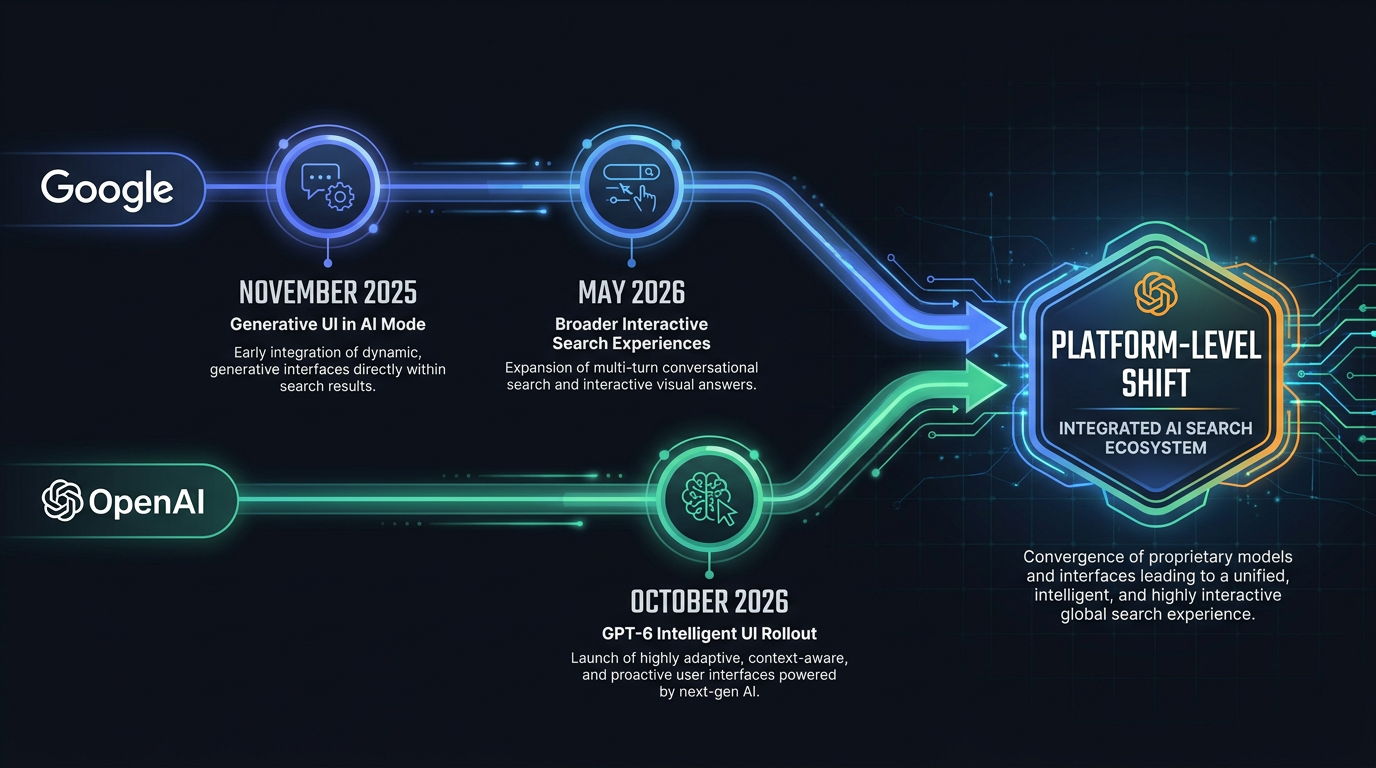
Google's generative UI research from November 2025 described an AI model generating a complete user experience on demand. Google introduced generative UI in AI Mode that month and outlined broader interactive experiences for Search in Google's May 2026 Search announcement. These features include custom interfaces, interactive visuals, and simulations. The convergence follows an obvious product judgment: a computation, comparison, or structured result is poorly served by a paragraph, however well cited it may be.
Earlier AI Overviews and SGE changes still exposed text and citations. Brands could respond by optimizing for AI-powered answer engines and competing for footnote placement. Intelligent UI can remove that layer for qualifying queries. Finance calculators, converters, recipe scalers, shopping comparisons, and data lookups are natural candidates for interactive answers.
However, the proportion of queries that trigger generated interfaces has not yet been established across platforms. Generative UI adds another dimension to the zero-click searches problem: users may complete certain tasks without visiting an external website, even when source links remain available elsewhere in the response. Google's AI Search linking update also shows that interactive and generative experiences can coexist with more prominent routes to source discovery.
The Attribution Problem: Where Does a Citation Sit on a Calculator?
Traditional AI answers have an anatomy publishers understand: synthesized text, then numbered source links. Interactive interfaces do not always follow the familiar structure of a paragraph followed by citations. A calculator or chart could display source information through labels, links, notes, or accompanying explanations, but attribution practices across these formats are still evolving. The launch therefore raises a basic unresolved question: how will sources be cited inside interactive formats? Search Engine Journal's GPT-6 coverage identified that unresolved citation question during the rollout (Search Engine Journal, 2026).
A widget may rely on a brand's content or data. USDA nutritional data can power a macros comparison; Zillow historical pricing can inform a mortgage estimate. OpenAI has not documented a universal citation format for Intelligent UI components. The unresolved question is how consistently generated interfaces will expose the sources behind their information. Whether generated calculators will identify the original sources of their information remains an open product and attribution question.
What Breaks in Your Current AEO Playbook
Most answer engine optimization assumes the output is text with a citation list. That assumption now fails for a growing share of responses, and it takes the familiar measurement model down with it.
Citation-list optimisation loses its target
Structured data helps search engines interpret content and supports eligibility for certain search features, but it does not guarantee inclusion or attribution in AI-generated answers. A rendered chart has no conventional footnote slot. Traditional citation-rate measurements become incomplete when responses contain interactive components without visible source links. Teams should measure citations separately from brand mentions and other visible signals. Schema still helps a model understand data, but understanding data does not create an attribution surface.
Click-through measurement goes dark
Referral analytics were already strained by zero-click answers. Interactive responses can reduce the need for external clicks on some tasks. However, recent changes in ChatGPT link tracking also show why declines in attributed referral traffic should not automatically be interpreted as lost visits. Vizup's analysis of why traffic metrics lie and visibility metrics don't showed the distance between reported traffic and actual exposure. Generative UI makes that distance much larger.
An October 2026 attribution issue makes the measurement problem more complicated. Search Engine Journal reported that several analytics datasets showed sharp declines in ChatGPT-attributed traffic after the GPT-6 rollout. Investigators linked part of the decline to missing tracking parameters and referrer information, which could cause ChatGPT visits to appear as Direct traffic. A fix reportedly began rolling out on October 15, but the incident highlights an important distinction: fewer recorded AI referrals do not necessarily mean fewer actual visits. Teams should compare AI referrals, Direct traffic, and landing-page trends before attributing a decline to Intelligent UI (Search Engine Journal, 2026).
Brand visibility needs a new definition
Being the data behind a widget still conveys influence, but brands lack a way to measure it. Named visibility, such as "Source: USDA" inside the UI, is materially different from invisible sourcing, where a brand's data appears without its name. Most tools do not distinguish the two. Most teams have not made the distinction part of their reporting.
Text Answers vs. Intelligent UI: A Side-by-Side
| Dimension | Traditional AI Text Answer | GPT-6 Intelligent UI Response |
|---|---|---|
| Output format | Synthesized prose paragraph | Text, visuals, interactive components, or a combination |
| Citation surface | Numbered footnote links below text | Source presentation varies; no universal widget citation format has been documented |
| Click opportunity | Low amid the zero-click trend, but possible | May decrease for self-contained tasks; links and external actions can still appear |
| Brand visibility mechanism | Earn a footnote citation | Visible brand mentions, links, product references, or unattributed information |
| Measurability with current tools | Citation tracking and referral analytics | Partial measurement through citations, mentions, response sampling, and referral analytics |
| Recommended AEO strategy | Optimize for citation inclusion through structured data and authority signals | Maintain strong SEO foundations and monitor brand mentions, citations, and interactive-answer formats |
| The move from text to interactive UI rewrites how brands earn and measure visibility in AI answers. |
How Intelligent UI Could Change Common Search Queries
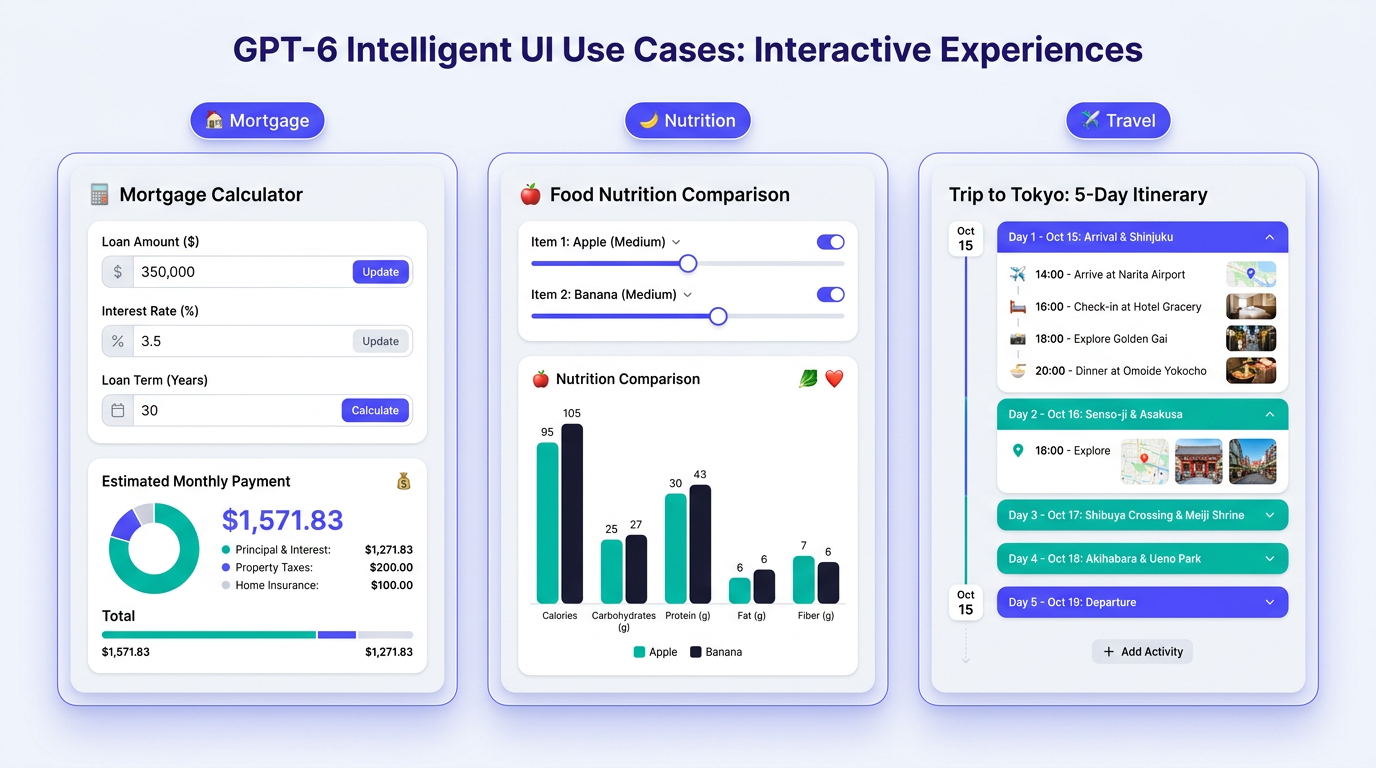
Consider three common tasks. A mortgage calculation could appear as an interactive tool instead of directing users to a financial calculator website. A nutrition comparison could become an adjustable chart rather than a list of external references. A travel-planning prompt could produce an interactive itinerary that users refine inside the conversation. These scenarios illustrate how Intelligent UI may change the discovery experience, but they do not establish that external links disappear in every response or that traditional publishers have already lost traffic from these queries.
Common Misconceptions About GPT-6 Intelligent UI
"This only affects informational queries." No. Transactional and commercial queries are especially suited to interactive rendering: price comparisons, specification tables, and "which plan fits my budget" all demand structured output. The commercial consequence arrives at the point of decision, not later in the funnel.
"Schema markup will solve this." Schema markup can make structured information easier for search systems to interpret, but there is no established evidence that adding schema directly increases the likelihood of a brand's data appearing in GPT-6 widgets. It cannot manufacture a citation surface. Data ingestion and attribution display are separate problems, and treating one as a solution to the other is a category error.
"We can wait for OpenAI to add attribution." Google and OpenAI are both adopting the pattern. Waiting cedes ground on both. OpenAI has not documented a universal citation treatment for generated interfaces, while Google continues to develop more prominent links and source discovery features in AI Search.
What to Measure Now (and How Vizup Fits)
The operating concept is presence monitoring, not citation tracking. Teams need to know when their brand or data appears inside a generated component, even when no footnote exists. That requires watching answer-engine outputs across formats for brand mentions, sourcing patterns, and category-level movement toward widgets.
Vizup's Watcher agent tracks how brands appear across search engines, AI answer engines, and social and community platforms. As interactive answers become more common, teams can combine these visibility signals with direct reviews of generated interfaces to assess brand mentions, visible citations, and shifts in discovery behaviour. Teams can track brand mentions in AI search and measure AI brand presence for the post-citation era. Watch the share of interactive responses in your category, brand-name presence within widgets, and referral decay as adoption rises. AEO without generative UI monitoring is aimed at a shrinking format. AI brand visibility analysis software is now part of the required stack.
Vizup approaches this challenge through its Organic Autopilot for modern discovery. It combines AI agents, human experts, and SEO, pSEO, AEO, and GEO workflows to help brands monitor, create, optimise, publish, and learn across Search, Social, Communities, AI Answer Engines, and Local Discovery. Instead of relying on citation counts alone, brands can connect visibility insights with content improvements and broader organic marketing decisions. Paid advertising can also support this strategy as an amplification add-on.
Key Takeaways
- GPT-6 Intelligent UI can combine text, charts, forms, and interactive tools in one response, changing how users consume information.
- Google began introducing generative UI before OpenAI's October 2026 rollout, signalling a broader move toward interactive discovery.
- Interactive answers may reduce clicks for some self-contained tasks, but they do not automatically eliminate source links.
- Citation visibility remains important, although traditional footnote tracking alone cannot capture every form of brand exposure.
- Recent changes to ChatGPT link tracking show why marketers must distinguish attribution problems from actual traffic declines.
- Brands should monitor citations, visible mentions, interactive response formats, and organic business outcomes together.
- Vizup helps connect AI visibility intelligence with broader organic marketing workflows across multiple discovery channels.
Frequently Asked Questions
What is GPT-6 Intelligent UI and how does it differ from standard ChatGPT answers?
GPT-6 Intelligent UI generates interactive components such as calculators, charts, and forms instead of relying exclusively on text paragraphs. Standard ChatGPT answers generally use prose with source links or citations. Intelligent UI can deliver a working tool, and OpenAI has not documented a universal citation format for those components.
Does GPT-6 Intelligent UI remove citations entirely?
Not for every query. Text answers can still carry source links and citations. When GPT-6 chooses an interactive widget, source information could appear through labels, links, notes, or accompanying text, but no universal widget citation format has been documented.
How does Intelligent UI affect SEO and organic traffic from AI search?
For self-contained tasks, Intelligent UI can reduce the need to visit an external site because the user receives a working tool inside the response. Links and external actions can still appear, so teams should compare referral traffic with broader visibility signals. Brands focused on improving brand visibility in AI search need to measure presence alongside clicks.
Can brands still optimise content to appear in GPT-6 interactive responses?
Brands can improve the accessibility of their information with authoritative, well-structured datasets and a strong content marketing strategy for AI search visibility. Schema supports machine interpretation, but it does not guarantee that data will populate a GPT-6 widget or receive a visible citation.
What tools can monitor brand visibility inside AI-generated UI components?
Vizup's Watcher agent tracks how brands appear across search engines, AI answer engines, and social and community platforms. As interactive answers become more common, teams can combine these visibility signals with direct reviews of generated interfaces to assess brand mentions, visible citations, and shifts in discovery behaviour.
