
ChatGPT topic ownership is what happens when a brand shows up as the default answer across a whole neighborhood of related questions inside AI-generated responses. Its not about spiking a single prompt. Its about being the name ChatGPT reaches for when users ask for definitions, comparisons, use cases, and buying guidance in the same category. By that standard, almost nobody owns anything yet.
A digital land grab is underway, and it is not happening on a search results page. Its happening inside chat windows. A 2026 study from Semrush and Kevin Indig of Growth Memo looked at 1,094 U.S. categories in ChatGPT, spanning more than 220,000 domains and 50,000 brands. The headline finding is the one that should force a strategy reset: about 85% of categories still have no clear brand leader. The playbooks that produced classic search dominance do not translate cleanly here. The metrics, the incentives, and the mental models are shifting. Below is the data behind that shift, plus a practical way to act on it.
What the Data Really Says About AI Visibility at the Topic Level
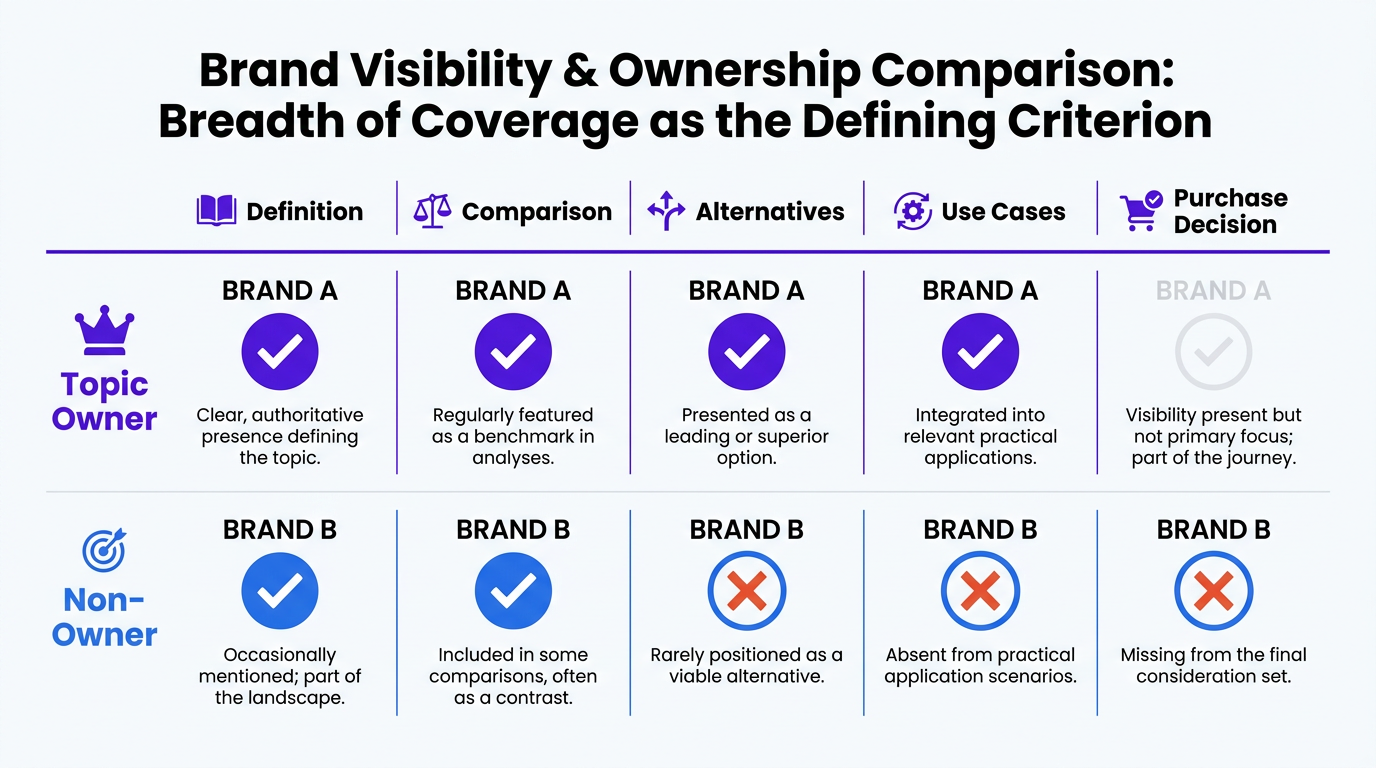
The Semrush ChatGPT study is the most disciplined attempt so far to measure AI mentions at scale without falling into the trap of cherry-picked prompts. Researchers wrote five representative prompts for each of 1,094 categories: definition, comparison, alternatives, use cases, and purchase decisions. They captured monthly snapshots from January through June 2026, producing more than 600,000 citations. The point was not to see who wins a single question on a good day. It was to identify who reliably shows up across the full topic.
Semrush set a high bar for what counts as ownership. A brand had to appear in at least four of the five prompt types and beat the runner-up by at least five percentage points. Under that definition, AI category ownership falls into three clear buckets.
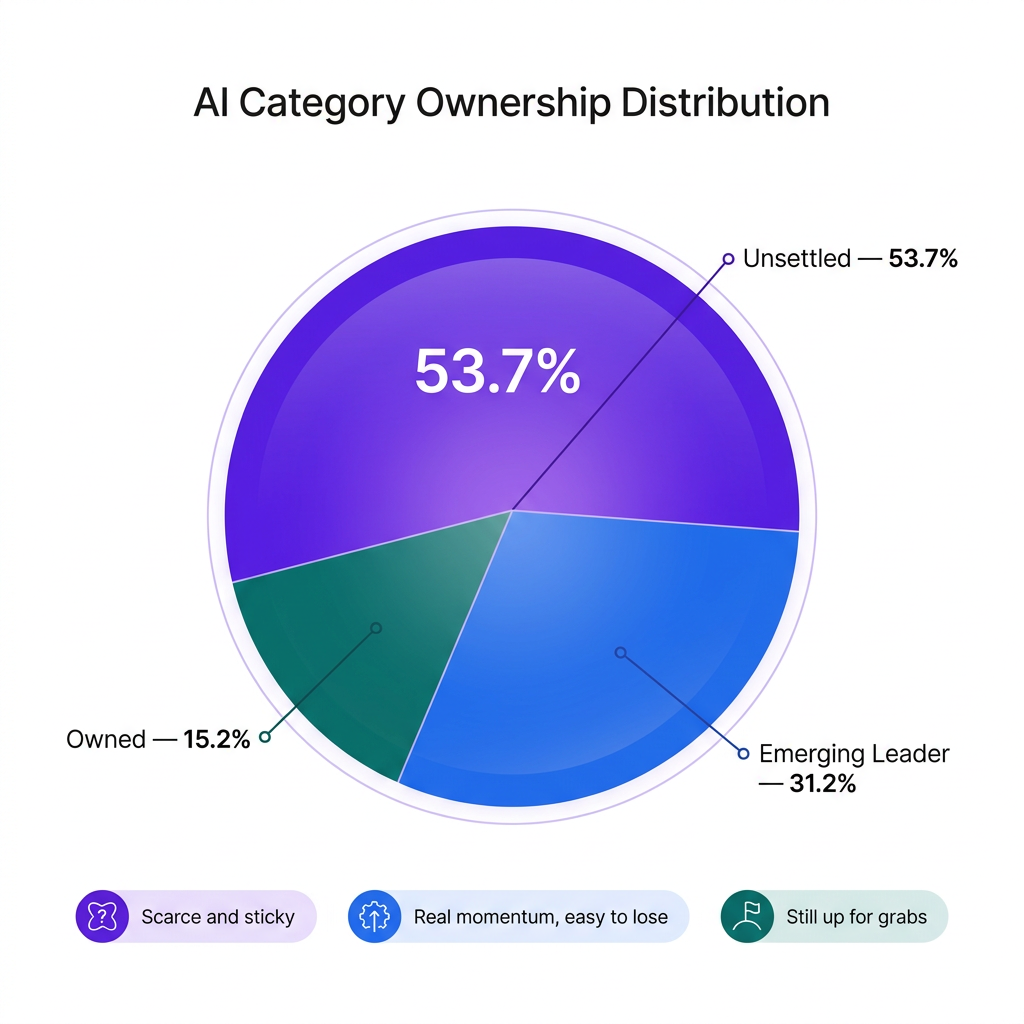
The three states of ChatGPT topic ownership:
- Owned (15.2%): One brand shows up across at least four of five prompt types and holds a five-point lead. These positions are scarce and tend to stick.
- Emerging Leader (31.2%): A brand appears in at least three prompts, but it does not have the lead or breadth to lock the category. Real momentum, easy to lose.
- Unsettled (53.7%): No brand is consistently present. Mentions are scattered, the gaps are small, and the category is still up for grabs.
The weird twist is that the biggest categories by AI search volume are the least likely to be owned. More volume pulls in more competitors, more varied source material, and more fragmented answers. That makes the most commercially attractive territory the most chaotic. It also means there is still room for a brand that is willing to pursue topical authority in AI search with a deliberate, multi-prompt plan instead of a single-query mindset.
The Great Disconnect: Why Your SEO Playbook Is Failing You
If you assumed the brands that win on Google would automatically win inside ChatGPT, the study offers a blunt reality check. Semrush compared familiar SEO signals with actual topic ownership in ChatGPT, and the overlap was a lot thinner than most teams would expect.
| Dimension | The Old Way (Classic SEO) | The New Way (AEO / Topic Ownership) |
|---|---|---|
| Unit of Measurement | Single keyword rankings | Repeat presence across a cluster of related prompts |
| Key Metric | Domain Authority / Authority Score | Brand mention share across prompt types |
| Predictor of Success | Backlinks and organic traffic | Branded search volume (modest); topical consistency (strong) |
| Strategic Goal | Rank #1 for target keywords | Become the default brand answer across definitions, comparisons, use cases, and purchase prompts |
| Traditional SEO metrics predicted AI ownership at rates statistically indistinguishable from a coin flip. |
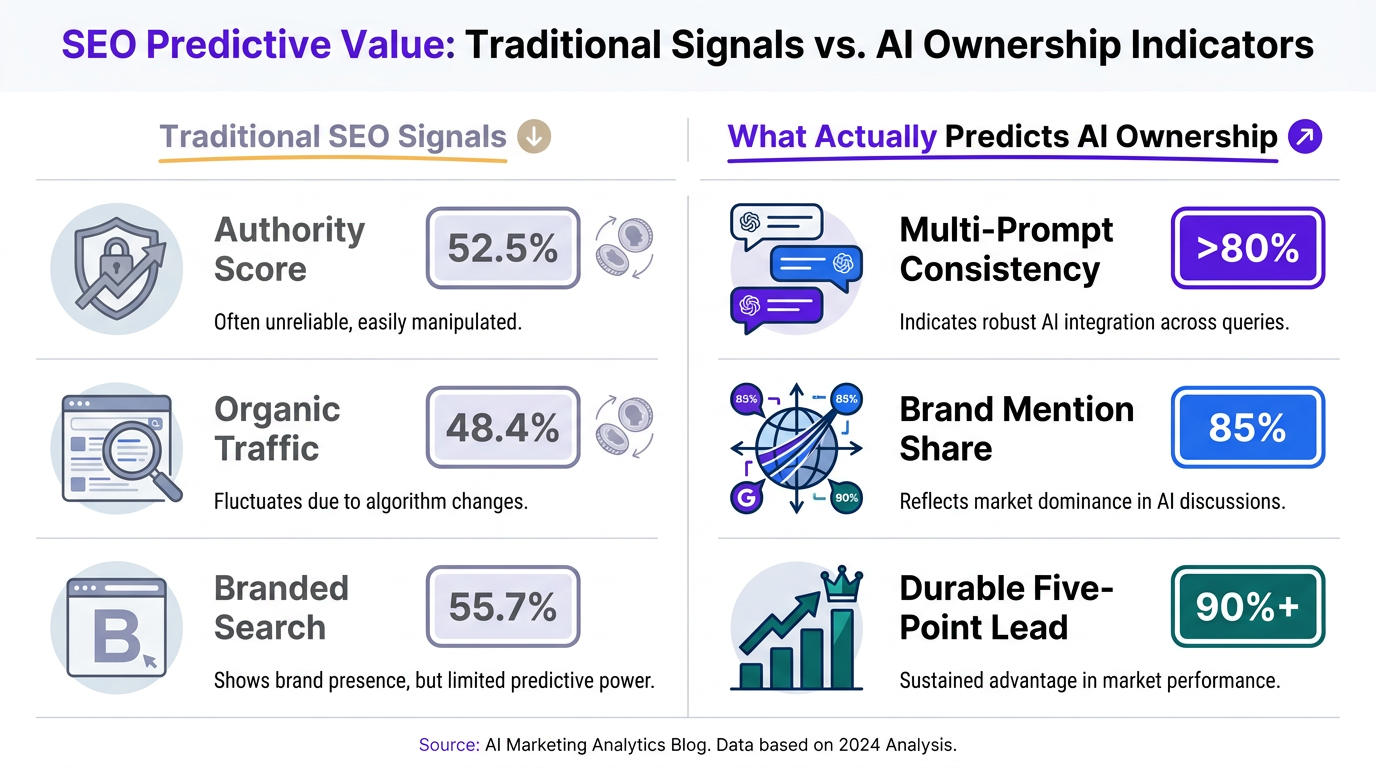
Owners led on Authority Score in just 52.5% of comparisons and on organic traffic in 48.4%. Both are effectively coin-flip territory. Branded search volume was the only classic metric that cleared statistical significance at 55.7%, and even there the relationship was mild. The takeaway is straightforward: strong traditional SEO performance does not automatically translate into ChatGPT topic ownership. Search visibility still matters, but the study suggests that brands also need consistent, topic-level coverage across the different questions buyers ask. This makes prompt coverage and brand mention share important additions to traditional SEO measurement.
None of this makes SEO obsolete. Organic content still feeds the training and retrieval pipelines these systems depend on. The relationship is just less direct, and the filters are different. Getting clear on why great brands are becoming invisible in AI answers, even with strong traditional search performance, is the first step toward a strategy built for how answers are actually produced.
Brand Mentions vs Citations: The Most Important Metric You're Probably Not Tracking
Most teams start by tracking citations: the links and source references ChatGPT attaches to responses. That instinct makes sense. Citations are easy to count, they feel familiar, and they rhyme with the backlink era. The problem is that the Semrush study found citations are a poor proxy for the thing brands actually want: being named.
Warning: The Semrush topic-ownership study found that the most-cited domain was also the most-mentioned brand in only 21% of categories. It also found a slight negative correlation of -0.229 between citations and brand mentions. The two signals should therefore be measured separately.
A separate Semrush analysis from June 2026 put numbers on the same gap: ChatGPTs citation rate is 87%, but its brand mention rate is only 20.7%. That difference is the whole ballgame. A citation is a footnote: evidence the model leaned on a document. A brand mention is the model treating your name as part of the answer. If someone asks, "What's the best project management tool for remote teams?" and ChatGPT recommends your product, thats a mention. If it links to your blog post about remote productivity as support, thats a citation. Mentions build preference. Citations might never be noticed.
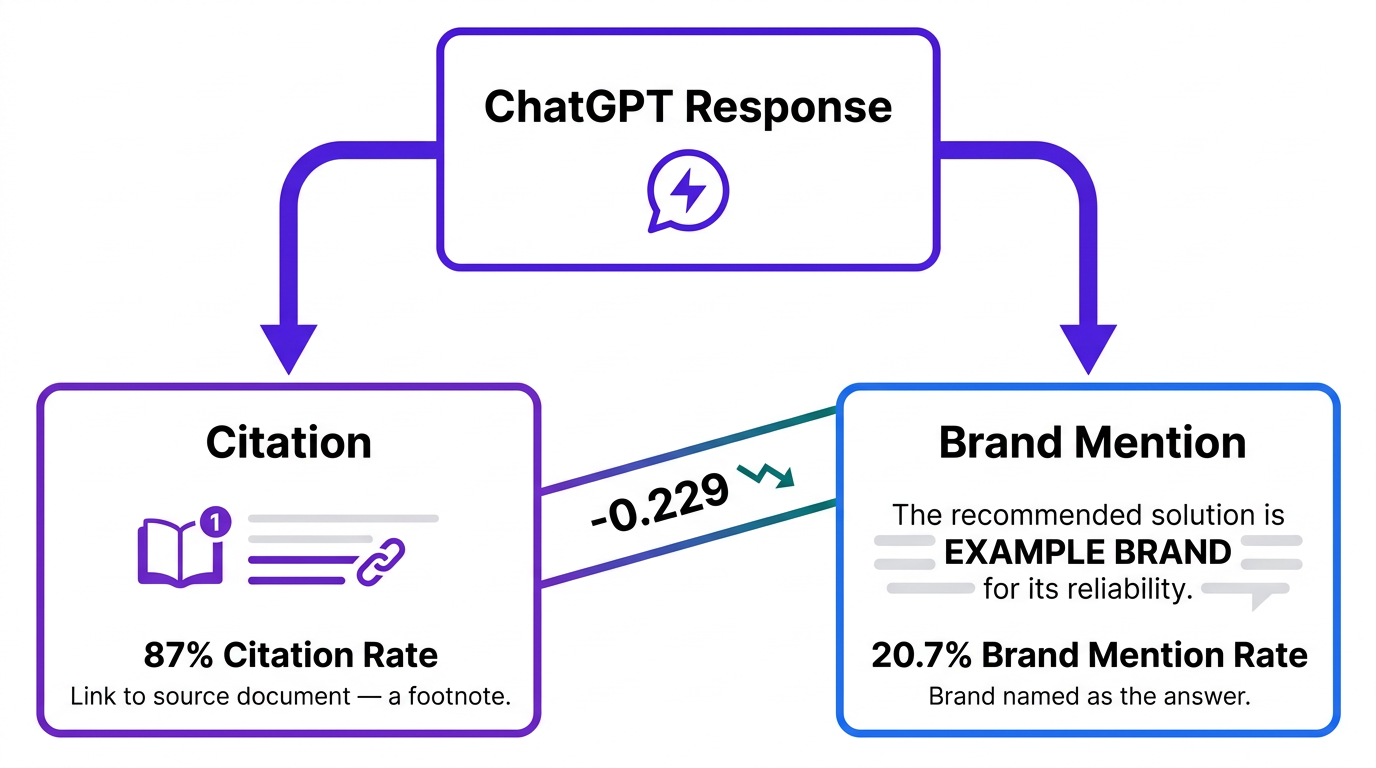
This is why citation-only dashboards can send teams in the wrong direction. You can watch citations climb while your mention share slips, or while a competitor becomes the name users actually see in the body of the answer. Treat mentions and citations as separate instruments. If you want to do this well, you need to track brand mentions in AI search alongside citations, not instead of them. One is a reference trail; the other is market position.
The Anatomy of an AI Topic Owner
So what separates the 15.2% from everyone else? The ownership criteria were intentionally strict, meant to surface brands with durable category control rather than one-off prompt luck. Across owners, two traits show up every time: broad consistency and a lead that holds.
Consistency Across Prompt Types
An owner appears in at least four of five prompt types: definition, comparison, alternatives, use cases, and purchase decisions. That requirement is doing real work. It forces you to win across the full set of questions a buyer asks as they move from curiosity to evaluation to purchase. A brand that owns "What is X?" but vanishes from "Best alternatives to Y" or "Should I buy Z?" is not an owner. The model has not learned to treat it as a category default.
This is where AI visibility breaks cleanly from classic keyword targeting. In traditional SEO, you could rank for a handful of isolated queries and still call it a win, even if adjacent intent was uncovered. In AI search, the model is synthesizing an answer from its broader understanding of the topic space. The brands that keep appearing across prompt types are the ones it has internalized as leaders. The practical move is to find your missing prompt types and fix them. Vizup's Answer Engine Monitoring helps teams identify where their brand appears, where it is absent, which sources are being cited, and how visibility changes across answer engines. This provides a clearer starting point than relying on isolated manual checks.
Durability: The Power of a Meaningful Lead
Consistency is table stakes, but it does not matter much if the race is a photo finish. In the study, owners with a five-percentage-point lead over the runner-up kept the top spot in 90% of month-over-month comparisons. Thin leads churn. A brand at 18% mention share with a competitor at 16% is not an owner; its one model update away from losing the headline.
Strategically, this pushes you to aim past "first" and toward separation. That five-point gap provides a useful benchmark: brands that reached it retained first place in 90% of the study's month-over-month comparisons. The hard climb is moving from "emerging" to "owned." After you have a real lead, the category becomes surprisingly sticky.
How to Compete for ChatGPT Topic Ownership: A New Framework
The data is useful only if it changes what you do on Monday. The operating model here is topic-level, not prompt-level. Stop asking, "Do we show up for this one query?" Start asking, "Across all the ways a buyer asks about this category, are we the default answer?"
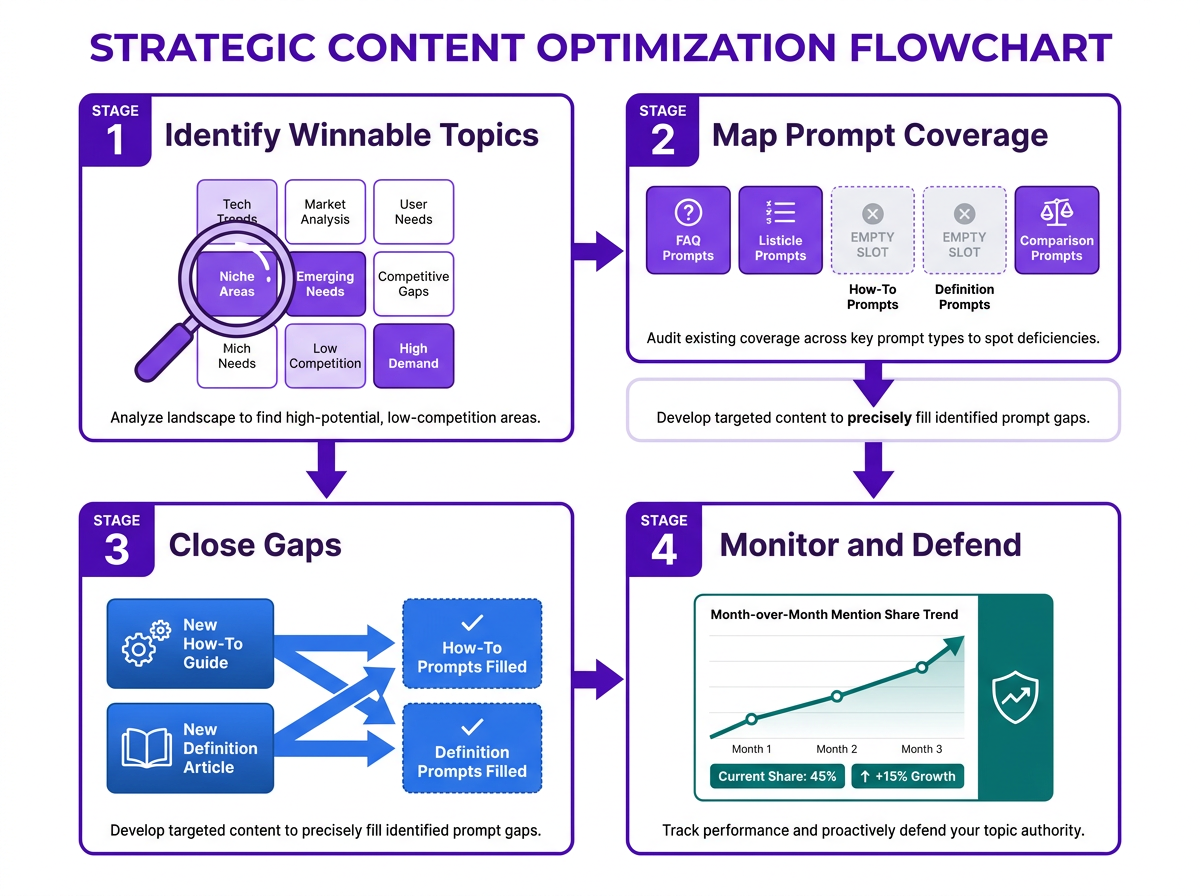
Stage 1: Identify winnable topics. Not every category deserves equal effort. The study shows the highest-volume categories are often the hardest to lock down. Look for categories where you already have a foothold (appearing in two or three prompt types) or where nobody has even established an emerging lead. Then do prompt research to find the questions buyers ask ChatGPT in the categories you care about.
Stage 2: Map your prompt coverage. For each target category, audit where your brand appears across all five prompt types, and where it does not. Note which competitors show up in the slots you are missing. This turns a vague goal ("be more visible") into a concrete gap list tied to the four-of-five threshold. Keep in mind that different answer engines surface different sources, so understanding why major answer engines cite different sources helps you decide which engines to watch first.
Stage 3: Close the gaps. This is where content strategy, positioning, and brand signals collide. Missing from "alternatives" prompts? You need coverage that places your brand in competitive context, including third-party mentions that the model is likely to ingest or retrieve. Missing from "purchase decision" prompts? Prioritize reviews, clear pricing, and buyer-facing pages that answer the questions people ask right before committing. The goal is not volume. Its precision: filling the specific prompt-type holes that keep you out of the ownership set.
Stage 4: Monitor and defend. Ownership is not a trophy you put on a shelf. Small leads evaporate fast, and you do not want to find out after the category has already flipped. Track mention share across prompt types month over month so you can see erosion early. This is the kind of consistency tracking Vizup's Watcher and Strategist Agents support, helping teams move from reactive spot-checks to proactive category defence. If you need a measurement baseline, you can measure your AI brand presence systematically instead of relying on anecdotes.
Common Misconceptions About AI Topic Ownership
"If we rank #1 on Google, we'll dominate ChatGPT too." The study does not support that assumption. Authority Score and organic traffic predicted AI ownership at roughly coin-flip rates. Google rankings and ChatGPT mentions are produced by different systems with different incentives, and treating them as interchangeable is how teams miss whats happening.
"Our citation count is growing, so our brand visibility must be improving." Citations and brand mentions move independently, and in the study they correlated slightly negatively. A rising citation count can hide the more important trend: whether your brand is being named less often while someone else becomes the default answer. If you only track citations, you are watching the wrong scoreboard.
"We won a prompt, so we own the topic." A prompt win is a moment, not a position. Ownership means showing up across at least four of five prompt types and holding a durable lead. Brands that celebrate isolated wins without measuring cross-prompt consistency are mistaking a skirmish for a campaign. Picking the right AI brand visibility analysis software matters because you need topic-level pattern detection, not a scrapbook of screenshots.
The Opportunity Is Now
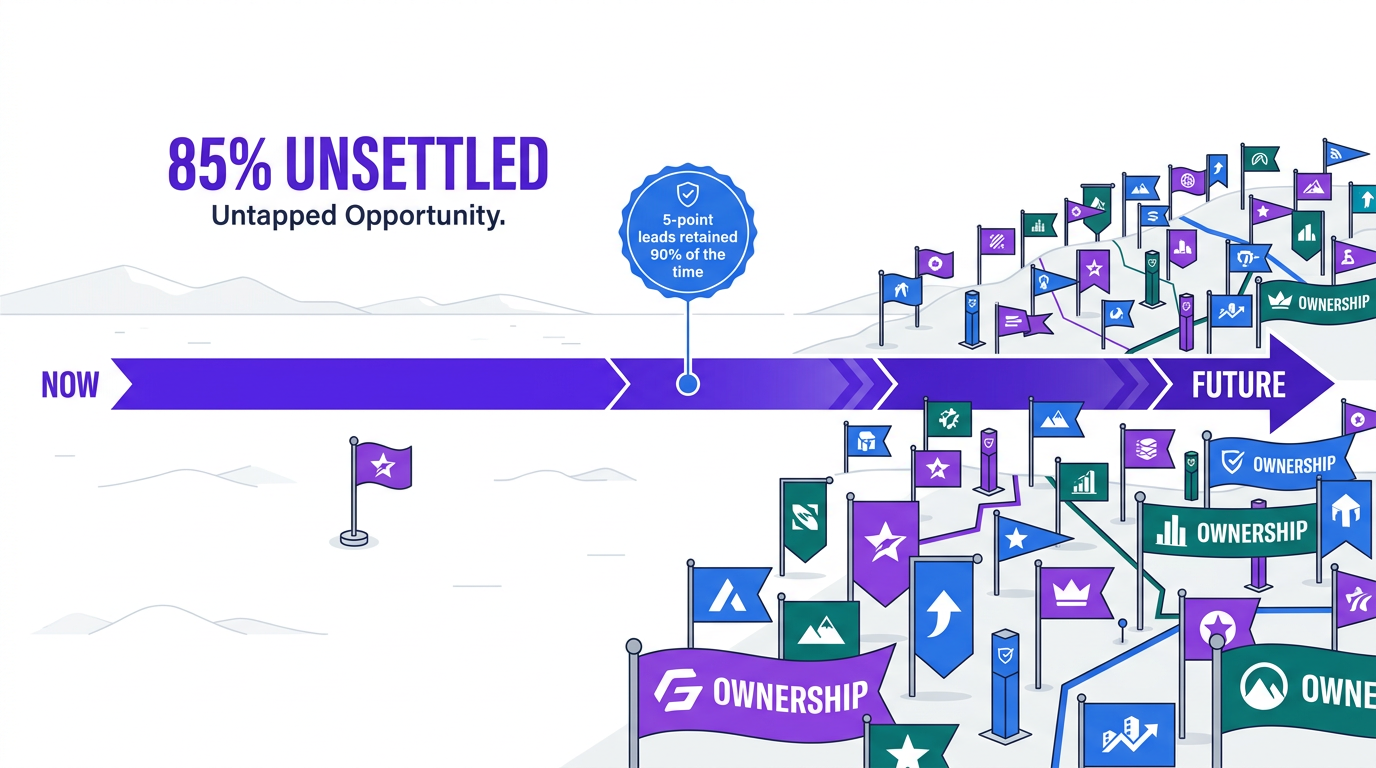
The Semrush ChatGPT study should be energizing if you are responsible for growth: 85% of categories still have no clear owner. The familiar SEO signals do not reliably predict who will win. Mentions, not citations, are the metric that maps to category leadership. And the competitive unit is a cluster of related prompts, not a single keyword victory lap.
Windows like this do not stay open for long. The map is being drawn in real time, and most of it is still blank. Brands that move early, with the right measurement and a topic-level plan, can define what ownership looks like in their categories. Brands that wait will run into five-point gaps that tend to stick, with that 90% retention rate turning into a headwind.
Stop treating AI visibility like a one-prompt experiment. Build ownership at the topic level and measure it across every place where customers discover and evaluate brands.
Vizup is an Organic Autopilot for modern discovery. It helps brands monitor, create, optimise, publish, and learn across Search, Social, Communities, AI Answer Engines, and Local Discovery. Vizup combines AI agents, human experts, and live SEO, pSEO, AEO, and GEO tools in one connected workflow. Paid ads are available as an amplification add-on. Start with the complete guide to AI search performance analytics, then turn the findings into an ongoing visibility strategy.
Key Takeaways
- Only 15.2% of 1,094 ChatGPT categories have a clear brand owner. Another 31.2% show an emerging leader, and 53.7% remain fully unsettled.
- Traditional SEO metrics (Authority Score, organic traffic) predict AI topic ownership at roughly coin-flip rates. Branded search volume is the only conventional metric with statistical significance, and even that effect is modest.
- Brand mentions and citations are different signals, and they correlate slightly negatively (-0.229). Citation dashboards do not equal brand visibility.
- Ownership means appearing in at least four of five prompt types and holding a five-percentage-point lead. One prompt win is not ownership.
- Once a five-point lead exists, it holds 90% of the time month over month. Early movers capture compounding, durable advantage.
Frequently Asked Questions
What is ChatGPT topic ownership?
ChatGPT topic ownership is when a brand becomes the default name that appears across a set of related prompts in a specific category inside AI-generated answers. In the 2026 Semrush/Growth Memo study, ownership required showing up in at least four of five prompt types (definition, comparison, alternatives, use cases, purchase decision) and leading the next competitor by at least five percentage points.
How is AI topic ownership different from SEO domain authority?
Domain authority is a traditional search concept tied to a sites link equity and ranking potential. AI topic ownership is about a brands mention share across a cluster of AI prompts. In the Semrush study, Authority Score predicted AI ownership in only 52.5% of comparisons, which is statistically no better than a coin flip. They are driven by different mechanisms.
Why are brand mentions more important than citations in AI search?
A citation is a link to a source document; a brand mention is the model naming your brand in the body of the answer as an option or recommendation. In the Semrush study, the most-cited domain matched the most-mentioned brand in only 21% of categories, and citations vs. mentions showed a slight negative correlation of -0.229. Mentions shape recognition and consideration; citations often function as background evidence. Vizup breaks this down further in its guide on improving brand visibility in AI search.
What percentage of ChatGPT topics currently have a clear brand leader?
15.2% of the 1,094 U.S. categories studied had a clear brand leader. Put differently, roughly 85% of topics are either contested by an emerging leader (31.2%) or completely unsettled (53.7%). The study also found that the largest categories by AI search volume are the least likely to have an owner.
How can I start tracking my brand's AI visibility at the topic level?
Pick target categories, then audit whether your brand appears across the five prompt types: definition, comparison, alternatives, use cases, and purchase decisions. Track brand mention share (separately from citations) month over month. Tools like Vizup's Watcher automate topic-level monitoring across AI answer engines. For a step-by-step process, see this guide on LLM visibility tracking tools.
