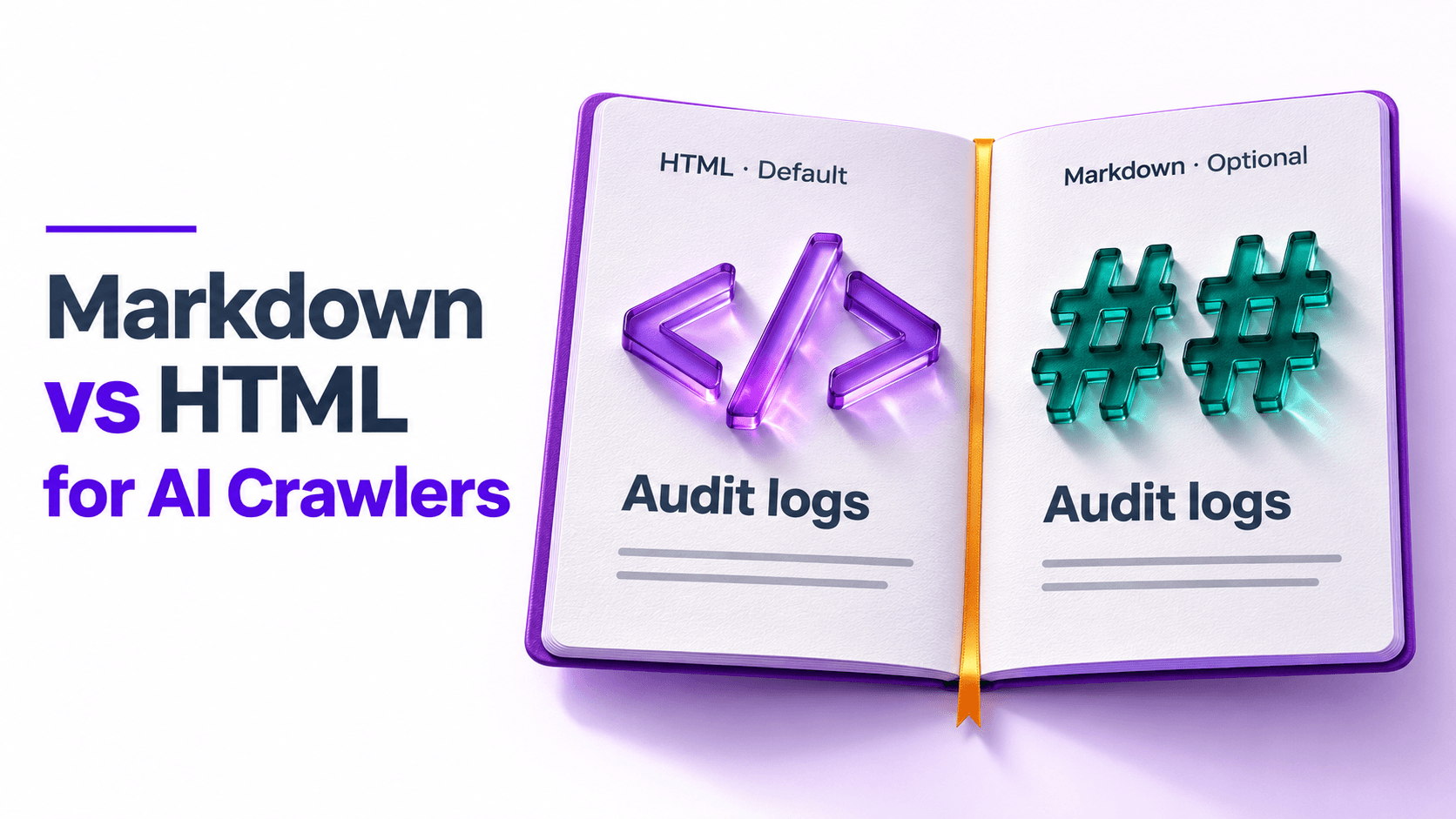
AI answer engines fetch, summarise and cite pages for users. Cloudflare's Markdown for Agents has put the format of those pages under scrutiny.
Start with crawlable, semantic HTML. No major AI platform or Google documents Markdown as a requirement or ranking factor. Offering it alongside HTML can reduce processing costs, but it remains optional.
Same Page, Two Formats: What Markdown and HTML Actually Look Like
HTML carries browser-rendered content, metadata, navigation, scripts and structured data. Markdown uses plain-text syntax created by John Gruber and later standardised through the CommonMark specification.
| HTML (line by line) | Markdown (same content) |
|---|---|
| <article> | ## Why Audit Logs Matter |
| <h2>Why Audit Logs Matter</h2> | Logs show which bots fetch your pages. |
| <p>Logs show which bots fetch your pages.</p> | - Spot AI crawler visits |
| <ul><li>Spot AI crawler visits</li> | - Find broken URLs |
| <li>Find broken URLs</li></ul> | Read the checklist |
| <a href="/checklist">Read the checklist</a> | (No schema, meta tags or navigation) |
| </article> | |
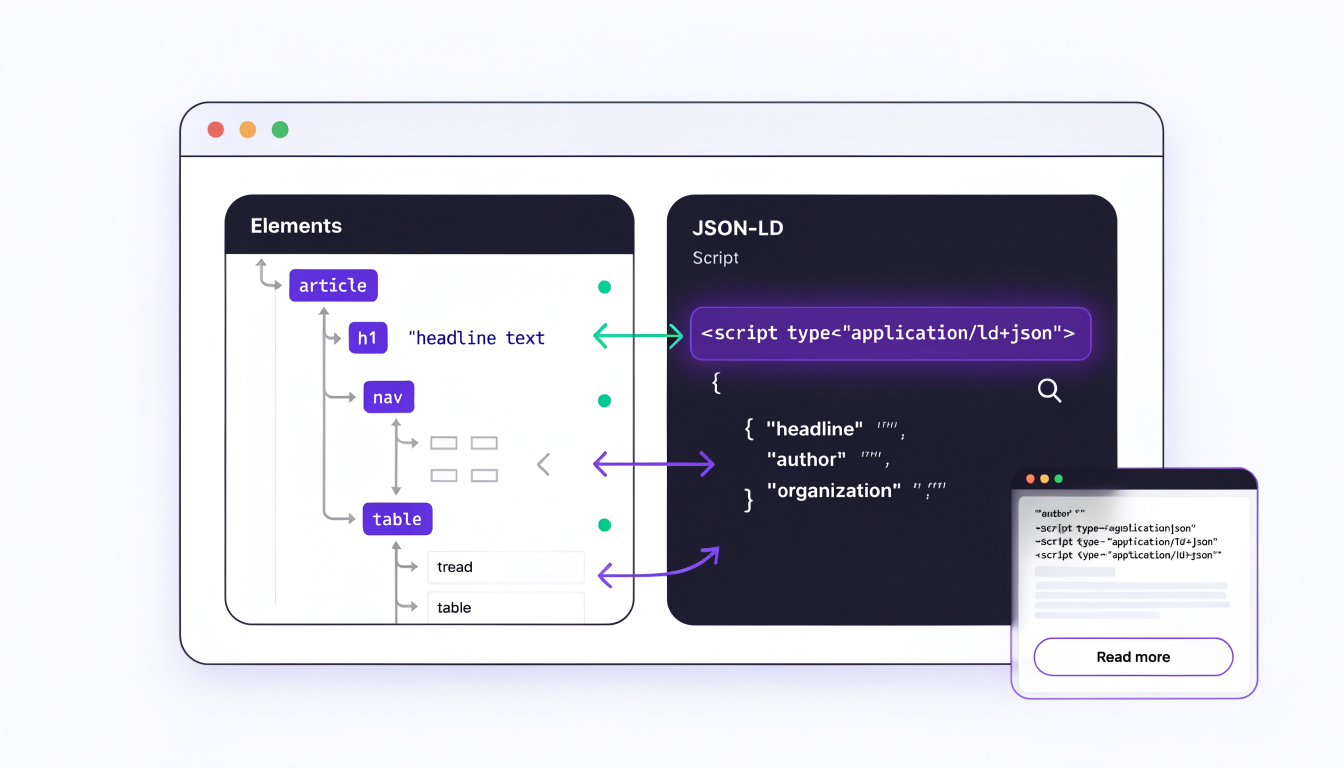
| <script type="application/ld+json">{"@type":"Article"}</script> | |
| The shorter version drops JSON-LD and page chrome. |
Cleaner text comes at a cost: information outside the article body can disappear during conversion.
How AI Crawlers Find, Fetch and Use Your Content
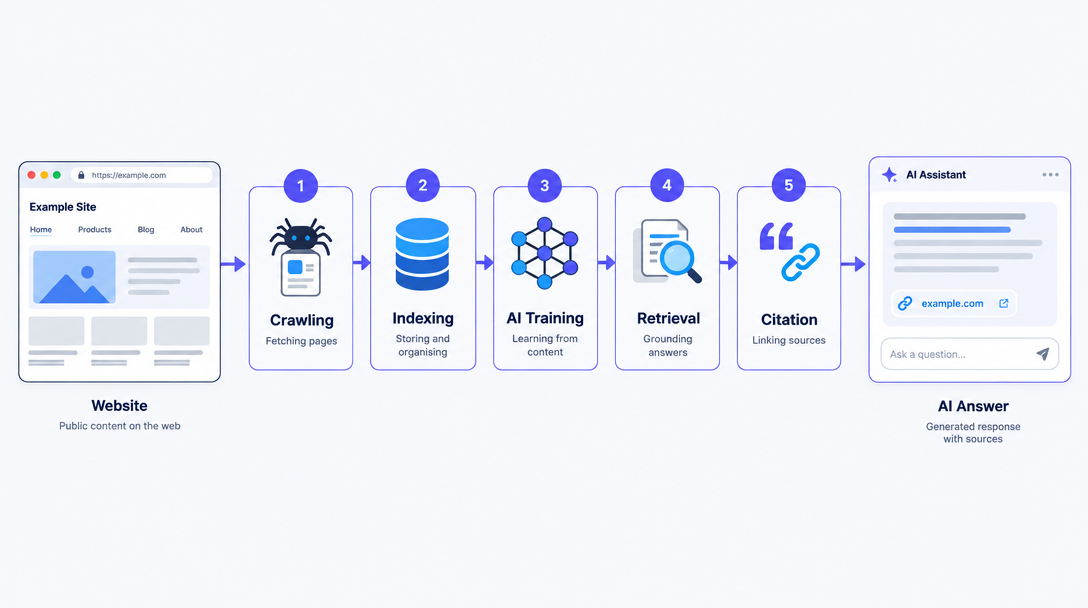
Separate these jobs:
- Crawling: fetching pages.
- Indexing: storing and organising pages for search.
- AI training: collecting content to train models.
- Retrieval: fetching sources to ground an answer.
- Citation: linking sources in generated answers.
OpenAI's documented bots distinguish training (GPTBot), search (OAI-SearchBot) and user-initiated fetches (ChatGPT-User). Set robots.txt rules accordingly; our guide to checking whether AI crawlers are blocked explains how. Cloudflare's crawler categories make similar distinctions.
Some AI retrieval systems remove navigation and other unnecessary elements to extract the main content before processing it. Some crawlers reportedly skip JavaScript, missing client-rendered content. Check platform documentation and logs.
Content format can influence extraction efficiency, but Markdown has no established ranking advantage over HTML. See how AI search engines retrieve and cite content.
Five Criteria for Comparing Markdown and HTML
Compare the engineering trade-offs:
- Extraction fidelity: does meaningful content survive?
- Token efficiency: how much context does it consume?
- Structure and metadata preservation: are schema, canonicals, hreflang and links retained?
- Search ecosystem compatibility: which platforms support it?
- Implementation and maintenance cost: what work and failure risks follow?
Platforms publish no weightings for these criteria. They are engineering checks, not ranking factors.
Markdown for AI Agents: Lean and Legible, With Trade-Offs
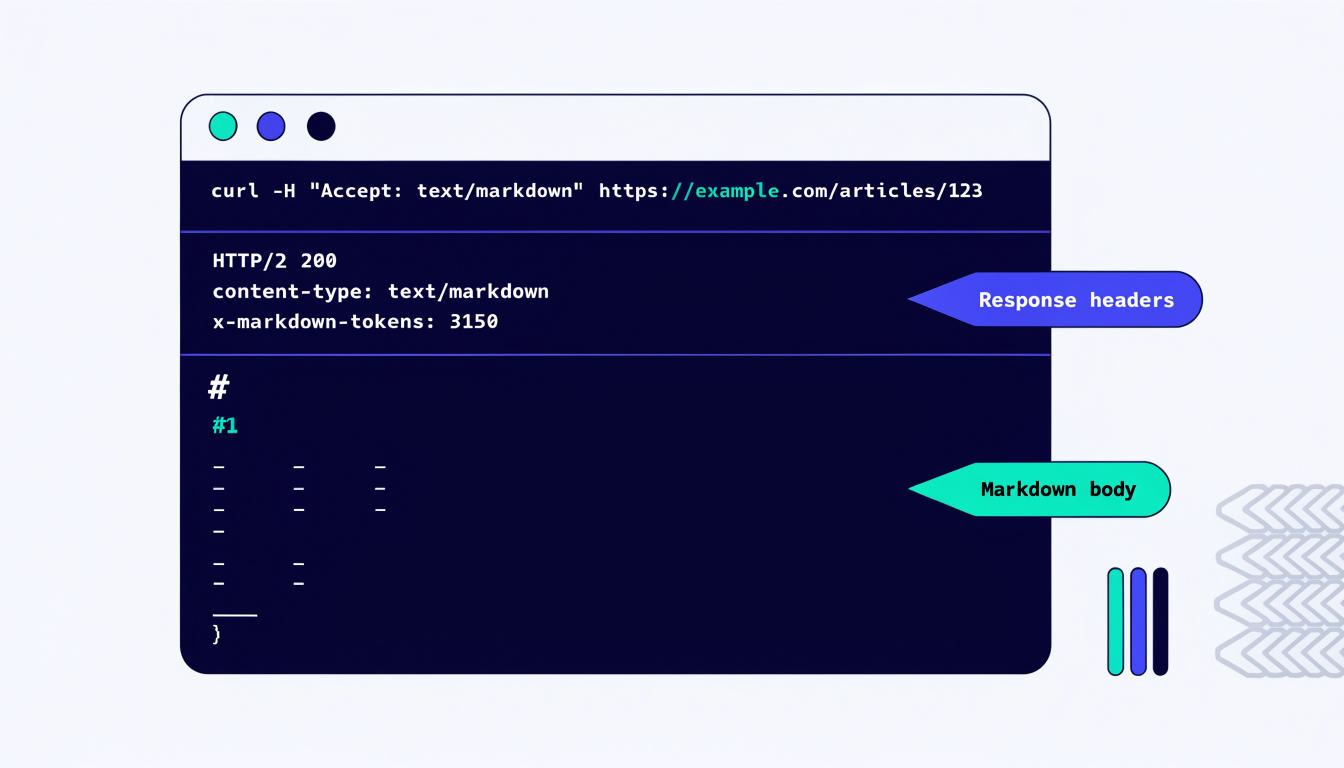
Cloudflare's announcement measured its post at 16,180 HTML tokens versus 3,150 Markdown tokens: roughly 80% fewer. Its x-markdown-tokens header reports estimated counts. Fewer tokens leave more context space and reduce processing costs, without proving a ranking or citation benefit.
Headings, lists, tables and code generally survive well; ads, scripts and navigation disappear. Documentation and long articles suit that trade-off.
Warning: Check what survives conversion. Cloudflare preserves JSON-LD and selected metadata, but navigation, canonical and hreflang tags, and interactive features may not carry over. Consult the Cloudflare documentation for converter behaviour.
HTML for AI Crawlers: The Format Everyone Already Reads
HTML is the standard format for websites and is widely supported by browsers, search engines and AI crawlers. Google indexes it and uses it for AI Overviews and AI Mode.
Semantic article, nav and table elements, heading hierarchies and structured data preserve explicit meaning. HTML also supports discovery through sitemap formats.
The practical balance:
- Pro: broad browser and crawler compatibility.
- Pro: metadata, structured data and accessibility features.
- Con: bloated, div-heavy templates waste tokens.
- Con: JavaScript-only content can escape crawlers.
Markdown vs HTML for AI Crawlers: The Head-to-Head Table
| Criterion | Markdown | Semantic HTML |
|---|---|---|
| Extraction fidelity | Clean text, lists, tables and code; omits chrome | Rich page structure; extraction quality depends on implementation. |
| Token efficiency | Fewer tokens; Cloudflare documented one example | Depends on template weight |
| Heading, list and table structure | Simple syntax | Explicit semantic tags |
| Metadata and structured data | Converter-dependent. Cloudflare preserves JSON-LD and selected metadata. | Supported in head and body |
| Links and navigation context | Body links retained; navigation context lost | Complete navigation and link graph |
| Interactivity and JavaScript | Does not natively support interactive forms or tools. | Supported; some crawlers miss JS-only content |
| Browser support | Not rendered by default | Universal |
| Search engine support (Google, Bing) | Not a documented requirement | Indexed format |
| AI agent support | Growing through negotiation; not universal | Widely supported; rendering capabilities vary. |
| Implementation effort | Edge conversion, CMS generation or native Markdown publishing. | Already deployed |
| Maintenance and parity risk | Versions can drift | Primary representation; template quality still matters. |
| Best use case | Documentation, knowledge bases, markup-heavy articles | Every public website |
| Check platform documentation; these comparisons are not invented benchmarks. |
Choose efficiency without sacrificing reach or metadata.
Serving Markdown Through HTTP Content Negotiation
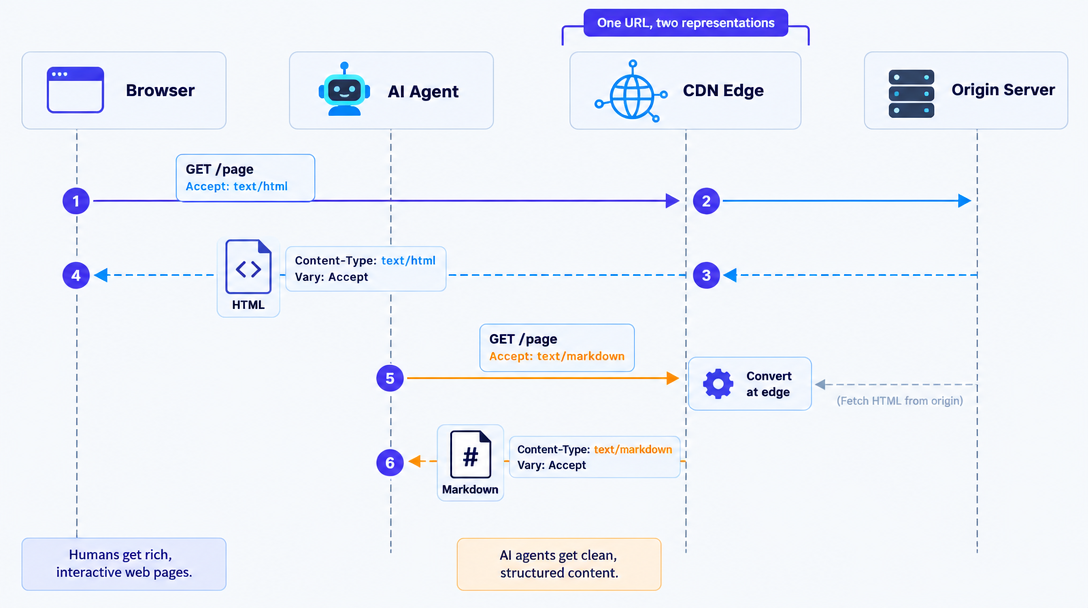
HTTP content negotiation uses Accept headers to serve HTML to browsers and Markdown to requesting agents at one URL. No duplicate site is needed; see why parallel Markdown pages hurt UX.
Cloudflare's Markdown for Agents
Cloudflare converts HTML at the edge for Accept: text/markdown requests, adding x-markdown-tokens and Content-Signal headers. Check official docs for plans, configuration and limitations.
Headers, Parity and Caching: The Details That Break Things
Return Content-Type: text/markdown; charset=utf-8 and Vary: Accept. Verify cache keys respect Accept so browsers never receive cached Markdown.
Keep facts, prices and claims identical across versions. Material differences for bots risk violating Google's cloaking policy. An optional link rel="alternate" type="text/markdown" can advertise the alternative.
Test It Yourself With curl
Test a URL you control:
- Headers: curl -sI -H 'Accept: text/markdown' https://example.com/page
- Body: curl -s -H 'Accept: text/markdown' https://example.com/page | head -n 20
- Default response: curl -sI https://example.com/page
Check Content-Type, Vary: Accept and preserved headings, prices and tables. The default response should remain text/html.
Markdown, llms.txt, robots.txt, Sitemaps and Schema: Who Does What?
Each serves a distinct purpose:
- Markdown: the page's content format.
- llms.txt: a proposed curated page index; major platforms' usage remains undocumented. See the llmstxt.org homepage.
- robots.txt: per-agent access rules, including Google's Google-Extended product token.
- XML sitemap: URL discovery.
- Structured data: explicit entity meaning.
These work together, not interchangeably. Allow appropriate bots, expose URLs and preserve extractable meaning. Start with our AI crawler checker.
What Google Actually Says About AI Search Optimisation
Google's AI optimisation guide and AI features documentation require indexed, snippet-eligible pages for AI Overviews and AI Mode. No additional technical requirements apply.
Google explicitly says special machine-readable or AI-specific files are unnecessary. Markdown isn't a universal prerequisite; generative engine optimisation builds on SEO, as our guide to brand visibility in AI search explains.
How to Measure AI Crawler Activity and AI Visibility
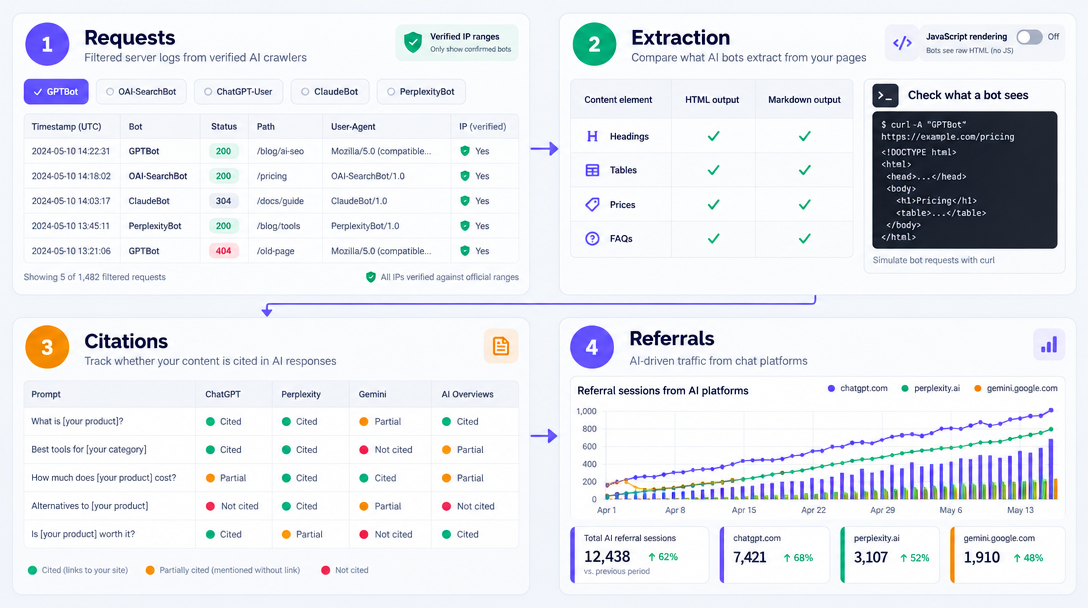
Measure access separately from visibility:
- Requests: filter server/CDN logs for GPTBot, OAI-SearchBot, ChatGPT-User, ClaudeBot and PerplexityBot. Verify suspicious IPs against published ranges. Cloudflare analytics reports Markdown requests.
- Extraction: compare HTML and Markdown using curl and JavaScript-disabled checks. Inspect headings, tables, prices and FAQs.
- Citations: track fixed prompts across ChatGPT, Perplexity, Gemini and AI Overviews. Vizup's Answer Engine Monitoring explains the records to keep.
- Referrals: inspect chatgpt.com, perplexity.ai and gemini.google.com in GA4. Search Console includes AI Overviews and AI Mode within Web totals, without separate reporting.
The Verdict: Which Format Should You Choose?
HTML remains the foundation. Add Markdown when agent processing efficiency justifies maintaining another representation, not because you expect a ranking boost.
Match the investment to the site:
- Semantic HTML: every public website, especially schema-dependent ecommerce, local and marketing sites.
- Negotiated Markdown: frequently fetched documentation, developer tools, knowledge bases and markup-heavy articles.
- Wait: small sites with clean HTML and no measured agent traffic.
Audit access before adding formats. Our checklist on whether your site is AI agent friendly provides a starting point.
Frequently Asked Questions
Do AI crawlers prefer Markdown?
There is no established universal preference for Markdown across AI search platforms. HTML is universally supported; requesting agents can use Markdown for efficiency. Compare the head-to-head table.
Does AI search require a separate Markdown website?
No. Google requires indexable, snippet-eligible pages, not special formats. Serve optional Markdown through negotiation at the existing URL.
Can Markdown damage Google rankings?
Not by itself. Preserve HTML parity and configure Vary: Accept correctly. Material differences for bots risk violating cloaking rules.
Is llms.txt equivalent to serving Markdown?
No. It proposes an index of pages, rather than another page representation. Adoption varies across platforms. Google confirms that it does not use llms.txt for Search.
How do I check for AI crawler visits?
Filter server/CDN logs for GPTBot, OAI-SearchBot or PerplexityBot and verify IP ranges. Use our AI crawler checker alongside log reviews.
Build for Humans, Serve Agents Well, Then Measure Both
Start with three checks:
- Check whether essential content is accessible in the initial HTML response.
- Run the curl tests on priority URLs.
- Track crawler requests and citations.
Choosing the right content format is only one part of improving organic discovery. Brands also need to understand whether their pages are accessible, how they appear in AI answers and where optimisation is needed.
Vizup is an Organic Autopilot for modern discovery, helping brands monitor, create, optimise, publish and learn across Search, Social, Communities, AI Answer Engines and Local Discovery using AI agents, human experts and live SEO, pSEO, AEO and GEO tools. Paid ads are available as an optional amplification add-on.
With Website Optimizer and Answer Engine Monitoring, brands can connect technical improvements with ongoing visibility tracking.
Explore Vizup to build a stronger organic discovery strategy.
