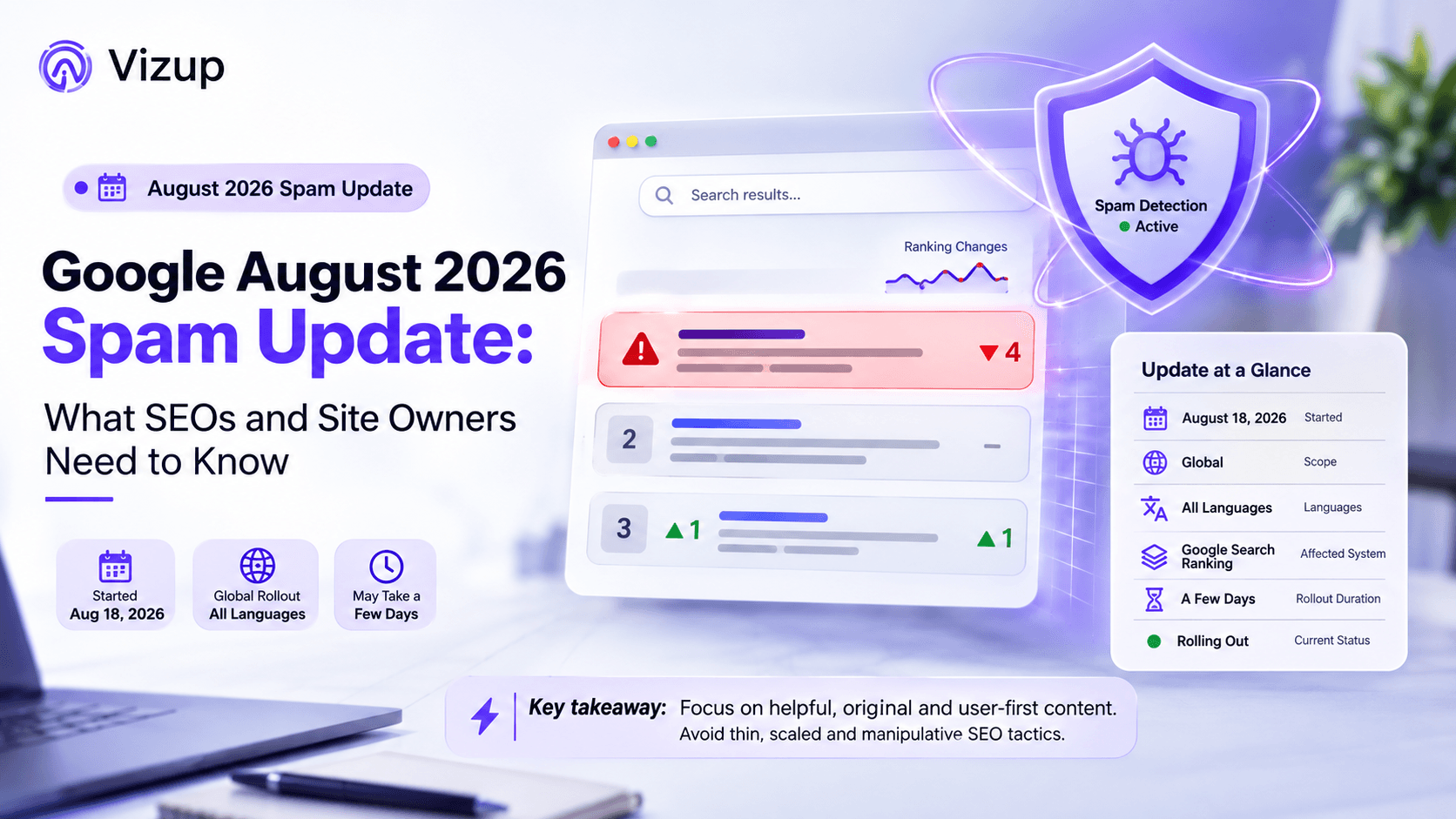
Google began rolling out its August 2026 spam update on August 18, 2026, the third confirmed anti-spam update this year. Unexpected movement in your analytics may be connected to the rollout.
Updates range from minor tremors to genuine disruptions. Don't panic over early data: establish what Google is targeting, then separate a real issue from ordinary search volatility.
1. Google Has Started Rolling Out the August 2026 Spam Update
Google announced the August 2026 spam update on August 18, 2026. Its Search Status Dashboard describes a global rollout affecting every language, expected to take a few days. The change is live across Google's ranking systems.
Google has not introduced new spam policies for this update. Instead, it is improving enforcement against sites that already violate documented policies - less a new rulebook than stricter policing of the existing one.
2. What Is a Google Spam Update?
Google's spam systems crawl and assess the web continuously. An update marks a more notable improvement to those systems.
These releases strengthen automated detection beyond its daily work. Google's anti-spam effort is centered on SpamBrain, an AI-based prevention system launched in 2018. It is built to spot manipulative tactics, including spammy links and low-quality content, often before indexing. Not every spam update is solely about SpamBrain, but it remains central to Google's anti-spam work.
3. What Google Has Officially Confirmed About the August 2026 Update
Google's announcement and industry reporting establish the following details.
| Attribute | Details |
|---|---|
| Update Name | August 2026 Spam Update |
| Rollout Started | August 18, 2026 |
| Scope | Global |
| Languages | All languages |
| Affected System | Google Search ranking |
| Rollout Duration | A few days |
| Current Status | Rolling out |
| *Official details of the August 2026 Spam Update. * |
4. What Types of Spam Could Put a Site at Risk?
Google has not named fresh targets, so the relevant reference is its existing spam policy. This update may simply improve detection of one or more long-standing violations.
Scaled Content Abuse
This means producing pages at scale primarily to manipulate rankings rather than serve users. The production method - AI, human, or both - is not the issue; scale without value is. It was a major focus of the March 2026 spam update.
Site Reputation Abuse
A news publisher hosting third-party "best payday loans" pages is the familiar example. Unrelated content borrows the host site's ranking signals. Google expects a site's reputation to align with the material it publishes.
Expired Domain Abuse
Buying a former veterinarian's domain and turning it into a casino-review site is expired domain abuse. The aim is to exploit residual authority for an unrelated subject, which Google treats as manipulation.
Other Classic Spam Tactics
SpamBrain also looks for familiar violations:
- Link Spam: Paid links, large-scale exchanges, and automated low-quality links.
- Keyword Stuffing: Out-of-context keywords or numbers inserted to manipulate rankings.
- Doorway Abuse: Near-identical pages targeting keyword variants and funneling visitors to one destination.
- Cloaking and Hidden Content: Showing Googlebot different material from users, or concealing ranking text and links.
5. Does AI-Generated Content Automatically Count as Spam?
AI-generated content is not automatically spam. The method of production is not Google's test.
Intent is. Under Google's spam policies for generative AI, content made primarily to manipulate search rankings without value is the problem. Thousands of thin, unedited AI articles are risky. AI used by a human expert to produce genuinely useful work is not.
Assess AI-assisted pages plainly: Do they add original insight? Were they fact-checked and reviewed by an expert? Do they meet search intent better than current results? If not, the production method will not rescue them. how Google catches AI spam offers useful context.
6. What Should You Monitor During the Rollout?
Do not make decisions from one day's data. Wait for the rollout to finish, then use Google Search Console to isolate where movement occurred:
- Overall Performance: Compare clicks, impressions, and average position before and after the update.
- Query & Page-Level Losses: Specific lost queries or pages reveal more than a site-wide decline.
- Directory Performance: A damaged section can point to programmatic pages or a shared template.
- Manual Actions: Check GSC's Manual Actions section; algorithmic updates and human action can coexist.
- Indexed Pages: A sharp decline in indexed pages is a warning sign.
7. What to Do If Your Rankings Drop
A traffic decline is unpleasant. Treat it as an investigation, not an emergency.
- Step 1: Don't Immediately Reverse Changes. Let the rollout finish; correlation is not causation.
- Step 2: Identify the Pattern. Determine whether losses affect the whole site or content types such as affiliate, guest, or programmatic pages.
- Step 3: Review Google's Spam Policies. Compare affected pages directly with Google's spam examples.
- Step 4: Audit Content at Scale. Find thin, duplicated, or heavily templated sections where pages are substantially alike.
- Step 5: Review Your Link Profile. Check for aggressive exchanges, unrelated paid placements, and low-quality directories. SpamBrain can devalue those links.
8. Can You Recover From a Google Spam Update?
Recovery takes time. Google says sites that correct policy violations can improve after its systems reassess them through recrawling and re-indexing.
That does not guarantee former rankings. Link-spam systems can neutralize manipulative links, removing an artificial lift rather than restoring it. Build a site that does not depend on shortcuts.
9. August 2026 Spam Update vs. Core Update
Spam updates and core updates address different problems.
- Spam updates target practices that violate Google's spam policies - enforcement of specific rules.
- Core updates broadly change how Google assesses relevance and quality across rankings. They can alter what counts as "helpful" content.
A decline during a spam update suggests Google's systems found spam-like signals. During a core update, the question is usually relevance or quality, not necessarily a policy violation.
10. What SEO Teams Should Do Right Now
The immediate checklist is straightforward.
- Monitor, Don't Panic: Watch analytics until the rollout concludes.
- Segment GSC Data: Filter by page type, directory, and device.
- Identify Big Losses: Find the hardest-hit pages and queries.
- Review Scaled Content: Audit programmatic and large-scale sections.
- Audit Third-Party Content: Check outside material for quality and relevance.
- Review Backlink Velocity: Look for unnaturally rapid link acquisition.
- Check Manual Actions: A quick check can prevent weeks of guessing.
- Re-read the Spam Policies: Use Google's language as the benchmark.
- Avoid Mass Deletion: Don't remove pages before finding a clear pattern of low-quality, non-performing content.
11. Final Takeaway
As with the previous June 2026 spam update, this release highlights the risk in scaling SEO or AI output without differentiation, usefulness, and editorial oversight.
The durable strategy is simple: publish pages that deserve to rank. Build for users rather than Googlebot. Spam updates are meant to narrow the distance between high rankings and good work.
Frequently Asked Questions
How long will the August 2026 spam update take to roll out?
Google says the rollout may take a few days. Recent updates suggest roughly 2 to 7 days.
Is this update related to the Helpful Content System?
Not directly. Spam updates enforce specific spam policies, while the Helpful Content System more broadly evaluates quality and usefulness. Spammy material is often unhelpful as well.
My traffic dropped. Does this mean I was penalized?
Not necessarily. An algorithmic ranking adjustment is different from a manual action. Google's systems may have identified spam-like signals on some pages, and GSC will not send a notice for that.
If I fix my site, will my rankings come back immediately?
No. Google must recrawl and reassess the corrected site, which can take weeks or months. There is no resubmit button for an algorithmic spam demotion.
Does this update target link spam specifically?
Google has not said. This is a general spam update, so it may address any policy violation, including link spam. Google also sometimes issues separate link spam updates.
