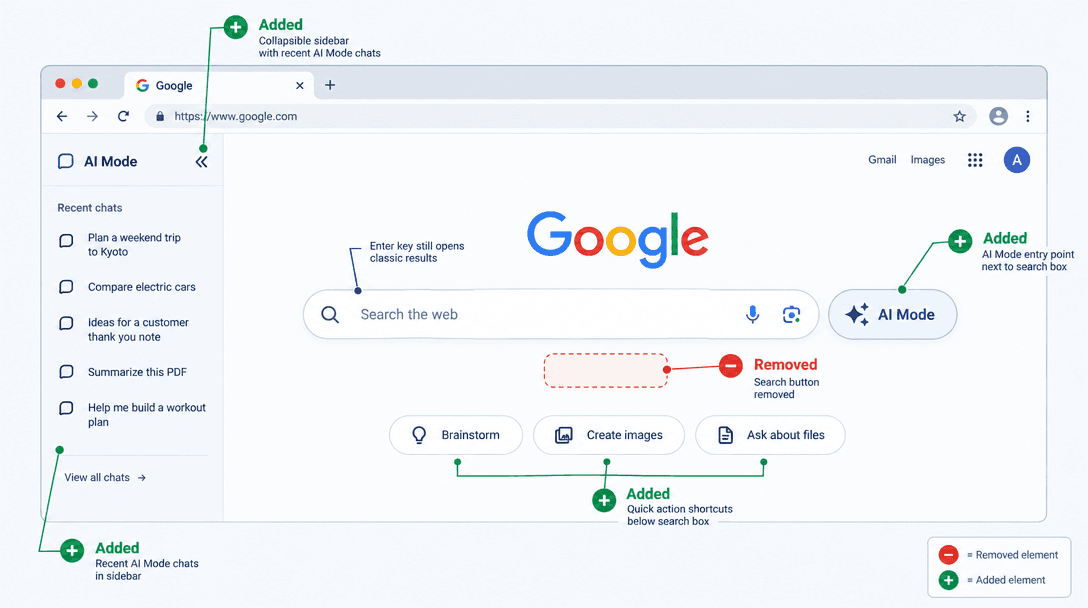
Headlines about Google's November 2026 desktop rollout say AI Mode 'became the default.' Press Enter after typing a query, though, and classic results still appear. The Google homepage redesign is real; that claim overstates it.
For SEO, publisher audience and strategy teams briefing stakeholders, the distinction matters: a missing button is not a changed default. The sidebar deserves closer attention.
What the Google Homepage Redesign Actually Changed
Google removed the 'Google Search' button beneath the box, as Android Authority's report describes, promoted AI Mode and added a collapsible sidebar of recent AI Mode chats. Layouts vary; check your account before quoting specifics.
Three shortcuts accompany the box:
- Brainstorm: starts an ideation task.
- Create images: invites image generation.
- Ask about files: invites an upload and question.
These AI-powered shortcuts give users direct access to tasks such as brainstorming, image generation and working with uploaded files. They can begin an AI Mode experience rather than a conventional ranked-results journey, creating another discovery path for users.
The desktop-only rollout varies by account and device, separate from the signed-out test The Next Web reported. Vizup's Google AI-powered search box piece traces the box's evolution.
Is AI Mode the Default Google Search Now?
Info: Test the default: Type a query and press Enter: classic results. AI Mode requires a deliberate click. Prominence is not a default.
Because pressing Enter still leads to traditional search results, the redesign does not automatically redirect every homepage query into AI Mode. However, the new sidebar and shortcuts could influence how some users begin or continue their research. Their impact on organic traffic remains unquantified. Before attributing traffic declines to the redesign, teams should review seasonality, algorithm updates, device-level performance and tracking issues.
'Google killed the search button' makes a poor board slide. Use: 'Google removed a button and promoted AI Mode; Enter still runs classic search.'
The AI Mode Sidebar Is the Change Worth Watching
Reopening a recent chat takes users into AI Mode, not classic results. Robby Stein's announcement, as SE Roundtable covered it, frames the sidebar around conversation continuity.
Someone researching 'best CRM for agencies' may return to an earlier AI Mode conversation instead of starting another traditional search. This creates a possible alternative discovery path that does not require revisiting the standard ranked results page. For publishers, that could affect click opportunities even when rankings remain stable. However, the scale of this behaviour and its impact on organic traffic have not yet been established.
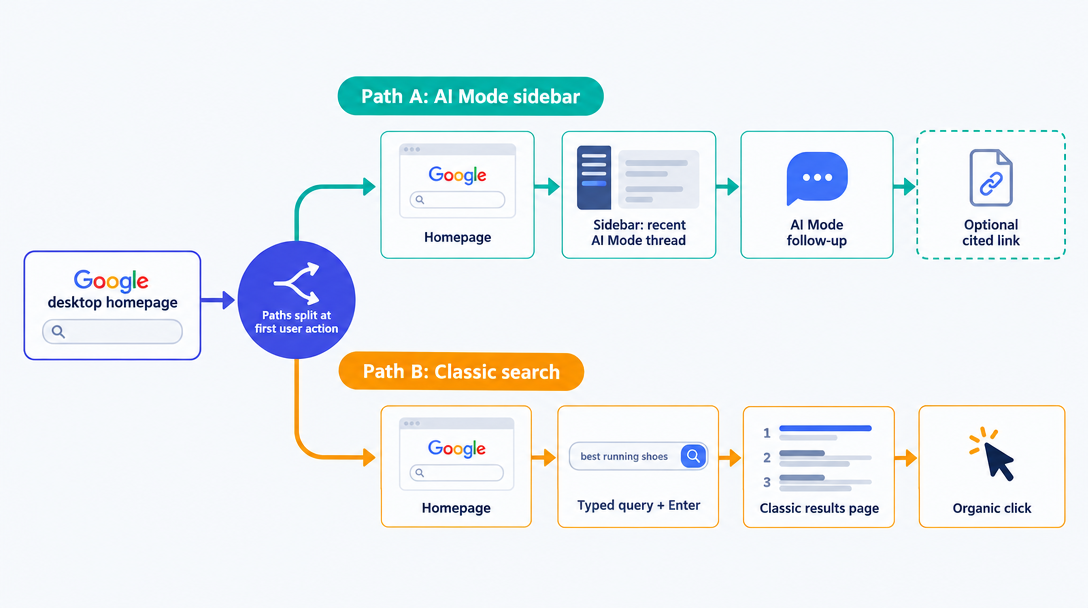
Citation clicks are a separate question, covered in Vizup's AI Mode's side-by-side view and its piece on AI Mode links sending more traffic without click data.
Google Homepage Changes and SEO: What Moves, What Stays Put
| Item | Changed by the redesign? | Likely effect on organic traffic | Confidence (no Google usage data) | What to monitor |
|---|---|---|---|---|
| Classic ranking signals | No | None directly | High | Positions |
| Enter-key query path | No | Traditional results remain accessible; query-volume impact unmeasured | High | Desktop branded clicks |
| Sidebar return journeys | Yes | Some returning sessions may continue within AI Mode | Low | Desktop organic clicks in GSC; returning-user behaviour in GA4 as an indirect signal |
| Gemini shortcuts: Brainstorm, Create images, Ask about files | Yes | May shift some task-based activity into AI Mode; impact unknown | Medium | Branded queries |
| Desktop versus mobile exposure | Partly | Desktop only; uneven rollout | Medium | Desktop versus mobile |
| Search Console reporting | No | Main Web totals include AI activity; dedicated Generative AI reporting provides AI-feature impressions | Medium | Web clicks, CTR and Generative AI impressions |
| Brand citations in AI Mode | Partly | Reopened threads increase exposure | Low | Citations and mentions |
| Confidence is low where Google has published nothing. |
Ranking work remains unchanged. Fewer desktop research journeys might reach ranked results, but Google has published no usage data to quantify that shift.
How to Measure the Impact Before You React
An uneven rollout without usage figures calls for measurement, not a forecast.
Split desktop organic from mobile and mark the rollout window
Annotate the rollout in GA4 and Search Console. Compare desktop clicks and CTR with unaffected mobile, accounting for existing differences using Vizup's desktop versus mobile CTR analysis.
Track AI Mode citations separately from rankings
Google Search Console includes AI Mode activity within its main Web performance reporting. It also provides a dedicated Generative AI performance report showing impressions across AI Overviews and AI Mode, including breakdowns by page, country, device and date. However, this dedicated report does not isolate AI Mode clicks or provide individual query-level citation data. Teams should therefore combine Search Console's AI visibility reporting with consistent prompt-level citation monitoring. Vizup's Watcher agent helps brands monitor how they appear across AI Answer Engines and identify changes in brand mentions and citations over time.
Agree on a decision threshold before anyone asks
Choose a clear decision threshold, such as desktop non-branded clicks falling by an agreed percentage for four consecutive weeks while mobile performance remains relatively stable. Review impressions, CTR, average position and query mix before drawing conclusions. Search activity and organic clicks can move in different directions, but this redesign should not be identified as the cause without supporting evidence.
Why Google's Direction Here Is Still Unsettled
Google began rolling out the collapsible AI Mode sidebar globally on desktop in November 2026. However, separate experiments involving AI Mode placement, search bar controls and signed-out homepage layouts show that other parts of the interface may continue to change. The sidebar rollout is confirmed, but Google's longer-term interface design is not yet settled.
Plan for AI Mode visibility independently of homepage experiments. Its retrieval and query fan-out matter more durably, as Vizup's Gemini 4 'Hydrogen' fan-out piece explains.
Note: For monthly reporting: Enter still runs classic search. Rankings are unchanged. Watch repeat journeys through the sidebar.
Frequently Asked Questions
Can you collapse or disable the homepage AI Mode sidebar?
Reports describe a collapsible sidebar. Google has not confirmed full disabling; check your account.
Does this redesign affect mobile search or the Google app?
Coverage describes desktop only. Google has announced no mobile equivalent, making mobile a useful comparison.
Does Search Console separate AI Mode traffic from classic search?
Google provides a dedicated Generative AI performance report for AI-feature impressions, but it does not provide a query-level breakdown or separate AI Mode click totals. AI Mode query activity can still appear within the main Web performance report without an explicit AI Mode label.
Do Brainstorm, Create images and Ask about files open Gemini or AI Mode?
Reports differ, and Google has not confirmed the destination. Test your account; treat undocumented claims as unverified.
Does the homepage redesign change classic search rankings?
No. It changes entry points, not ranking systems. The potential difference is how many desktop journeys reach ranked results.
The Short Version
A button disappeared; AI Mode, a sidebar and shortcuts gained space. Enter still runs classic search. Watch returning users, not rankings, for the sidebar's effect.
Next steps:
- Annotate rollout timing in GA4 and Search Console.
- Compare desktop with mobile.
- Track citations against fixed prompts.
- Set a decision threshold; reassess in 30 days as Google's tests continue.
What Google's Homepage Redesign Means for Your Organic Strategy
Google's redesigned homepage makes AI Mode more visible, but traditional search remains accessible. The bigger question for brands is whether users begin spending more of their research journeys inside AI conversations, where visibility and citations may matter alongside conventional rankings.
Vizup is an Organic Autopilot for modern discovery. It helps brands monitor visibility, create and optimise content, publish improvements, and learn across Search, Social, Communities, AI Answer Engines, and Local Discovery, combining AI agents, human experts, and live SEO, pSEO, AEO, and GEO tools.
Track organic clicks, review AI visibility, and act on the gaps rather than attributing every traffic change to a new interface. Explore Vizup to connect monitoring with ongoing organic growth.
